


Trends in Positive Depression and Suicide Risk Screens in Pediatric Primary Care During COVID-19
- PMID: 36584938
- PMCID: PMC9792424
- DOI: 10.1016/j.acap.2022.12.006
Trends in Positive Depression and Suicide Risk Screens in Pediatric Primary Care During COVID-19
Abstract
Objective: Adolescent mental health concerns increased during COVID-19, but it is unknown whether early increases in depression and suicide risk have been sustained. We examined changes in positive screens for depression and suicide risk in a large pediatric primary care network through May 2022.
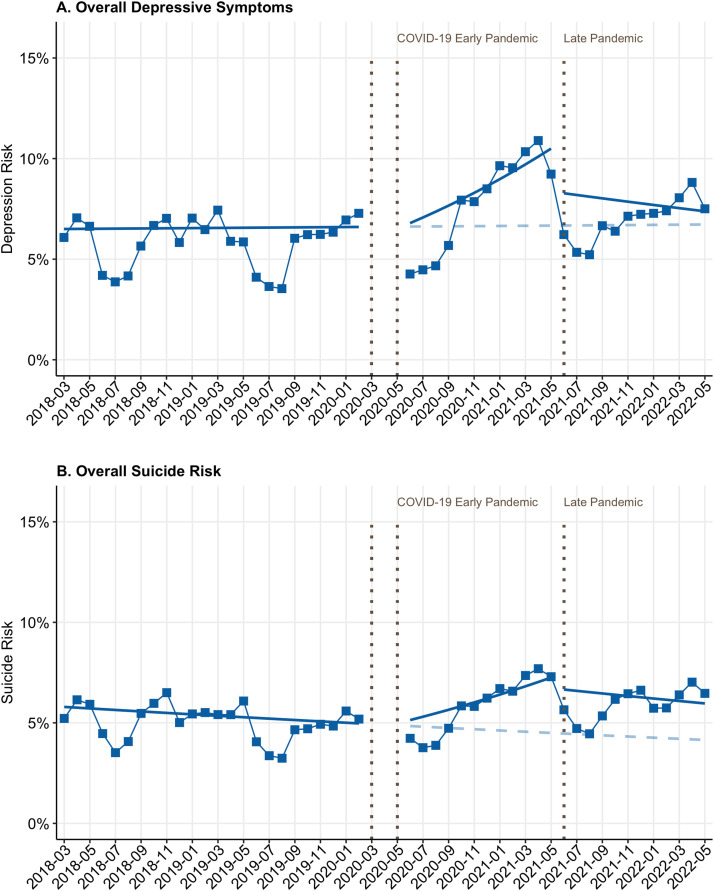
Methods: Using an observational repeated cross-sectional design, we examined changes in depression and suicide risk during the pandemic using electronic health record data from adolescents. Segmented logistic regression was used to estimate risk differences (RD) for positive depression and suicide risk screens during the early pandemic (June 2020-May 2021) and late pandemic (June 2021-May 2022) relative to before the pandemic (March 2018-February 2020). Models adjusted for seasonality and standard errors accounted for clustering by practice.
Results: Among 222,668 visits for 115,627 adolescents (mean age 15.7, 50% female), the risk of positive depression and suicide risk screens increased during the early pandemic period relative to the prepandemic period (RD, 3.8%; 95% CI, 2.9, 4.8; RD, 2.8%; 95% CI, 1.7, 3.8). Risk of depression returned to baseline during the late pandemic period, while suicide risk remained slightly elevated (RD, 0.7%; 95% CI, -0.4, 1.7; RD, 1.8%; 95% CI, 0.9%, 2.7%).
Conclusions: During the early months of the pandemic, there was an increase in positive depression and suicide risk screens, which later returned to prepandemic levels for depression but not suicide risk. Results suggest that pediatricians should continue to prioritize screening adolescents for depressive symptoms and suicide risk and connect them to treatment.
Keywords: depression; pandemic; suicide risk.
Copyright © 2023 Academic Pediatric Association. Published by Elsevier Inc. All rights reserved.
Figures
Similar articles
-
COVID-19 and Adolescent Depression and Suicide Risk Screening Outcomes.Pediatrics. 2021 Sep;148(3):e2021051507. doi: 10.1542/peds.2021-051507. Epub 2021 Jun 17. Pediatrics. 2021. PMID: 34140393
-
Impact of COVID-19 and Public Health Measures on Positive Suicide Screens Among Emergency Department Children.Pediatr Emerg Care. 2024 Sep 1;40(9):e227-e232. doi: 10.1097/PEC.0000000000003206. Epub 2024 Aug 23. Pediatr Emerg Care. 2024. PMID: 39178009
-
Adolescent suicide risk screening in the emergency department.Acad Emerg Med. 2009 Nov;16(11):1234-41. doi: 10.1111/j.1553-2712.2009.00500.x. Epub 2009 Oct 20. Acad Emerg Med. 2009. PMID: 19845554 Free PMC article.
-
Trends in Adolescent Depression Screening Outcomes Over the COVID-19 Pandemic at a Large, Integrated Health Care System in Southern California.J Adolesc Health. 2024 Dec;75(6):912-920. doi: 10.1016/j.jadohealth.2024.07.029. Epub 2024 Oct 1. J Adolesc Health. 2024. PMID: 39352364
-
Emergency Department Encounters Among Youth With Suicidal Thoughts or Behaviors During the COVID-19 Pandemic.JAMA Psychiatry. 2021 Dec 1;78(12):1319-1328. doi: 10.1001/jamapsychiatry.2021.2457. JAMA Psychiatry. 2021. PMID: 34468724 Free PMC article.
Cited by
-
COVID-19 and Youth Mental Health Disparities: Intersectional Trends in Depression, Anxiety and Suicide Risk-Related Diagnoses.Acad Pediatr. 2024 Jul;24(5):837-847. doi: 10.1016/j.acap.2024.01.021. Epub 2024 Feb 1. Acad Pediatr. 2024. PMID: 38309579 Free PMC article.
-
Risk for Suicide Attempts Assessed Using the Patient Health Questionnaire-9 Modified for Teens.JAMA Netw Open. 2024 Oct 1;7(10):e2438144. doi: 10.1001/jamanetworkopen.2024.38144. JAMA Netw Open. 2024. PMID: 39378032 Free PMC article.
-
Identifying Children and Adolescents at Elevated Mental Health Risk Before and During COVID-19.J Dev Behav Pediatr. 2024 Jul-Aug 01;45(4):e341-e348. doi: 10.1097/DBP.0000000000001273. Epub 2024 Jun 13. J Dev Behav Pediatr. 2024. PMID: 39146230 Free PMC article.
-
A qualitative exploration of research-school partnerships during COVID: How to better serve our community partners during times of crisis.Evid Based Pract Child Adolesc Ment Health. 2024 Mar 28:10.1080/23794925.2024.2330393. doi: 10.1080/23794925.2024.2330393. Online ahead of print. Evid Based Pract Child Adolesc Ment Health. 2024. PMID: 40786590 Free PMC article.
-
Reappraisal Mitigates, While COVID-19 Burnout Exacerbates the Impact of Depressive Symptoms on Suicidal Ideation Among Chinese College Students.Psychol Res Behav Manag. 2024 Sep 11;17:3147-3157. doi: 10.2147/PRBM.S463316. eCollection 2024. Psychol Res Behav Manag. 2024. PMID: 39280038 Free PMC article.
References
-
- Abrams AH, Badolato GM, Boyle MD, et al. Racial and ethnic disparities in pediatric mental health-related emergency department visits. Pediatr Emerg Care. 2022;38:e214–e218. - PubMed
Publication types
MeSH terms
LinkOut - more resources
Full Text Sources
Medical
Miscellaneous
