


Relationship between work performance and quality of life in long-term survivors of pediatric and adolescent hematopoietic cell transplant
- PMID: 36585573
- PMCID: PMC9803401
- DOI: 10.1007/s11764-022-01308-7
Relationship between work performance and quality of life in long-term survivors of pediatric and adolescent hematopoietic cell transplant
Abstract
Purpose: To assess work status, missed time at work (absenteeism), work performance (presenteeism), and their relationship with quality of life (QOL) among long-term survivors of childhood hematopoietic cell transplant (HCT).
Methods: A single-center cross-sectional survey study of adult survivors of childhood allogeneic HCT (performed between 1985 and 2010). Work and QOL data were captured using the World Health Organization Health and Work Performance Questionnaire and the National Institutes of Health Patient Reported Outcomes Measurement Information System (PROMIS), respectively. Higher absenteeism and presenteeism scores meant higher missed time at work and productivity, respectively. PROMIS domains were scored on a T-score metric with a mean score of reference population at 50 and standard deviation of 10. Univariate linear regression was performed to study factors associated with increase in PROMIS scores.
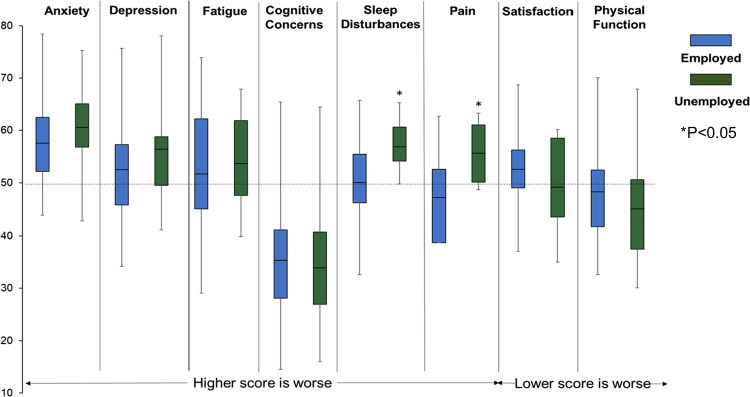
Results: Forty-four survivors completed the survey. Median ages at HCT and survey were 11 years (interquartile range [IQR] 7-13) and 30 years (IQR 26-34), respectively. Seventy-three percent were working, 23% were unemployed, and 4% were students. Employed survivors reported less pain and sleep disturbance. Higher absolute presenteeism was associated with less pain interference and more satisfaction with social roles and activities and physical function. Higher relative presenteeism was associated with less cognitive concerns.
Conclusions and implications for cancer survivors: We found significant associations between survivors' work status, performance, and QOL. Our findings provide an important insight on the implications of work outcomes on HCT survivors' physical, mental, and social health and emphasize the importance of longitudinal assessment of work status, performance, and QOL.
Keywords: Hematopoietic cell transplant; Quality of life; Survivorship; Work performance.
© 2022. The Author(s), under exclusive licence to Springer Science+Business Media, LLC, part of Springer Nature.
Conflict of interest statement
Dr. Rachel Phelan reports receiving research funding from Amgen. Dr. Bronwen Shaw reports receiving payment from Mallinkrodt and consultancy with Orca Bio. The other authors report no financial interests.
Figures
References
Publication types
MeSH terms
LinkOut - more resources
Full Text Sources
Medical
