


Predictors of bleeding events in acute decompensated heart failure patients with antithrombotic therapy: AURORA study
- PMID: 36585753
- PMCID: PMC10053354
- DOI: 10.1002/ehf2.14277
Predictors of bleeding events in acute decompensated heart failure patients with antithrombotic therapy: AURORA study
Abstract
Aims: Heart failure (HF) is reported to be one of the major risks of bleeding events. On the other hand, HF patients frequently receive anticoagulants or antiplatelet therapy to manage various co-morbidities. However, predictors of bleeding events in patients with HF have rarely been reported. This study aimed to evaluate the predictors of bleeding events and relationship between bleeding events and HF re-hospitalizations.
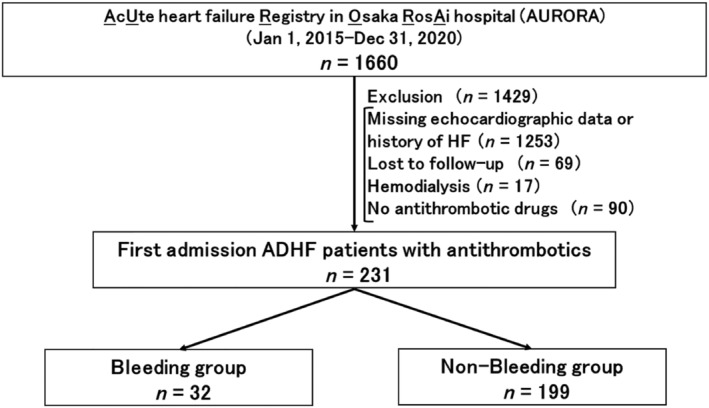
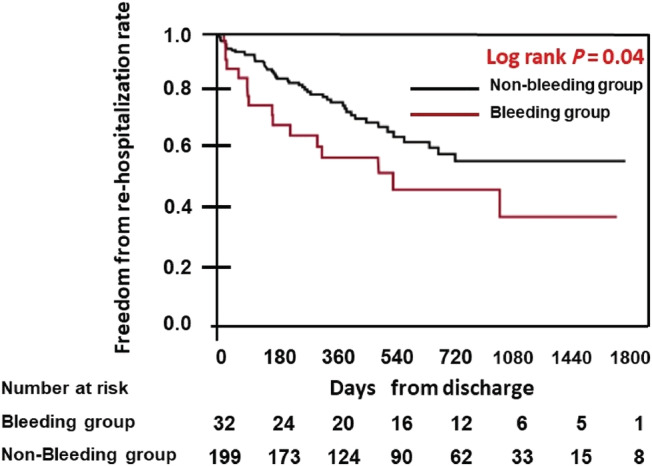
Methods and results: We included 1660 acute decompensated heart failure (ADHF) patients from the AURORA registry between January 2015 and December 2020. A total of 1429 patients were excluded because of history of HF admission, missing echocardiographic data at discharge, lost to follow-up, haemodialysis and no antithrombotic drugs. Finally, we evaluated 231 patients from AURORA registry. The bleeding events were defined as Type 2 to 5 bleeding according to the Bleeding Academic Research Consortium definition. We divided our patients into the bleeding group and non-bleeding group. We compared the baseline characteristics, medications, laboratory data, and echocardiographic data between the two groups. Median age was 78 (IQR 71-82) years old and male accounted for 59%. Approximately half of the patients had an antiplatelet therapy and 70% had an anticoagulant therapy. During a median follow-up of 651 (IQR 357-1139) days, 32 patients (13.8%) suffered from bleeding events. The major driver of the registered events was gastrointestinal bleeding (n = 21, 65.6%), and the other events were cerebral bleeding (n = 4, 12.5%), intraarticular bleeding (n = 2, 6.3%), urogenital bleeding (n = 2, 6.3%), haemorrhagic pericardial effusions (n = 1, 3.1%), subcutaneous hematomas (n = 1, 3.1%), and haemothorax (n = 1, 3.1%). There was a significantly lower haemoglobin level (P < 0.01), higher proportion of inferior vena cava (IVC) diameter ≥21 mm (P < 0.01), and higher furosemide equivalent doses per kilogram (P < 0.01) in the bleeding group than non-bleeding group. A multivariate analysis revealed an equivalent dose of furosemide per kilogram ≥0.66 mg/kg (hazard ratios (HR) of 2.64, 95% confidence interval (CI) 1.26-5.68, P = 0.01), haemoglobin ≤10.3 g/dL (HR of 2.43, 95% CI 1.14-5.03, P = 0.02), and IVC diameter ≥21 mm (HR of 2.79, 95% CI 1.16-6.29, P = 0.02) were independently associated with bleeding events. The Kaplan-Meier analysis showed that HF re-hospitalization rates were higher in the bleeding group than non-bleeding group (P = 0.04).
Conclusions: High doses of oral loop diuretics, IVC dilatation, and anaemia were predictors of bleeding events in patients hospitalized with ADHF patients. In addition, bleeding events were associated with HF re-hospitalizations.
Keywords: ADHF; Anaemia; Bleeding events; High dose loop diuretics; IVC.
© 2022 The Authors. ESC Heart Failure published by John Wiley & Sons Ltd on behalf of European Society of Cardiology.
Conflict of interest statement
None declared.
Figures
References
-
- Natsuaki M, Morimoto T, Yamaji K, Watanabe H, Yoshikawa Y, Shiomi H, Nakagawa Y, Furukawa Y, Kadota K, Ando K, Akasaka T, Hanaoka KI, Kozuma K, Tanabe K, Morino Y, Muramatsu T, Kimura T. Prediction of thrombotic and bleeding events after percutaneous coronary intervention: CREDO‐Kyoto thrombotic and bleeding risk scores. J Am Heart Assoc. 2018; 7: e008708. - PMC - PubMed
-
- Pozzoli M, Gonzalez‐Costello J, Bayes‐Genis A, Sinagra G, Anker SD, Coats AJS, Crespo‐Leiro MG, Filippatos G, Laroche C, Maggioni AP, Mebazaa A, Piepoli MF, Tavazzi L. Prevalence of risk of thrombosis and of bleeding and antithrombotic treatment in patients with heart failure. Eur J Heart Fail. 2020; 22: 906–910. - PubMed
-
- Yoshihisa A, Kanno Y, Ichijo Y, Sato Y, Takiguchi M, Yokokawa T, Abe S, Misaka T, Sato T, Oikawa M, Kobayashi A, Yamaki T, Kunii H, Takeishi Y. Incidence and subsequent prognostic impacts of gastrointestinal bleeding in patients with heart failure. Eur J Prev Cardiol. 2020; 27: 664–666. - PubMed
-
- Nochioka K. Simplifying bleeding risk assessment in heart failure. Circ J. 2021; 86: 156, CJ‐21‐0921–157. - PubMed
MeSH terms
Substances
LinkOut - more resources
Full Text Sources
Medical
Research Materials
Miscellaneous
