


Hamstring injury rates have increased during recent seasons and now constitute 24% of all injuries in men's professional football: the UEFA Elite Club Injury Study from 2001/02 to 2021/22
- PMID: 36588400
- PMCID: PMC9985757
- DOI: 10.1136/bjsports-2021-105407
Hamstring injury rates have increased during recent seasons and now constitute 24% of all injuries in men's professional football: the UEFA Elite Club Injury Study from 2001/02 to 2021/22
Abstract
Objectives: To: (1) describe hamstring injury incidence and burden in male professional football players over 21 seasons (2001/02 to 2021/22); (2) analyse the time-trends of hamstring muscle injuries over the most recent eight seasons (2014/15 to 2021/22); and (3) describe hamstring injury location, mechanism and recurrence rate.
Methods: 3909 players from 54 teams (in 20 European countries) from 2001/02 to 2021/22 (21 consecutive seasons) were included. Team medical staff recorded individual player exposure and time-loss injuries. Time-trend analyses were performed with Poisson regression using generalised linear models.
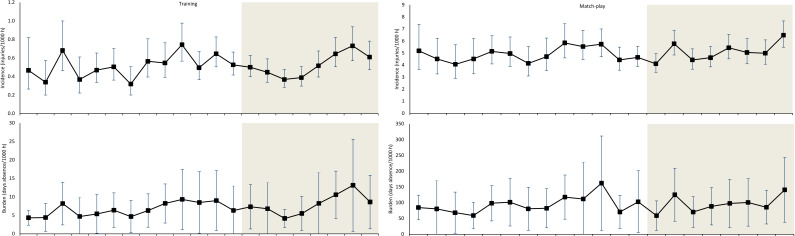
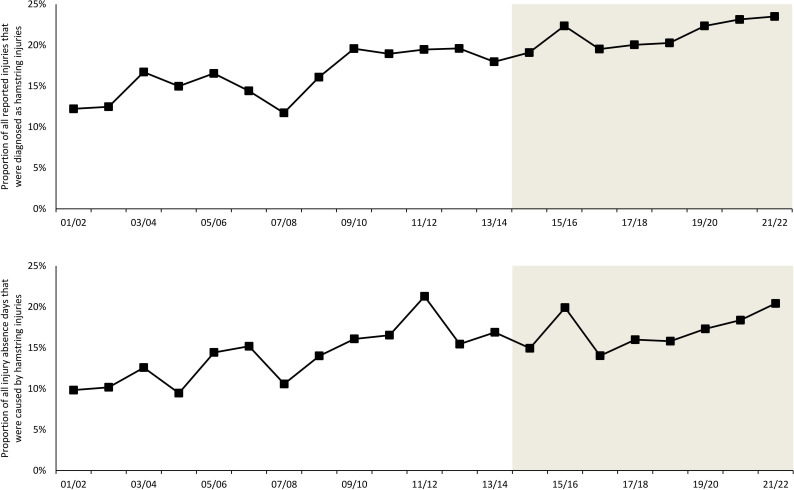
Results: 2636 hamstring injuries represented 19% of all reported injuries, with the proportion of all injuries increasing from 12% during the first season to 24% in the most recent season. During that same period, the percentage of all injury absence days caused by hamstring injuries increased from 10% to 20%. Between 2014/15 and 2021/22, training hamstring injury incidence increased (6.7% annually, 95% CI 1.7% to 12.5%) as did burden (9.0% annually, 95% CI 1.2% to 18.3%). During those years, the match hamstring injury incidence also increased (3.9% annually, 95% CI 0.1% to 7.9%) and with the same trend (not statistically significant) for match hamstring injury burden (6.2% annually, 95% CI -0.5% to 15.0%).
Conclusions: Hamstring injury proportions-in number of injuries and total absence days-doubled during the 21-year period of study. During the last eight seasons, hamstring injury rates have increased both in training and match play.
Keywords: Athletic Performance; Epidemiology; Hamstring Muscles; Injuries; Soccer.
© Author(s) (or their employer(s)) 2022. Re-use permitted under CC BY. Published by BMJ.
Conflict of interest statement
Competing interests: None declared.
Figures
References
LinkOut - more resources
Full Text Sources
Medical
