


Healthspan and chronic disease burden among young adult and middle-aged male former American-style professional football players
- PMID: 36588423
- PMCID: PMC9887383
- DOI: 10.1136/bjsports-2022-106021
Healthspan and chronic disease burden among young adult and middle-aged male former American-style professional football players
Abstract
Objective: To examine the relationships between age, healthspan and chronic illness among former professional American-style football (ASF) players.
Methods: We compared age-specific race-standardised and body mass index-standardised prevalence ratios of arthritis, dementia/Alzheimer's disease, hypertension and diabetes among early adult and middle-aged (range 25-59 years) male former professional ASF players (n=2864) with a comparator cohort from the National Health and Nutrition Examination Survey and National Health Interview Survey, two representative samples of the US general population. Age was stratified into 25-29, 30-39, 40-49 and 50-59 years.
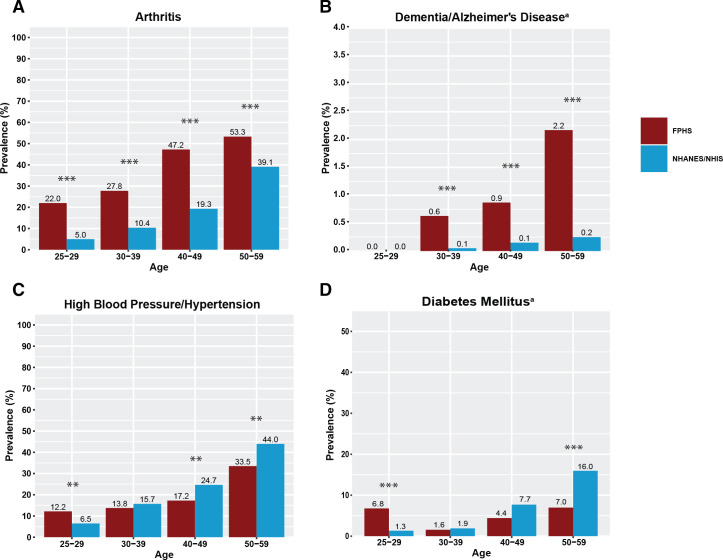
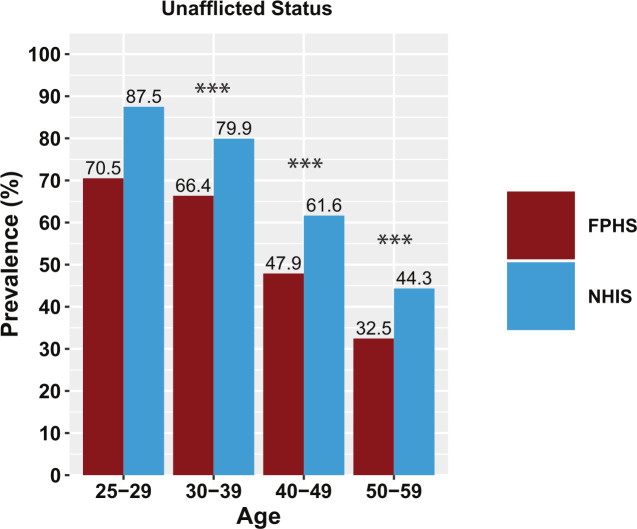
Results: Arthritis and dementia/Alzheimer's disease were more prevalent among ASF players across all study age ranges (all p<0.001). In contrast, hypertension and diabetes were more prevalent among ASF players in the youngest age stratum only (p<0.001 and p<0.01, respectively). ASF players were less likely to demonstrate intact healthspan (ie, absence of chronic disease) than the general population across all age ranges.
Conclusion: These data suggest the emergence of a maladaptive early ageing phenotype among former professional ASF players characterised by premature burden of chronic disease and reduced healthspan. Additional study is needed to investigate these findings and their impact on morbidity and mortality in former ASF players and other athlete groups.
Keywords: cardiovascular diseases; chronic; football; osteoarthritis.
© Author(s) (or their employer(s)) 2022. Re-use permitted under CC BY-NC. No commercial re-use. See rights and permissions. Published by BMJ.
Conflict of interest statement
Competing interests: The Football Players Health Study is supported by the NFL Players Association. The NFL Players Association did not contribute to the design and conduct of the study; collection, management, analysis and interpretation of the data; preparation, review or approval of the manuscript; and decision to submit the manuscript for publication. This work received support from Harvard Catalyst | The Harvard Clinical and Translational Science Center (National Center for Advancing Translational Sciences, National Institutes of Health Award UL1 TR002541) and financial contributions from Harvard University and its affiliated academic healthcare centers. The content is solely the responsibility of the authors and does not necessarily represent the official views of Harvard Catalyst, Harvard University and its affiliated academic healthcare centers, or the National Institutes of Health. The authors wish to acknowledge the study participants, advisors and staff of the Football Players Health Study for their time and effort.
Figures
References
LinkOut - more resources
Full Text Sources
