


Sleep deficiency promotes Alzheimer's disease development and progression
- PMID: 36588906
- PMCID: PMC9795181
- DOI: 10.3389/fneur.2022.1053942
Sleep deficiency promotes Alzheimer's disease development and progression
Abstract
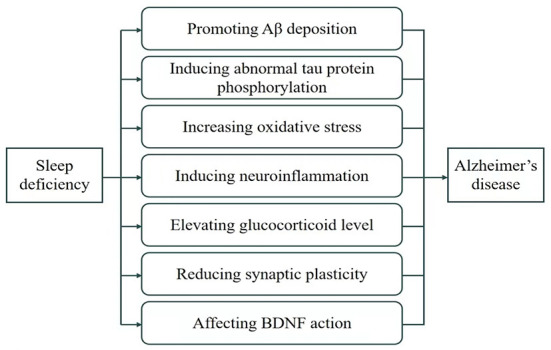
Sleep disorders are a common health problem in modern society. Long-term sleep deficiency increases the risk for Alzheimer's disease. However, the exact mechanisms by which sleep deficiency affects Alzheimer's disease remain unclear. Therefore, we reviewed the relevant studies and investigated the role of sleep deprivation in Alzheimer's disease pathogenesis. Sleep deficiency was found to be associated with oxidative stress, β-amyloid protein deposition, tau hyperphosphorylation, and neuroinflammation, which are known to increase the risk for Alzheimer's disease. In addition, insufficient sleep also increases glucocorticoid levels, decreases brain-derived neurotrophic factor levels, and reduces the number of synapses in the central nervous system. These factors also promote Alzheimer's disease development and progression. The present study showed that a growing body of evidence supports an association between sleep disturbances and Alzheimer's disease. It discusses the role of sleep insufficiency in Alzheimer's disease pathogenesis, which may provide a theoretical basis for effective treatment and prevention strategies.
Keywords: Alzheimer's disease; BDNF; glucocorticoid; inflammatory response; oxidative stress; sleep deficiency; tau protein; β-amyloid protein.
Copyright © 2022 Lv, Cui, Zhang and Huang.
Conflict of interest statement
The authors declare that the research was conducted in the absence of any commercial or financial relationships that could be construed as a potential conflict of interest.
Figures
References
Publication types
LinkOut - more resources
Full Text Sources
