


Higher baseline BMI and lower estimated median income associated with increasing BMI after endometrial cancer diagnosis
- PMID: 36589506
- PMCID: PMC9797639
- DOI: 10.1016/j.gore.2022.101123
Higher baseline BMI and lower estimated median income associated with increasing BMI after endometrial cancer diagnosis
Abstract
Introduction: Endometrial cancer is often directly related to obesity and interventions for weight loss have mixed results. Risk factors for continued weight gain after diagnosis are not clearly defined in the literature. The objective of this study is to describe risk factors associated with increased body mass index (BMI) trajectory among endometrial cancer patients.
Methods: Patients who were surgically treated for endometrial cancer at a single institution between 2010 and 2015 were identified. Demographics including age, race/ethnicity and estimated median income at diagnosis were obtained. BMI at five time points after diagnosis were calculated. BMI trajectories were estimated by latent class growth modeling using the PROC TRAJ procedure in SAS. Chi-squared tests and ANOVA were used to assess differences between trajectory groups. Statistical significance was set to a p-value < 0.05.
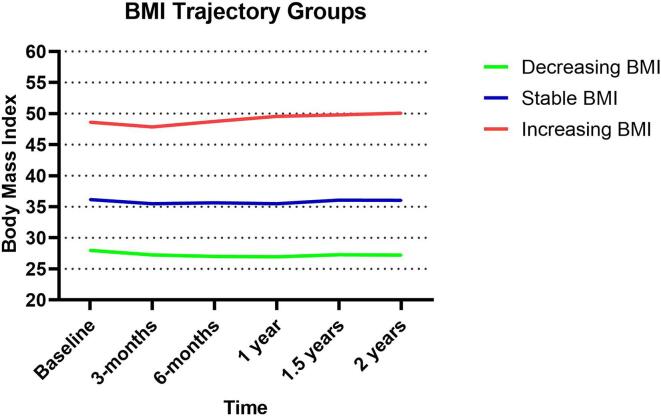
Results: Of 695 patients included in the study, the average age at diagnosis was 62 years and over 70% of patients were obese at baseline. Patients experienced increasing, stable, or decreasing BMI over 2 years following diagnosis. Patients with younger age and lower estimated median income were most likely to be in the increasing BMI group. Among obese patients, those with Class I obesity (BMI 30 to 34.9 kg/m2) were most likely to experience decreasing BMI and those with Class III obesity (BMI > 40 kg/m2) were most likely to experience increasing BMI, p < 0.0001.
Conclusion: A third of endometrial cancer survivors experience increasing BMI. Severity of obesity at diagnosis matters, patients with severe obesity (Class III) were most likely to experience weight gain.
Keywords: Class III obesity; Endometrial cancer; Increasing BMI.
© 2022 The Author(s).
Conflict of interest statement
The authors declare the following financial interests/personal relationships which may be considered as potential competing interests: Shariska Petersen Harrington: This work was supported by a CTSA grant from NCATS awarded to the University of Kansas (# TL1TR002368). This work was a result of TREC Training Workshop R25CA203650 (PI: Melinda Irwin). HERON is funded by CTSA Award #UL1TR002366.
References
-
- Alberti K.G., Zimmet P., Shaw J. The metabolic syndrome–a new worldwide definition. Lancet. 2005;366(9491):1059–1062. - PubMed
-
- Aleksandrova K., Drogan D., Boeing H., Jenab M., Bas Bueno-de-Mesquita H., Jansen E., van Duijnhoven F.J.B., Rinaldi S., Fedirko V., Romieu I., Kaaks R., Riboli E., Gunter M.J., Romaguera D., Westhpal S., Overvad K., Tjønneland A., Halkjaer J., Boutron-Ruault M.-C., Clavel-Chapelon F., Lukanova A., Trichopoulou A., Trichopoulos D., Vidalis P., Panico S., Agnoli C., Palli D., Tumino R., Vineis P., Buckland G., Sánchez-Cruz J.-J., Dorronsoro M., Díaz M.J.T., Barricarte A., Ramon Quiros J., Peeters P.H., May A.M., Hallmans G., Palmqvist R., Crowe F.L., Khaw K.-T., Wareham N., Pischon T. Adiposity, mediating biomarkers and risk of colon cancer in the European prospective investigation into cancer and nutrition study. Int. J. Cancer. 2014;134(3):612–621. - PubMed
-
- Arrandale, An Evaluation of Two Existing Methods for Analyzing Longitudinal Respiratory Symptom Data. University of British Columbia, 2006. M. Sc. Thesis.
-
- Bokhman J.V. Two pathogenetic types of endometrial carcinoma. Gynecol. Oncol. 1983;15(1):10–17. - PubMed
-
- Calle E.E., Kaaks R. Overweight, obesity and cancer: epidemiological evidence and proposed mechanisms. Nat. Rev. Cancer. 2004;4(8):579–591. - PubMed
LinkOut - more resources
Full Text Sources
Medical