


Eimeria spp. and Tyzzeria perniciosa Allen, 1936 (Apicomplexa: Eimeriidae) from a Pacific black duck, Anas superciliosa Gmelin (Aves: Anseriformes), in western Australia
- PMID: 36589875
- PMCID: PMC9795352
- DOI: 10.1016/j.crpvbd.2022.100075
Eimeria spp. and Tyzzeria perniciosa Allen, 1936 (Apicomplexa: Eimeriidae) from a Pacific black duck, Anas superciliosa Gmelin (Aves: Anseriformes), in western Australia
Abstract
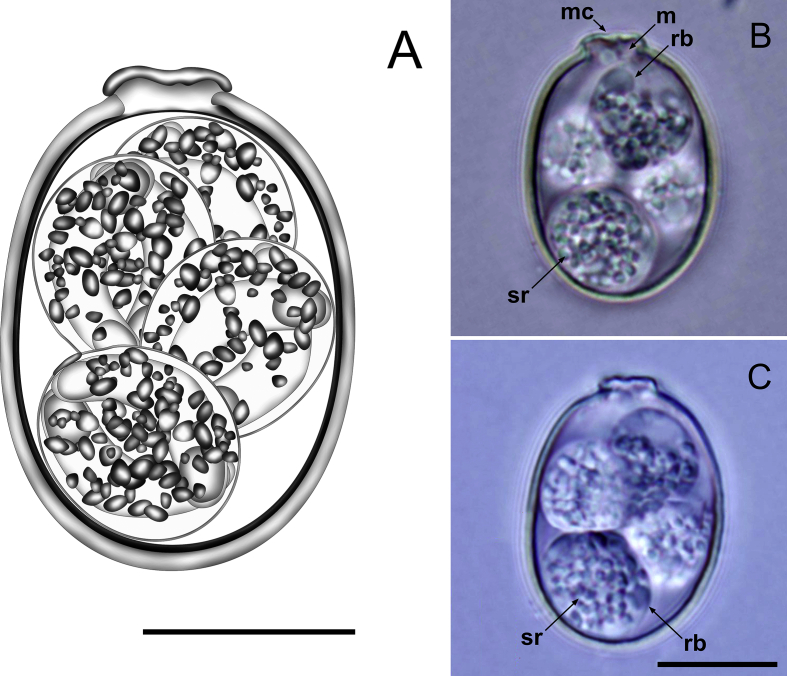
Four species of the Eimeriidae, Eimeria anatis Scholtyseck, 1955, Eimeria aythyae Farr, 1965, Eimeria krylovi Svanbaev & Rakhmatullina, 1967 and Tyzzeria perniciosa Allen, 1936, were morphologically identified from oöcysts recovered from a Pacific black duck, Anas superciliosa Gmelin. Additionally, genotypic characterization of E. anatis is provided via sequencing of the mitochondrial cytochrome c oxidase subunit 1 (cox1) and the small subunit ribosomal RNA (18S) genes. The four species are redescribed, providing additional morphological details. The validity of genera and coccidian species parasitizing birds of the order Anseriformes such as Wenyonella Hoare, 1933 and some Tyzzeria spp. are discussed. Molecular phylogenetic analyses for the cox1 and 18S rRNA genes resulted in monophylies of Eimeria spp. from Anseriformes which included the sequences obtained from E. anatis oöcysts.
Keywords: 18S rRNA gene; Anas superciliosa; Coccidia; Eimeria; Pacific black duck; Tyzzeria; cox1 gene.
© 2022 The Author(s).
Conflict of interest statement
The authors declare that they have no known competing financial interests or personal relationships that could have appeared to influence the work reported in this paper.
Figures




References
-
- Abdullah D.A. Coccidiosis in domesticated ducks in Ninevah Governorate. Iraqi J. Vet. Sci. 2010;24:149–153.
-
- Allen E.A. Tyzzeria pernicosa gen. et sp. nov., a coccidium from the small intestine of the Pekin duck Anas domesticus L. Arch. Protistenkd. 1936;87:262–267.
-
- Baker D.G. Blackwell Publishing; Hoboken, USA: 2007. Flynn's Parasites of Laboratory Animals.
-
- Berto B.P., Teixeira M., Lopes C.W.G. Tyzzeria parvula (Kotlan, 1933) Klimes, 1963 (Apicomplexa: Eimeriidae) in the greylag goose (Anser anser Linnaeus, 1758) in southeastern Brazil. Rev. Bras. Parasitol. Vet. 2007;16:156–158. - PubMed
-
- Bhatia B.B., Pande B.P. On two new species of coccidia from wild Anatidae. Acta Vet. Acad. Sci. Hung. 1966;16:335–340. - PubMed
LinkOut - more resources
Full Text Sources
Miscellaneous
