. 2022 Dec 15:9:1076073.
doi: 10.3389/fnut.2022.1076073. eCollection 2022.

Effect of lifelong sucrose consumption at human-relevant levels on food intake and body composition of C57BL/6N mice

Affiliations

Effect of lifelong sucrose consumption at human-relevant levels on food intake and body composition of C57BL/6N mice

Ruolin Yan et al. Front Nutr. .

Abstract

Introduction: Controversies surround the issue if chronic consumption of a high-sugar diet is detrimental to health or not. This study investigates whether lifelong consumption of a higher sucrose diet will induce overeating, and obesity, and cause metabolic dysfunctions such as hyperglycemia and dyslipidaemia in C57BL/6N mice, compared to a lower sucrose diet.

Methods: Male C57BL/6N mice at 3 weeks of age were randomized into consuming a diet with 25 or 10% kcal from sucrose for the rest of their lives. Body weight, food and water intake, fasting blood glucose, insulin, and lipid levels were measured at regular intervals. At the end of the study, organs and tissues were collected and gene expression was measured.

Results: There was no discernible difference in the impact on food intake, body composition, glucose and lipid homeostasis, liver triglyceride content, life expectancy, as well as gene expression related to intermediary metabolism between mice fed a diet with 10 vs. 25% kcal as sucrose over their lifespan. We also showed that switching from a 25% kcal diet to a 10% kcal diet at different life stages, or vice versa, did not appear to affect these outcomes of interest.

Discussion: The results from our study suggest that lifelong consumption of a higher sugar diet generally did not induce overeating and obesity, disrupt carbohydrate metabolism and lipid homeostasis, and reduce life expectancy compared with a lower sugar diet. Our unorthodox findings disagreed with the popular belief that higher sugar consumption is detrimental to health, which should be confirmed in future studies.

Keywords: body composition; food intake; glycemia; life expectancy; lifelong; lipid; obesity; sugar.


Conflict of interest statement

The authors declare that the research was conducted in the absence of any commercial or financial relationships that could be construed as a potential conflict of interest.

Figures
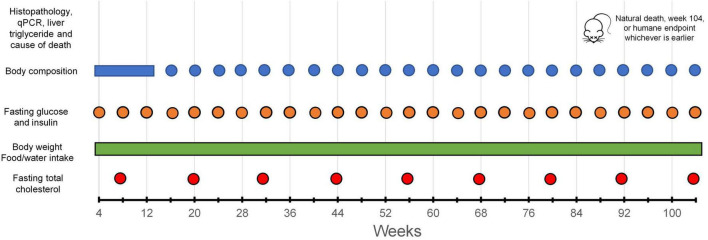
FIGURE 1
FIGURE 1
Data collection schedule.
FIGURE 2
FIGURE 2
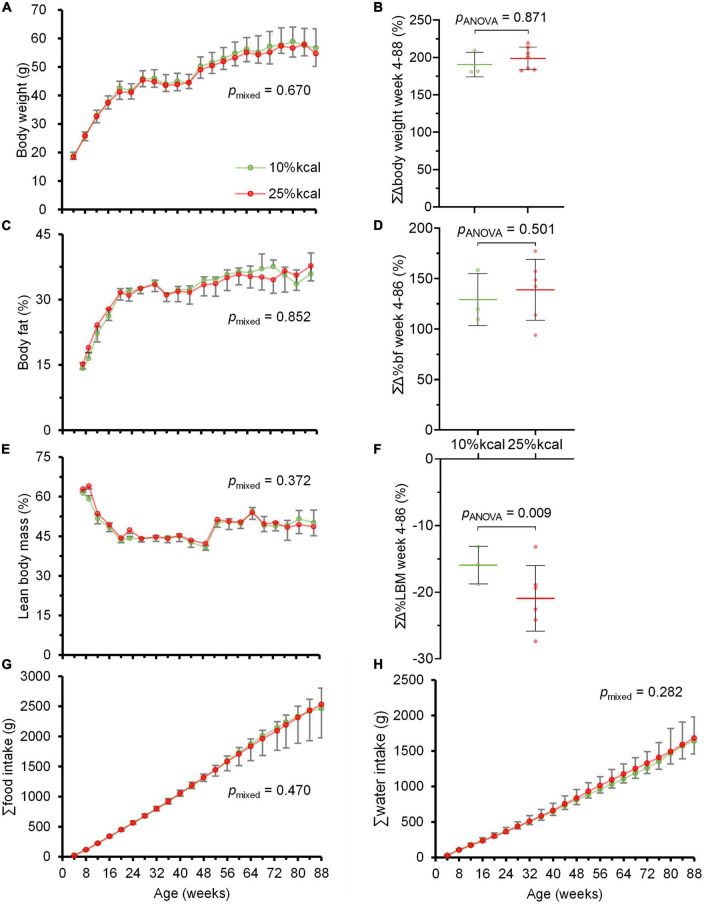
Chronic higher added sugars intake does not lead to overweight and obesity in male C57BL/6N mice. (A) Body weight (g); (B) cumulative change in body weight (%); (C) body fat (%); (D) cumulative change in body fat (%); (E) lean body mass (%); (F) cumulative change in lean body mass (%); (G) cumulative food intake (g); and (H) cumulative water intake (g) of male C57BL/6N (n = 10 in each group at the start, see Supplementary Tables 1, 2 for n at each timepoint) fed 10 vs. 25% kcal sucrose diets between weeks 4 and 88. Values are presented as mean ± SD. Differences between groups were tested using linear mixed model for time-series analysis, and one-way ANOVA for single timepoint analysis. Although the study ended at week 104, only data until week 88 were plotted as the study mice were losing weight due to aging and other ailments rather than the study diets.
FIGURE 3
FIGURE 3
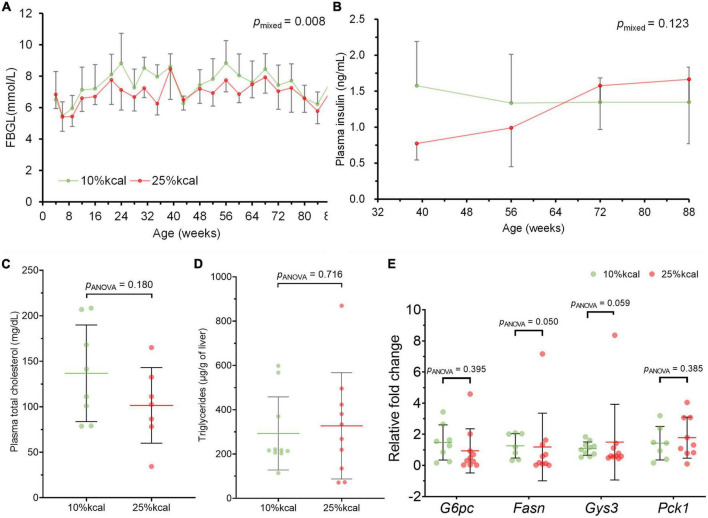
Intake of 25% kcal sucrose diet does not cause hyperglycemia and dyslipidemia and disrupt expression of related genes in male C57BL/6N mice, compared with a 10% kcal sucrose. (A) Fasting blood glucose level (FBGL; n = 10 in each group at the start, see Supplementary Table 1 for n at each timepoint), (B) fasting plasma insulin level (n = 9 in each group for weeks 39, 56, and 72; n = 3 in each group at week 88); and (C) fasting plasma total cholesterol (n = 10 in each group); (D) liver triglycerides (n = 8 in 10% kcal and 7 in 25% kcal); and (E) hepatic expression of G6pc (n = 8 in 10% kcal and 10 in 25% kcal), Fasn (n = 7 in 10% kcal and 9 in 25% kcal), Gys3 (n = 10 in each group), and Pck1 (n = 7 in 10% kcal and 8 in 25% kcal) of male C57BL/6N at time of sacrifice (week 87–104). Values are presented as mean ± SD. Differences between groups were tested using linear mixed model for time-series analysis, and one-way ANOVA for single timepoint analysis. RFC, relative fold change.
FIGURE 4
FIGURE 4
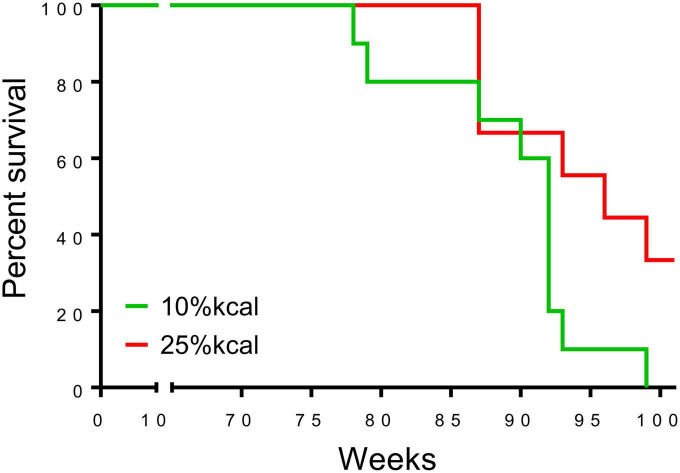
Survival curve of male C57BL/6N mice (n = 10 in each group) that have been fed with different diets. A censored death at 37 in the 25% kcal group was excluded from the analysis.
FIGURE 5
FIGURE 5
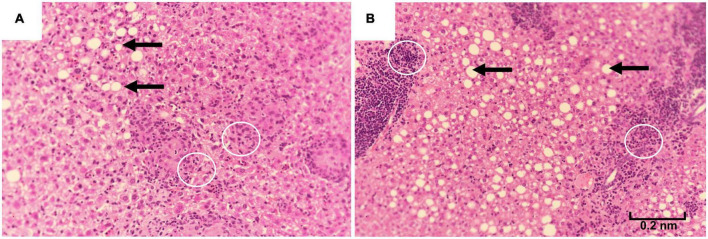
Liver histopathology of male C57BL/6N mice fed different diets at time of sacrifice, assessed using hematoxylin-eosin staining of liver samples (magnification 200 ×). (A) A total of 10% kcal, (B) 25% kcal. Both groups showed fatty lipid droplets (arrows). Prescence of Kupffer cells (white circles) were also observed.

References

    1. World Health Organization [WHO]. Guideline: sugars intake for adults and children. Geneva: WHO; (2015). - PubMed
    1. Rippe J, Angelopoulos T. Relationship between added sugars consumption and chronic disease risk factors: current understanding. Nutrients. (2016) 8:697. 10.3390/nu8110697 - DOI - PMC - PubMed
    1. Walton J, Bell H, Re R, Nugent A. Current perspectives on global sugar consumption: definitions, recommendations, population intakes, challenges and future direction. Nutr Res Rev. (2021). [Epub ahead of print]. 10.1017/S095442242100024X - DOI - PubMed
    1. Kibblewhite R, Nettleton A, McLean R, Haszard J, Fleming E, Kruimer D, et al. Estimating free and added sugar intakes in New Zealand. Nutrients. (2017) 9:1292. 10.3390/nu9121292 - DOI - PMC - PubMed
    1. Grundy S. Obesity, metabolic syndrome, and cardiovascular disease. J Clin Endocrinol Metab. (2004) 89:2595–600. 10.1210/jc.2004-0372 - DOI - PubMed

LinkOut - more resources