


Significant changes in lower limb alignment due to flexion and rotation-a systematic 3D simulation of radiographic measurements
- PMID: 36595052
- PMCID: PMC10050026
- DOI: 10.1007/s00167-022-07302-x
Significant changes in lower limb alignment due to flexion and rotation-a systematic 3D simulation of radiographic measurements
Abstract
Background: Many radiographic lower limb alignment measurements are dependent on patients' position, which makes a standardised image acquisition of long-leg radiographs (LLRs) essential for valid measurements. The purpose of this study was to investigate the influence of rotation and flexion of the lower limb on common radiological alignment parameters using three-dimensional (3D) simulation.
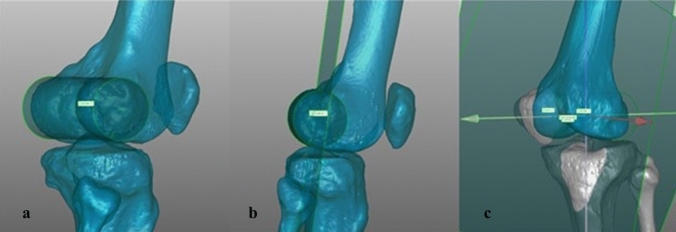
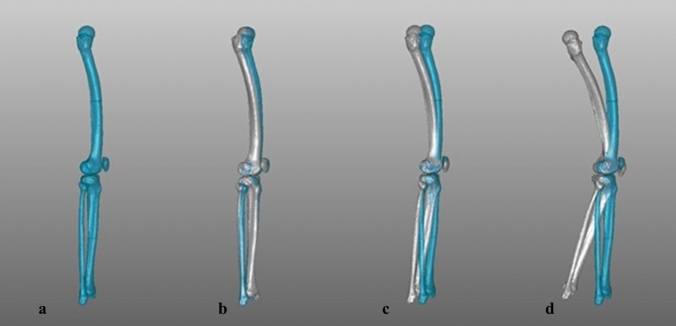
Methods: Joint angles and alignment parameters of 3D lower limb bone models (n = 60), generated from computed tomography (CT) scans, were assessed and projected into the coronal plane to mimic radiographic imaging. Bone models were subsequently rotated around the longitudinal mechanical axis up to 15° inward/outward and additionally flexed along the femoral intercondylar axis up to 30°. This resulted in 28 combinations of rotation and flexion for each leg. The results were statistically analysed on a descriptive level and using a linear mixed effects model.
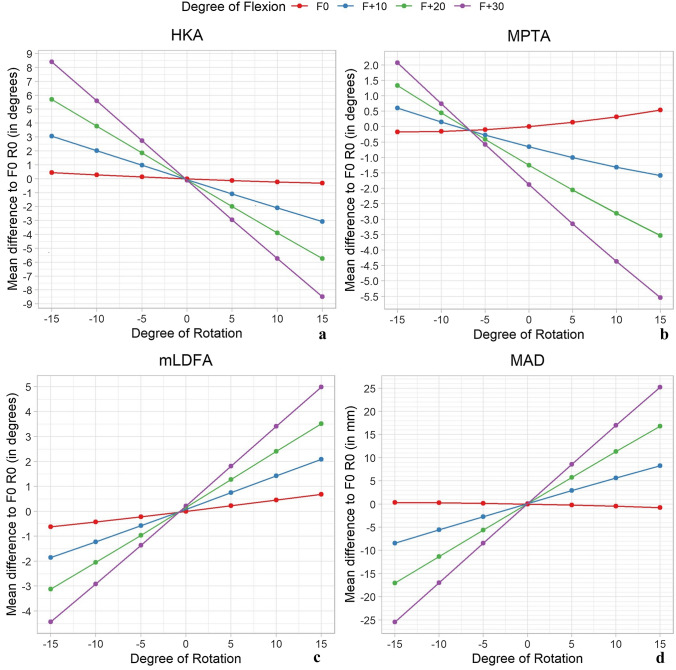
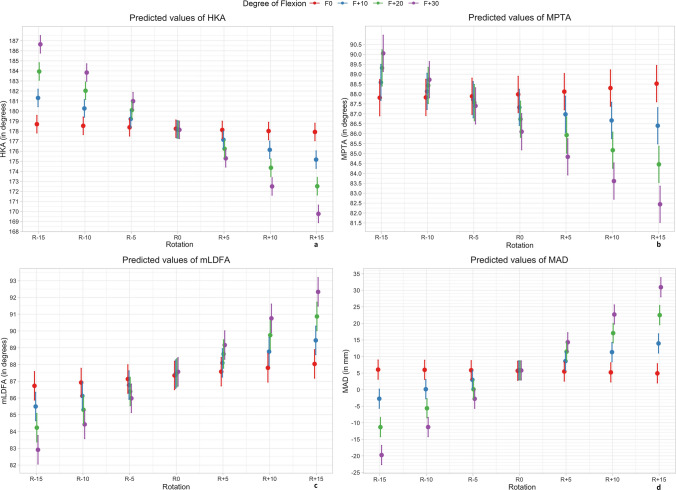
Results: A total of 1680 simulations were performed. Mechanical axis deviation (MAD) revealed a medial deviation with increasing internal rotation and a lateral deviation with increasing external rotation. This effect increased significantly (p < 0.05) with combined flexion up to 30° flexion (- 25.4 mm to 25.2 mm). With the knee extended, the mean deviation of hip-knee-ankle angle (HKA) was small over all rotational steps but increased toward more varus/valgus when combined with flexion (8.4° to - 8.5°). Rotation alone changed the medial proximal tibial angle (MPTA) and the mechanical lateral distal femoral angle (mLDFA) in opposite directions, and the effects increased significantly (p < 0.05) when flexion was present.
Conclusions: Axial rotation and flexion of the 3D lower limb has a huge impact on the projected two-dimensional alignment measurements in the coronal plane. The observed effects were small for isolated rotation or flexion, but became pronounced and clinically relevant when there was a combination of both. This must be considered when evaluating X-ray images. Extension deficits of the knee make LLR prone to error and this calls into question direct postoperative alignment controls.
Level of evidence: III (retrospective cohort study).
Keywords: 3D simulation; Coronal alignment; Knee flexion; Lower limb rotation; Radiographic measurement.
© 2023. The Author(s).
Conflict of interest statement
The authors received no financial or material support for the research, authorship, and/or publication of this article.
Figures
References
-
- Bates D, Mächler M, Bolker B, Walker S. Fitting linear mixed-effects models using lme4. J Stat Softw. 2015;67:1–48. doi: 10.18637/jss.v067.i01. - DOI
-
- Benjamini Y, Hochberg Y. Controlling the false discovery rate: a practical and powerful approach to multiple testing. J R Stat Soc Ser B Methodol. 1995;57:289–300.
MeSH terms
LinkOut - more resources
Full Text Sources
Research Materials
