Association of Habitual Checking Behaviors on Social Media With Longitudinal Functional Brain Development
- PMID: 36595277
- PMCID: PMC9857400
- DOI: 10.1001/jamapediatrics.2022.4924
Association of Habitual Checking Behaviors on Social Media With Longitudinal Functional Brain Development
Erratum in
-
Errors in Figures.JAMA Pediatr. 2023 Apr 1;177(4):440. doi: 10.1001/jamapediatrics.2023.0001. JAMA Pediatr. 2023. PMID: 36780149 Free PMC article. No abstract available.
Abstract
Importance: Social media platforms provide adolescents with unprecedented opportunities for social interactions during a critical developmental period when the brain is especially sensitive to social feedback.
Objective: To explore how adolescents' frequency of checking behaviors on social media platforms is associated with longitudinal changes in functional brain development across adolescence.
Design, setting, and participants: A 3-year longitudinal cohort study of functional magnetic resonance imaging (fMRI) among sixth- and seventh-grade students recruited from 3 public middle schools in rural North Carolina.
Exposures: At wave 1, participants reported the frequency at which they checked Facebook, Instagram, and Snapchat.
Main outcome or measure: Neural responses to the Social Incentive Delay task when anticipating receiving social feedback, measured annually using fMRI for 3 years. Participants saw a cue that indicated whether the social feedback (adolescent faces with emotional expressions) would be a reward, punishment, or neutral; after a delay, a target appeared and students responded by pressing a button as quickly as possible; a display of social feedback depended on trial type and reaction time.
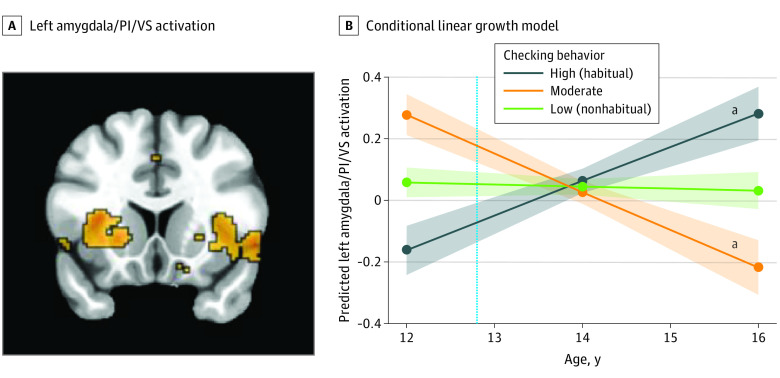
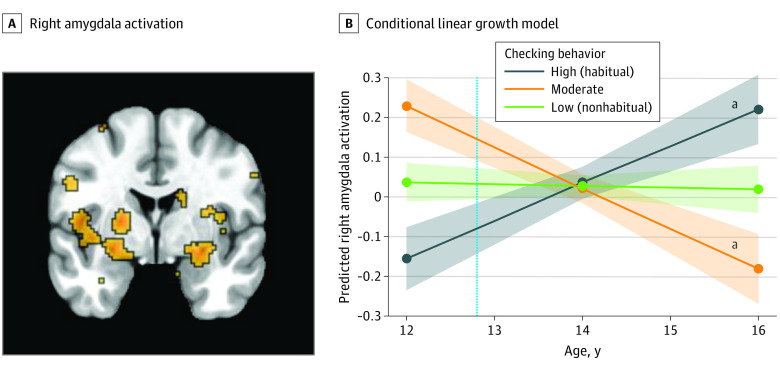
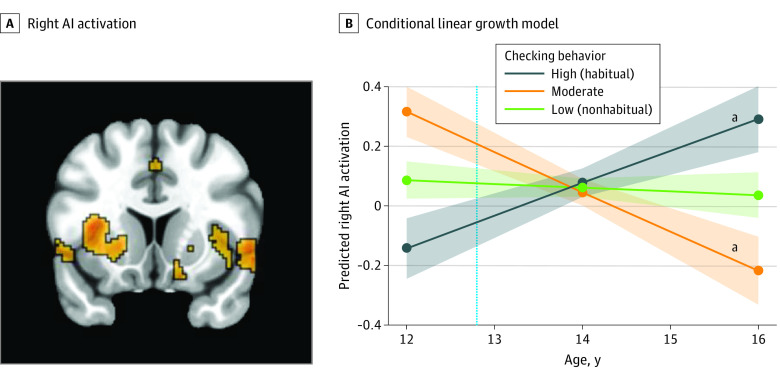
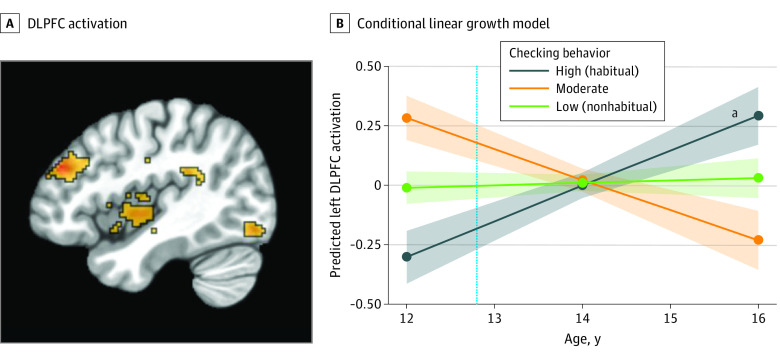
Results: Of 178 participants recruited at age 12 years, 169 participants (mean [SD] age, 12.89 [0.58] years; range, 11.93-14.52 years; 91 [53.8%] female; 38 [22.5%] Black, 60 [35.5%] Latinx, 50 [29.6%] White, 15 [8.9%] multiracial) met the inclusion criteria. Participants with habitual social media checking behaviors showed lower neural sensitivity to social anticipation at age 12 years compared with those with nonhabitual checking behaviors in the left amygdala, posterior insula (PI), and ventral striatum (VS; β, -0.22; 95% CI, -0.33 to -0.11), right amygdala (β, -0.19; 95% CI, -0.30 to -0.08), right anterior insula (AI; β, -0.23; 95% CI, -0.37 to -0.09), and left dorsolateral prefrontal cortex (DLPFC; β, -0.29; 95% CI, -0.44 to -0.14). Among those with habitual checking behaviors, there were longitudinal increases in the left amygdala/PI/VS (β, 0.11; 95% CI, 0.04 to 0.18), right amygdala (β, 0.09; 95% CI, 0.02 to 0.16), right AI (β, 0.15; 95% CI, 0.02 to 0.20), and left DLPFC (β, 0.19; 95% CI, 0.05 to 0.25) during social anticipation, whereas among those with nonhabitual checking behaviors, longitudinal decreases were seen in the left amygdala/PI/VS (β, -0.12; 95% CI, -0.19 to -0.06), right amygdala (β, -0.10; 95% CI, -0.17 to -0.03), right AI (β, -0.13; 95% CI, -0.22 to -0.04), and left DLPFC (β, -0.10, 95% CI, -0.22 to -0.03).
Conclusions and relevance: The results of this cohort study suggest that social media checking behaviors in early adolescence may be associated with changes in the brain's sensitivity to social rewards and punishments. Further research examining long-term associations between social media use, adolescent neural development, and psychological adjustment is needed to understand the effects of a ubiquitous influence on development for today's adolescents.
Conflict of interest statement
Figures
References
-
- Griffiths M. Adolescent social networking: how do social media operators facilitate habitual use? Education and Health. 2018;36(3):66-69.
Publication types
MeSH terms
Grants and funding
LinkOut - more resources
Full Text Sources
Research Materials
Miscellaneous