


Impact of Female Stress Urinary Incontinence on Quality of Life, Mental Health, Work Limitation, and Healthcare Seeking in China, Taiwan, and South Korea (LUTS Asia): Results from a Cross-Sectional, Population-Based Study
- PMID: 36597480
- PMCID: PMC9805714
- DOI: 10.2147/IJWH.S383651
Impact of Female Stress Urinary Incontinence on Quality of Life, Mental Health, Work Limitation, and Healthcare Seeking in China, Taiwan, and South Korea (LUTS Asia): Results from a Cross-Sectional, Population-Based Study
Abstract
Background: Stress urinary incontinence (SUI) is common among adult women with negative effects on psychosocial well-being, mental health, and health-related quality of life. The purpose of the research is to determine if SUI in women is a factor implicated in changes in health-related quality of life (HRQoL) in both physical and mental health domains and in work difficulties.
Methods: Data of women 40 years or older from a cross-sectional, population-based, internet survey were examined post-hoc. The effect of SUI frequency on HRQoL (SF12 score), in physical and mental health domains, was assessed. In addition, multivariate and univariate analyses were used to show the influence of SUI on HADS (Hospital Anxiety and Depression Scale) depression score and HADS anxiety score. The effects of demographic factors and physical ailments and SUI on work difficulties were similarly analyzed using multivariate logistic regression.
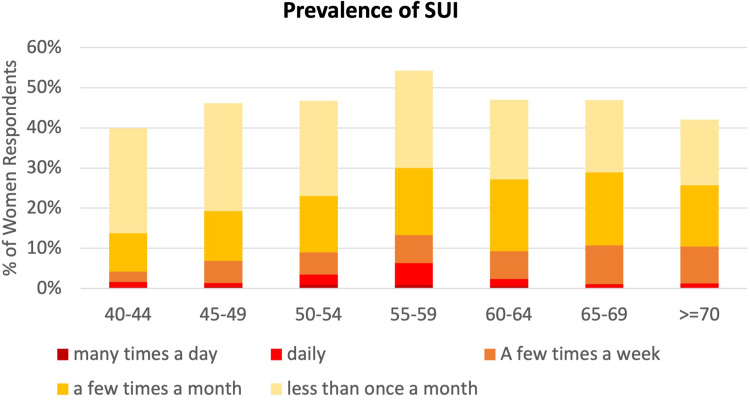
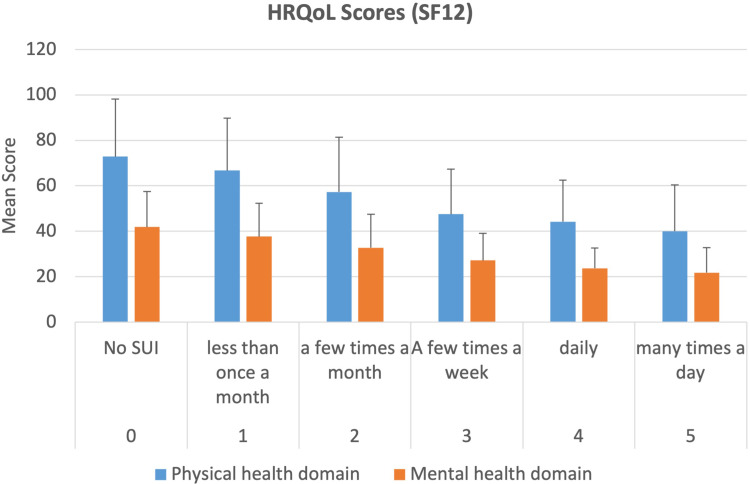
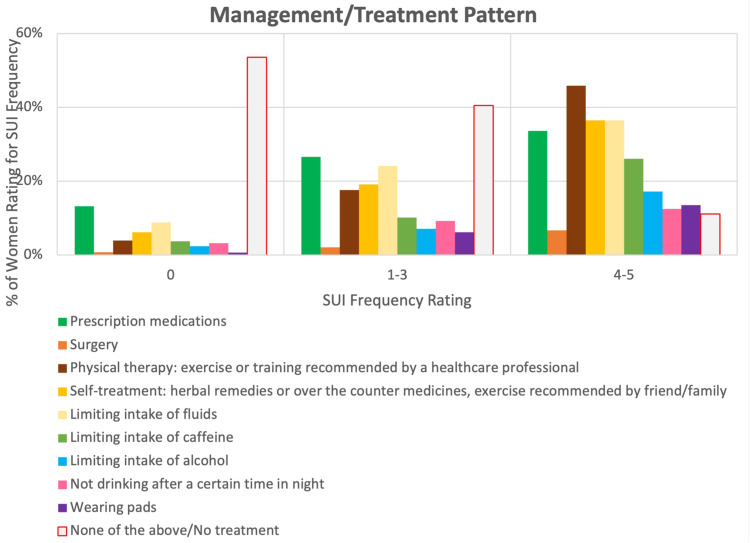
Results: A total of 4208 women with mean age of 60 were included in the analysis. The more frequent SUI episodes were associated with a greater reduction of HRQoL in both physical and mental health domains. In addition, both multivariate and univariate analyses showed that SUI could be correlated with a negative effect on HADS anxiety score (OR 1.617, CI 1.335-1.958, p=0.000) and HADS depression score (OR 1.263, CI 1.044-1.527, p=0.016). Univariate analyses suggested that work difficulties were correlated with SUI. Available data revealed that many sufferers, including up to 40% of individuals with SUI frequency rating 1 (less than once a month) to 3 (a few times a week), failed to seek treatment.
Conclusion: SUI, common in women ≥40 years of age, impairs quality of life in both physical and mental health domains. SUI is an independent risk factor for anxiety and depression and has been linked to significant work dysfunctions.
Trial registration: This study is registered at ClinicalTrials.gov: NCT02618421 (Date of registration: December 1, 2015).
Keywords: China; South Korea; Taiwan; quality of life; stress urinary incontinence.
© 2022 Chow et al.
Conflict of interest statement
SP Liu has received research support from Astellas Pharma Singapore Pte. Ltd. KCP Hsu is a former employee of Astellas Pharma Taiwan, Inc. PM Chow, YC Chuang and YC Shen declare no conflicts of interest.
Figures
References
Associated data
LinkOut - more resources
Full Text Sources
Medical
