Associations Between Procrastination and Subsequent Health Outcomes Among University Students in Sweden
- PMID: 36598789
- PMCID: PMC9857662
- DOI: 10.1001/jamanetworkopen.2022.49346
Associations Between Procrastination and Subsequent Health Outcomes Among University Students in Sweden
Abstract
Importance: Procrastination is prevalent among university students and is hypothesized to lead to adverse health outcomes. Previous cross-sectional research suggests that procrastination is associated with mental and physical health outcomes, but longitudinal evidence is currently scarce.
Objective: To evaluate the association between procrastination and subsequent health outcomes among university students in Sweden.
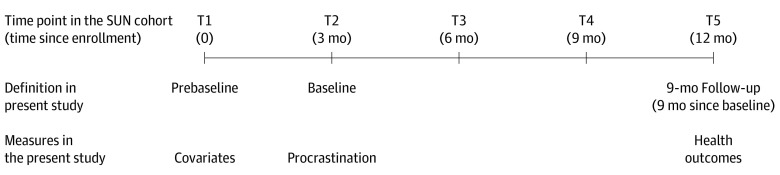
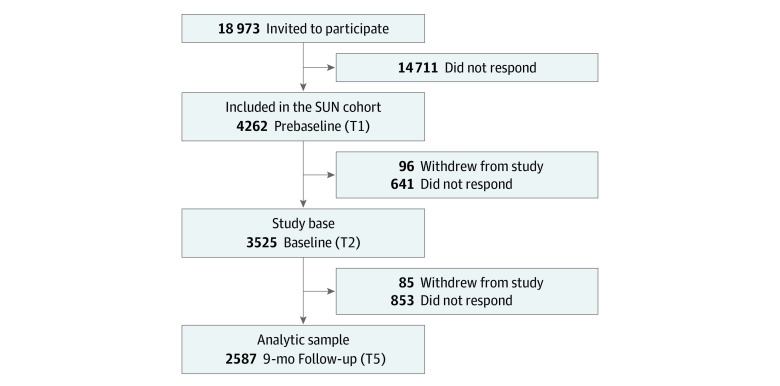
Design, setting, and participants: This cohort study was based on the Sustainable University Life study, conducted between August 19, 2019, and December 15, 2021, in which university students recruited from 8 universities in the greater Stockholm area and Örebro were followed up at 5 time points over 1 year. The present study used data on 3525 students from 3 time points to assess whether procrastination was associated with worse health outcomes 9 months later.
Exposure: Self-reported procrastination, measured using 5 items from the Swedish version of the Pure Procrastination Scale rated on a Likert scale from 1 ("very rarely or does not represent me") to 5 ("very often or always represents me") and summed to give a total procrastination score ranging from 5 to 25.
Main outcomes and measures: Sixteen self-reported health outcomes were assessed at the 9-month follow-up. These included mental health problems (symptoms of depression, anxiety, and stress), disabling pain (neck and/or upper back, lower back, upper extremities, and lower extremities), unhealthy lifestyle behaviors (poor sleep quality, physical inactivity, tobacco use, cannabis use, alcohol use, and breakfast skipping), psychosocial health factors (loneliness and economic difficulties), and general health.
Results: The study included 3525 participants (2229 women [63%]; mean [SD] age, 24.8 [6.2] years), with a follow-up rate of 73% (n = 2587) 9 months later. The mean (SD) procrastination score at baseline was 12.9 (5.4). An increase of 1 SD in procrastination was associated with higher mean symptom levels of depression (β, 0.13; 95% CI, 0.09-0.17), anxiety (β, 0.08; 95% CI, 0.04-0.12), and stress (β, 0.11; 95% CI, 0.08-0.15), and having disabling pain in the upper extremities (risk ratio [RR], 1.27; 95% CI, 1.14-1.42), poor sleep quality (RR, 1.09, 95% CI, 1.05-1.14), physical inactivity (RR, 1.07; 95% CI, 1.04-1.11), loneliness (RR, 1.07; 95% CI, 1.02-1.12), and economic difficulties (RR, 1.15, 95% CI, 1.02-1.30) at the 9-month follow-up, after controlling for a large set of potential confounders.
Conclusions and relevance: This cohort study of Swedish university students suggests that procrastination is associated with subsequent mental health problems, disabling pain, unhealthy lifestyle behaviors, and worse psychosocial health factors. Considering that procrastination is prevalent among university students, these findings may be of importance to enhance the understanding of students' health.
Conflict of interest statement
Figures
References
-
- Steel P, Ferrari J. Sex, education and procrastination: an epidemiological study of procrastinators’ characteristics from a global sample. Eur J Pers. 2013;27(1):51-58. doi:10.1002/per.1851 - DOI
-
- Day V, Mensink D, O’Sullivan M. Patterns of academic procrastination. J Coll Read Learn. 2000;30(2):120-134. doi:10.1080/10790195.2000.10850090 - DOI