. 2023 Jan 31;89(1):e0157522.
doi: 10.1128/aem.01575-22. Epub 2023 Jan 5.

Convergent Community Assembly among Globally Separated Acidic Cave Biofilms

Affiliations

Convergent Community Assembly among Globally Separated Acidic Cave Biofilms

Daniel S Jones et al. Appl Environ Microbiol. .

Abstract

Acidophilic bacteria and archaea inhabit extreme geochemical "islands" that can tell us when and how geographic barriers affect the biogeography of microorganisms. Here, we describe microbial communities from extremely acidic (pH 0 to 1) biofilms, known as snottites, from hydrogen sulfide-rich caves. Given the extreme acidity and subsurface location of these biofilms, and in light of earlier work showing strong geographic patterns among snottite Acidithiobacillus populations, we investigated their structure and diversity in order to understand how geography might impact community assembly. We used 16S rRNA gene cloning and fluorescence in situ hybridization (FISH) to investigate 26 snottite samples from four sulfidic caves in Italy and Mexico. All samples had very low biodiversity and were dominated by sulfur-oxidizing bacteria in the genus Acidithiobacillus. Ferroplasma and other archaea in the Thermoplasmatales ranged from 0 to 50% of total cells, and relatives of the bacterial genera Acidimicrobium and Ferrimicrobium were up to 15% of total cells. Rare phylotypes included Sulfobacillus spp. and members of the phyla "Candidatus Dependentiae" and "Candidatus Saccharibacteria" (formerly TM6 and TM7). Although the same genera of acidophiles occurred in snottites on separate continents, most members of those genera represent substantially divergent populations, with 16S rRNA genes that are only 95 to 98% similar. Our findings are consistent with a model of community assembly where sulfidic caves are stochastically colonized by microorganisms from local sources, which are strongly filtered through environmental selection for extreme acid tolerance, and these different colonization histories are maintained by dispersal restrictions within and among caves. IMPORTANCE Microorganisms that are adapted to extremely acidic conditions, known as extreme acidophiles, are catalysts for rock weathering, metal cycling, and mineral formation in naturally acidic environments. They are also important drivers of large-scale industrial processes such as biomining and contaminant remediation. Understanding the factors that govern their ecology and distribution can help us better predict and utilize their activities in natural and engineered systems. However, extremely acidic habitats are unusual in that they are almost always isolated within circumneutral landscapes. So where did their acid-adapted inhabitants come from, and how do new colonists arrive and become established? In this study, we took advantage of a unique natural experiment in Earth's subsurface to show how isolation may have played a role in the colonization history, community assembly, and diversity of highly acidic microbial biofilms.

Keywords: Acidithiobacillus; acidophiles; biofilms; biogeography; cave.


Conflict of interest statement

The authors declare no conflict of interest.

Figures

FIG 1
FIG 1
(A) Schematic depicting the snottite niche in sulfidic caves. Snottites hang from gypsum wall crusts on cave walls and ceilings in close proximity to sulfidic cave streams. Figure modified from reference . (B to G) Representative photographs of snottite communities described in this study. Bars 2 cm (yellow) and 1 cm (black [B]). (F) Photo by Kenneth Ingham.
FIG 2
FIG 2
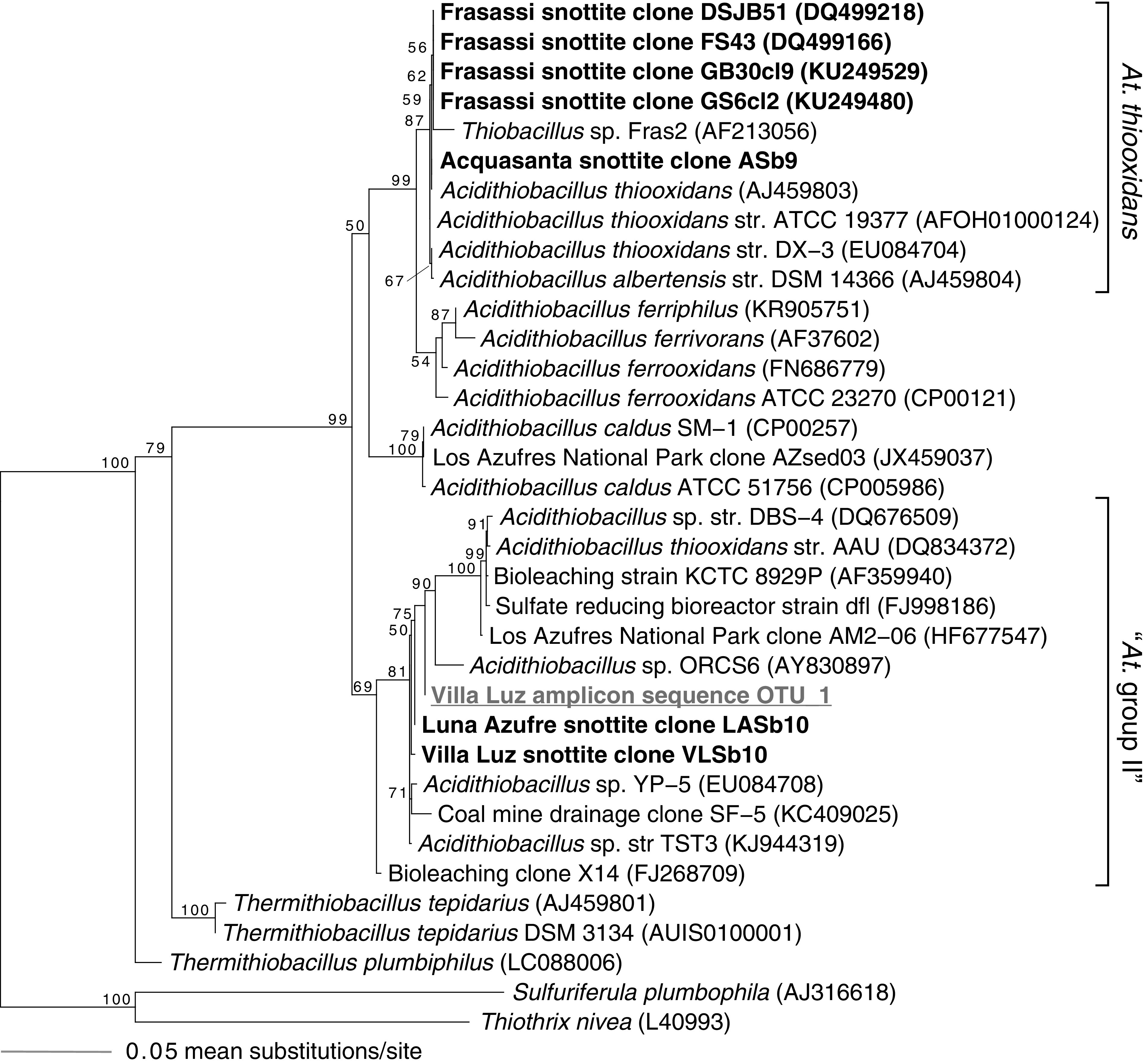
Phylogenetic analysis of 16S rRNA gene sequences from the genus Acidithiobacillus. The base tree is a maximum-likelihood phylogram created with nearly full-length sequences, with shorter amplicon sequence (gray underline) placed using the EPA algorithm. Representative sequences from 16S rRNA gene clones are in boldface. Bootstrap values of >50% are provided for each node.
FIG 3
FIG 3
Phylogenetic analysis of 16S rRNA gene sequences from the family Acidimicrobiaceae. The base tree is a maximum-likelihood phylogram created with nearly full-length sequences, with shorter amplicon sequences (gray underline) placed after the fact using the EPA algorithm. Representative sequences from 16S rRNA gene clones are in black boldface. The amplicon sequence in gray boldface with two asterisks represents the most abundant Acidimicrobiaceae OTU (24.8 and 13.7% of the VL13-1 and VL13-2 libraries, respectively); other Acidimicrobiaceae OTUs had <2% relative abundance (Table S2). Bootstrap values of >50% are provided for each node.
FIG 4
FIG 4
Neighbor joining phylogram of 16S rRNA gene sequences from the archaeal order Thermoplasmatales. Snottite clones are in boldface. Bootstrap values of >50% are provided for each node. Group names for the “alphabet plasmas” are as in the work of Baker and Banfield (3).
FIG 5
FIG 5
Representative FISH photomicrographs. The sample names and probes used for each photo are provided in the keys. Bars, 5 μM. Abundant DAPI-labeled cells in AS08-6 are nearly all archaea, as are abundant DAPI-labeled cells in RS08-31.
FIG 6
FIG 6
Representative FISH photomicrographs. The sample names and probes used for each photo are provided in the keys. Bars, 5 μM. Note the abundant non-THIO1-labeled cells (arrows) in VL07-20. The thick arrow in GS08-6 indicates THIO1-labeled cells linked into filaments, and thin arrows indicate non-THIO1-labeled bacterial cells.
FIG 7
FIG 7
PCA of FISH cell counts (Table 3). Sample scores are coded by cave (communities from different caves are significantly different by ANOSIM). Fitted vectors of environmental variables are included as an overlay; CO2 and SO2 gas concentrations are statistically significantly correlated with the ordination axes (P < 0.05), while H2S gas and temperature are not (P > 0.1).

References

    1. Vera M, Schippers A, Sand W. 2013. Progress in bioleaching: fundamentals and mechanisms of bacterial metal sulfide oxidation—part A. Appl Microbiol Biotechnol 97:7529–7541. 10.1007/s00253-013-4954-2. - DOI - PubMed
    1. Johnson DB. 2014. Biomining—biotechnologies for extracting and recovering metals from ores and waste materials. Curr Opin Biotechnol 30:24–31. 10.1016/j.copbio.2014.04.008. - DOI - PubMed
    1. Baker BJ, Banfield JF. 2003. Microbial communities in acid mine drainage. FEMS Microbiol Ecol 44:139–152. 10.1016/S0168-6496(03)00028-X. - DOI - PubMed
    1. Rowe OF, Sánchez-España J, Hallberg KB, Johnson DB. 2007. Microbial communities and geochemical dynamics in an extremely acidic, metal-rich stream at an abandoned sulfide mine (Huelva, Spain) underpinned by two functional primary production systems. Environ Microbiol 9:1761–1771. 10.1111/j.1462-2920.2007.01294.x. - DOI - PubMed
    1. Santelli CM, Pfister DH, Lazarus D, Sun L, Burgos WD, Hansel CM. 2010. Promotion of Mn(II) oxidation and remediation of coal mine drainage in passive treatment systems by diverse fungal and bacterial communities. Appl Environ Microbiol 76:4871–4875. 10.1128/AEM.03029-09. - DOI - PMC - PubMed

Publication types

Substances

LinkOut - more resources