Review
. 2023 Jan 6;15(1):5.
doi: 10.1038/s41368-022-00208-x.

Tooth number abnormality: from bench to bedside

Affiliations
Review

Tooth number abnormality: from bench to bedside

Han Zhang et al. Int J Oral Sci. .

Abstract

Tooth number abnormality is one of the most common dental developmental diseases, which includes both tooth agenesis and supernumerary teeth. Tooth development is regulated by numerous developmental signals, such as the well-known Wnt, BMP, FGF, Shh and Eda pathways, which mediate the ongoing complex interactions between epithelium and mesenchyme. Abnormal expression of these crutial signalling during this process may eventually lead to the development of anomalies in tooth number; however, the underlying mechanisms remain elusive. In this review, we summarized the major process of tooth development, the latest progress of mechanism studies and newly reported clinical investigations of tooth number abnormality. In addition, potential treatment approaches for tooth number abnormality based on developmental biology are also discussed. This review not only provides a reference for the diagnosis and treatment of tooth number abnormality in clinical practice but also facilitates the translation of basic research to the clinical application.


Conflict of interest statement

The authors declare no competing interests.

Figures
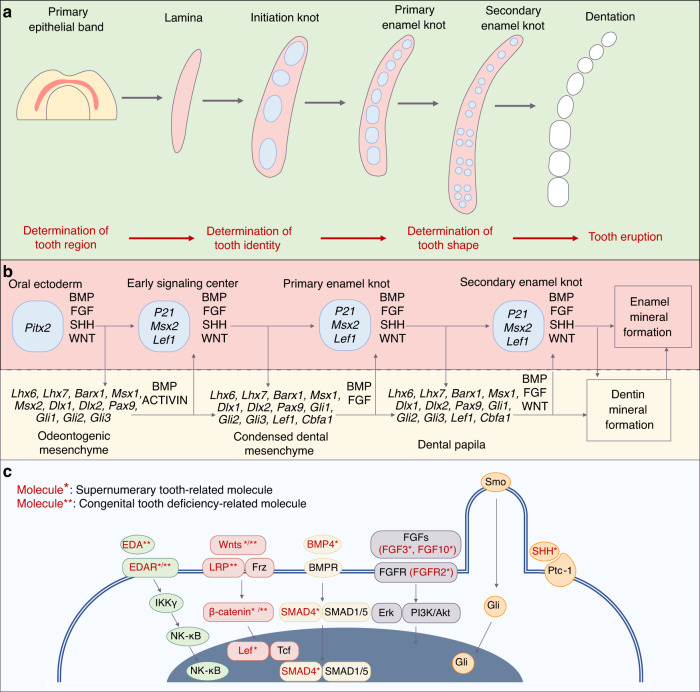
Fig. 1
Fig. 1
Tooth development process and summary of key odontogenic signal pathways. a The development process from primary epithelial band to dentation. b Molecules and signal pathways involved in tooth development. c Five key odontogenic signal pathways and related molecules involved in tooth number abnormality
Fig. 2
Fig. 2
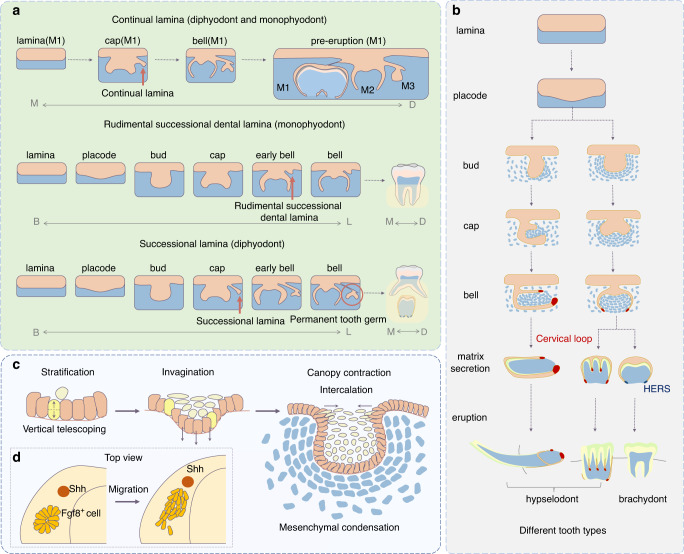
Schematic of tooth development process. a The continual lamina is present in diphyodonts and monophyodonts. The rudimental successional dental lamina cannot develop into a tooth under normal conditions, whereas the successional lamina forms the second dentition in diphyodonts. The dotted arrow indicates that a few parts of the tooth developmental process are omitted. B: buccal; L: lingual; M: mesial; D: distal; M1: first molar; M2: second molar; M3: third molar. b Different tooth types are classified according to the clinical crown-to-root ratio and the self-renewal ability after eruption. c Cell behaviour during early tooth development. Yellow cells form the suprabasal cells (light yellow) via asymmetric division; orange cells undergo vertical expansion. Grey–blue mesenchymal cells condense around the epithelium. d Top view of the migration of Fgf8+ epithelium in the lower jaw
Fig. 3
Fig. 3
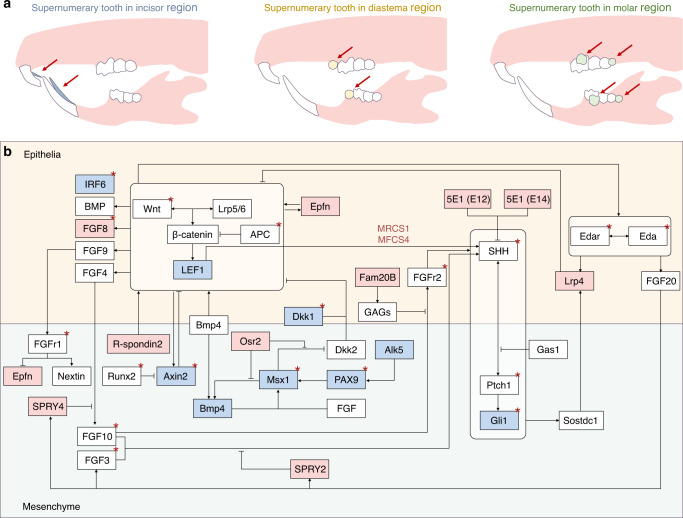
Schematic of location and genes regarding tooth number abnormality. a Schematic of supernumerary teeth located in different regions. b Summary of genes related to tooth number abnormality. Red represents genes associated with extra teeth; blue represents genes associated with inhibition of tooth development; Red * represents genes reported in humans
Fig. 4
Fig. 4
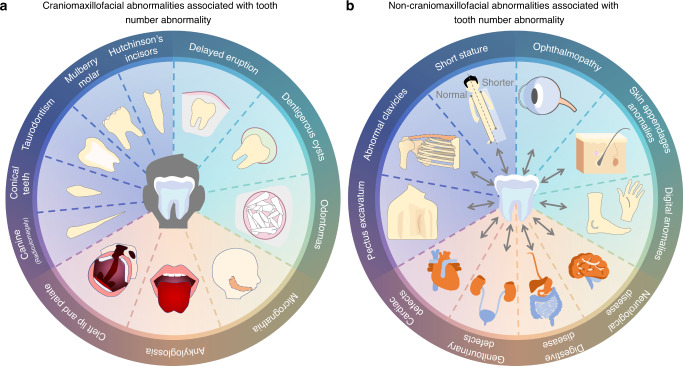
Human diseases connected with tooth number abnormalities. a Craniomaxillofacial abnormalities associated with tooth number abnormality. b Non-craniomaxillofacial abnormalities associated with tooth number abnormality

References

    1. Cammarata-Scalisi F, Avendano A, Callea M. Main genetic entities associated with supernumerary teeth. Arch. Argent. Pediatr. 2018;116:437–444. - PubMed
    1. Demiriz L, Durmuslar MC, Misir AF. Prevalence and characteristics of supernumerary teeth: a survey on 7348 people. J. Int Soc. Prev. Community Dent. 2015;5:S39–S43. doi: 10.4103/2231-0762.156151. - DOI - PMC - PubMed
    1. De Santis D, et al. Syndromes associated with dental agenesis. Minerva Stomatol. 2019;68:42–56. doi: 10.23736/S0026-4970.18.04129-8. - DOI - PubMed
    1. Al-Ani AH, Antoun JS, Thomson WM, Merriman TR, Farella M. Hypodontia: an update on Its etiology, classification, and clinical management. Biomed. Res. Int. 2017;2017:9378325. doi: 10.1155/2017/9378325. - DOI - PMC - PubMed
    1. Mogollon, I., Moustakas-Verho, J. E., Niittykoski, M. & Ahtiainen, L. The initiation knot is a signaling center required for molar tooth development. Development10.1242/dev.194597 (2021). - PMC - PubMed

Publication types