


The 2000HIV study: Design, multi-omics methods and participant characteristics
- PMID: 36605197
- PMCID: PMC9809279
- DOI: 10.3389/fimmu.2022.982746
The 2000HIV study: Design, multi-omics methods and participant characteristics
Abstract
Background: Even during long-term combination antiretroviral therapy (cART), people living with HIV (PLHIV) have a dysregulated immune system, characterized by persistent immune activation, accelerated immune ageing and increased risk of non-AIDS comorbidities. A multi-omics approach is applied to a large cohort of PLHIV to understand pathways underlying these dysregulations in order to identify new biomarkers and novel genetically validated therapeutic drugs targets.
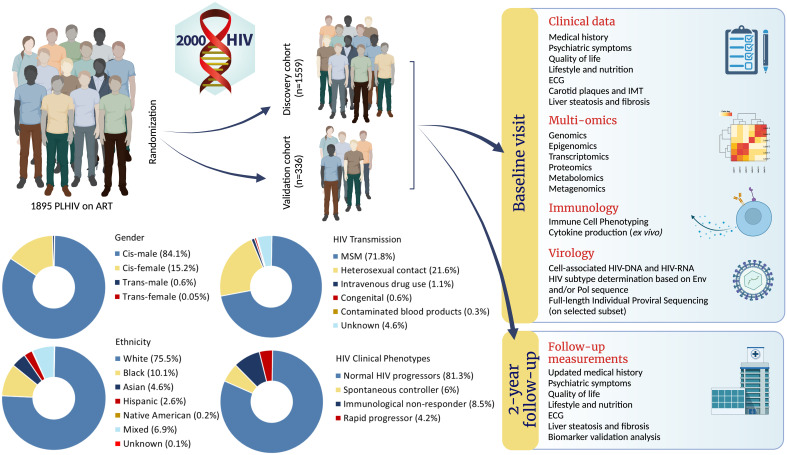
Methods: The 2000HIV study is a prospective longitudinal cohort study of PLHIV on cART. In addition, untreated HIV spontaneous controllers were recruited. In-depth multi-omics characterization will be performed, including genomics, epigenomics, transcriptomics, proteomics, metabolomics and metagenomics, functional immunological assays and extensive immunophenotyping. Furthermore, the latent viral reservoir will be assessed through cell associated HIV-1 RNA and DNA, and full-length individual proviral sequencing on a subset. Clinical measurements include an ECG, carotid intima-media thickness and plaque measurement, hepatic steatosis and fibrosis measurement as well as psychological symptoms and recreational drug questionnaires. Additionally, considering the developing pandemic, COVID-19 history and vaccination was recorded. Participants return for a two-year follow-up visit. The 2000HIV study consists of a discovery and validation cohort collected at separate sites to immediately validate any finding in an independent cohort.
Results: Overall, 1895 PLHIV from four sites were included for analysis, 1559 in the discovery and 336 in the validation cohort. The study population was representative of a Western European HIV population, including 288 (15.2%) cis-women, 463 (24.4%) non-whites, and 1360 (71.8%) MSM (Men who have Sex with Men). Extreme phenotypes included 114 spontaneous controllers, 81 rapid progressors and 162 immunological non-responders. According to the Framingham score 321 (16.9%) had a cardiovascular risk of >20% in the next 10 years. COVID-19 infection was documented in 234 (12.3%) participants and 474 (25.0%) individuals had received a COVID-19 vaccine.
Conclusion: The 2000HIV study established a cohort of 1895 PLHIV that employs multi-omics to discover new biological pathways and biomarkers to unravel non-AIDS comorbidities, extreme phenotypes and the latent viral reservoir that impact the health of PLHIV. The ultimate goal is to contribute to a more personalized approach to the best standard of care and a potential cure for PLHIV.
Keywords: COVID-19; HIV extreme phenotype; HIV reservoir; HIV-1; cardiovascular disease; hepatic disease; multi-omics; non-AIDS comorbidities.
Copyright © 2022 Vos, Groenendijk, Blaauw, van Eekeren, Navas, Cleophas, Vadaq, Matzaraki, dos Santos, Meeder, Fröberg, Weijers, Zhang, Fu, ter Horst, Bock, Knoll, Aschenbrenner, Schultze, Vanderkerckhove, Hwandih, Wonderlich, Vemula, van der Kolk, de Vet, Blok, Brinkman, Rokx, Schellekens, de Mast, Joosten, Berrevoets, Stalenhoef, Verbon, van Lunzen, Netea and van der Ven.
Conflict of interest statement
All authors are part of the 2000HIV collaboration, which is supported by ViiV Healthcare. ViiV Healthcare funded this research and the included authors employed by the company contributed in the writing of the final manuscript. Although there is close collaboration, ViiV Healthcare did not have any role in data quality control, statistical analyses and final interpretation of the data.Author CR received grants from Gilead sciences, ViiV Healthcare, Janssen-Cilag, Health Holland, AIDSfonds, ErasmusMC, outside the submitted work. Authors EW, SVV, MK and JL are employed by ViiV healthcare. Authors QM and AJV received grants from Sysmex Corporation. Author TH is employed by Sysmex Corporation.
Figures
References
Publication types
MeSH terms
Substances
LinkOut - more resources
Full Text Sources
Medical
