


"I Knew She'd Get It, and Get Me": Participants' Perspectives of a Participatory Autism Research Project
- PMID: 36605972
- PMCID: PMC9645671
- DOI: 10.1089/aut.2021.0039
"I Knew She'd Get It, and Get Me": Participants' Perspectives of a Participatory Autism Research Project
Abstract
Introduction: Autistic advocates and their supporters have long argued that conventional research practices provide too few opportunities for genuine engagement with autistic people, contributing to social disenfranchisement among autistic people. We recently described one attempt to develop and implement a participatory study in which a team of autistic and nonautistic researchers worked together to gather life histories from late-diagnosed autistic people. In the current study, we sought to understand the impact of this participatory approach on the participants themselves.
Methods: We spoke to 25 Australian late-diagnosed autistic adults (aged 45-72 years), who had been interviewed by an autistic researcher using an oral history approach. We asked them about their experience of being involved in that project and the research process more broadly. We thematically analyzed participants' interviews.
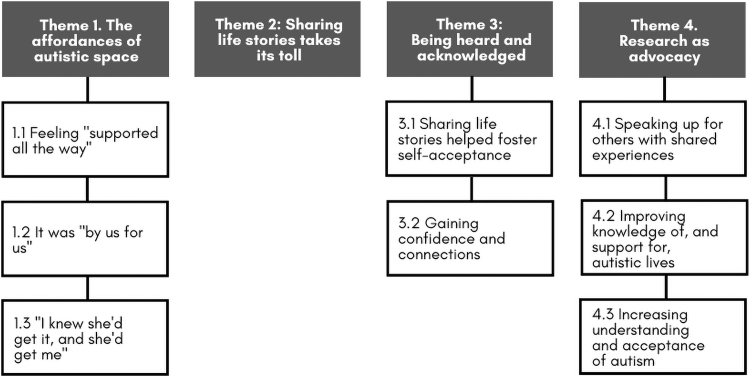
Results: Participants responded overwhelmingly positively to the opportunity to tell their life history, considering it illuminating and empowering. While recounting their life history was often described as "exhausting" and "draining," participants also reported feeling "supported all the way" and agreed "it was made easier because I had an autistic researcher interviewing me." One participant went so far as to say that they "probably would have dropped out [of the project] if it was run by people who weren't autistic."
Conclusions: These findings demonstrate that the benefits of coproduction to researchers and community partners extend to study participants and to the quality of the research itself. Involving autistic partners in the research process, especially in its implementation, can play a crucial role in enhancing autism research.
Keywords: community involvement; coproduction; research impact.
Plain language summary
Why is this an important issue?: Autistic people are often left out of decisions that affect them, including in research. We wanted to change that. We, a group of autistic and nonautistic researchers, worked together to come up with a research project. In that project, we wanted to know more about autistic people who were diagnosed late in their lives.
What was the purpose of this study?: We wanted to know about their experiences of taking part in the research. We also wanted to understand what it was like for our study participants to tell their life story to another autistic person.
What did we do?: We spoke to 25 autistic people about their experiences of telling their life history. We asked questions like, “Can you tell me a bit about why you wanted to share your life history?” and “What was your overall experience of taking part in this research project?” We interviewed participants for about 25 minutes.
What were the results of the study?: We found that participants felt good about taking part in this project. They felt supported and were pleased that the project was being run by autistic people. They also told us that telling their story was often painful. However, it was made easier because they had an autistic researcher interviewing them. They also felt that they could share more with this person than with someone who was not an autistic person.
What do these findings add to what was already known?: This study shows that research that is done together by autistic and nonautistic researchers has a positive effect on participants.
What are the potential weaknesses in the study?: Most of our participants were well educated, White, and were in some form of work. We do not know if participants' positive experiences would also happen with other autistic people, including those from different cultural groups. This study was also unusual because it allowed participants to tell their own stories in their own way. That might have made participants more positive about it.
How will these findings help autistic adults now or in the future?: These findings show how important it is to include autistic people in research. It makes a real difference to the participants and to the quality of the research.
Copyright 2022, Mary Ann Liebert, Inc., publishers.
Conflict of interest statement
No competing financial interests exist.
Figures
References
-
- den Houting J, Pellicano E. A portfolio analysis of autism research funding in Australia, 2008-2017. J Autism Dev Disord. 2019;49(11):4400–4408. - PubMed
-
- Office of Autism Research Coordination, National Institute of Mental Health, on behalf of the Interagency Autism Coordinating Committee. 2016. IACC autism spectrum disorder research: Portfolio analysis report. 2019. Retrieved from https://iacc.hhs.gov/publications/portfolio-analysis/2016/ Accessed October 29, 2021.
-
- Pellicano E, Dinsmore A, Charman T. A future made together: Shaping autism research in the UK. 2013. Retrieved from http://discovery.ucl.ac.uk/10017703/1/A_Future_Made_Together_1.2_LR.pdf Accessed October 29, 2021.
-
- Dawson G. Dramatic increase in autism prevalence parallels explosion of research into its biology and causes. JAMA Psychiatry. 2013;70(1):9–10. - PubMed
LinkOut - more resources
Full Text Sources
Research Materials