. 2023 Feb 27;51(1):207-221.
doi: 10.1042/BST20220681.

Targeting the DNA damage response for cancer therapy

Affiliations

Targeting the DNA damage response for cancer therapy

Nicola J Curtin. Biochem Soc Trans. .

Abstract

The DNA damage response (DDR) is an elegant system, coordinating DNA repair with cell cycle checkpoints, that evolved to protect living organisms from the otherwise fatal levels of DNA damage inflicted by endogenous and environmental sources. Since many agents used to treat cancer; radiotherapy and cytotoxic chemotherapy, work by damaging DNA the DDR represents a mechanism of resistance. The original rational for the development of drugs to inhibit the DDR was to overcome this mechanism of resistance but clinical studies using this approach have not led to improvements in the therapeutic index. A more exciting approach is to exploit cancer-specific defects in the DDR, that represent vulnerabilities in the tumour and an opportunity to selectively target the tumour. PARP inhibitors (PARPi) selectively kill homologous recombination repair defective (HRD, e.g. through BRCA mutation) cells. This approach has proven successful clinically and there are now six PARPi approved for cancer therapy. Drugs targeting other aspects of the DDR are under pre-clinical and clinical evaluation as monotherapy agents and in combination studies. For this promising approach to cancer therapy to be fully realised reliable biomarkers are needed to identify tumours with the exploitable defect for monotherapy applications. The possibility that some combinations may result in toxicity to normal tissues also needs to be considered. A brief overview of the DDR, the development of inhibitors targeting the DDR and the current clinical status of such drugs is described here.

Keywords: ATM; ATR; CHK1; DNA damage response; DNA-PK; PARP.


Conflict of interest statement

The author was involved in the development of rucaparib and has received royalty payments but does not take them personally. She has also been involved in the development of DNA-PK inhibitors (NU7XXX series) and ATM inhibitors (KU55933 etc) and also diverts any royalty payments elsewhere. She identified NU6027 as an ATR inhibitor but this has never been commercialised.

Figures
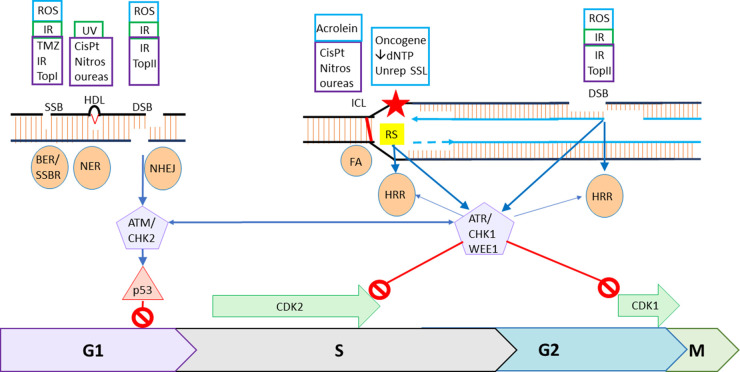
Figure 1.
Figure 1.. The DNA damage response: integration of repair and cell cycle checkpoints.
Endogenous DNA damage is shown in blue boxes, environmental in green boxes and therapeutically induced in purple boxes. ROS (reactive oxygen species), IR (irradiation) TMZ (temozolomide) and other DNA methylating agents and TopI (topoisomerase I poisons) result in damaged bases and SSBs. BER/SSBR (base excision repair/single strand break repair) repair these lesions by removing damaged bases by glycosylase and endonuclease action to produce a SSB. PARP binds to and is activated by the nick to recruit the SSB repair proteins XRCC1, PolB and Ligase 1 or 3 to fill the gap and join the ends, for short patch repair with the additional requirement for PNPK, PCNA and FEN1 for long patch repair. HDL (Helix distorting lesions) caused by UV photoproducts, bulky adducts, e.g. from tobacco smoke and platinum therapy are repaired by NER (nucleotide excision repair) which can be global or transcription-coupled and involves several proteins including TFIIH XPG and XPF-ERCC1 to remove 25–30 nt, re-filling the gap using the complementary strand as a template by DNA pol δ, ε or κ and ligation by Lig 1 or 3. TopII (topoisomerase II poisons) along with ROS and IR cause DSBs that are repaired in GI exclusively by NHEJ (non-homologous end-joining) which involves the recognition, stabilisation and synapsis of the break by DNA-dependent protein kinase DNA-PK, a heterodimeric complex of KU70 and Ku80 and the catalytic subunit, DNA-PKcs, modest end resection, limited by 53BP1, and end ligation by Ligase 4 and XRCC4-XLF. DSBs signal via ATM and CHK2, primarily but not exclusively via p53, to G1 cell cycle arrest. ICL (interstrand cross-links) induced endogenously and environmentally by, e.g. acrolein and therapeutically by CisPt (cis- or carboplatin) are repaired by the FA (Fanconi anaemia) pathway when the replication fork encounters the lesion. The ICL is recognised by FANCM then recruitment of the core FA proteins for fork stabilisation, nucleases to excise the lesion then translesional and/or homologous recombination DNA synthesis. Several FA components are in common with NER (FANCM/ERCC1/XPF family) and HRR (homologous recombination repair), including BRCA2/FANCD1, PALB2/FANCN, RAD51C/FANCO. Oncogene activation and dNTP depletion and unrepaired (SSL) single strand lesions result in RS (replication stress) that can cause stalled/collapsed replication forks are repaired by HRR. Similarly DSBs are repaired by HRR during S phase. HRR involves end-resection involving MRN and CtIP, promoted by BRCA1, to produce single strand overhangs, BRCA2 recruits RAD51 to allow invasion of the complementary chromatid template for faithful DNA synthesis across the break. The process is completed by resolution of Holliday junctions by helicases and synthesis-dependent strand annealing. NER, FA, stalled replication forks and resected DSBs all result in SS DNA, which activate ATR, that activates CHK1, and WEE1 ultimately resulting in increased inactivating phosphorylation of the S and G2/M cyclin dependent kinases CDK2 and CDK1 causing S-phase and G2/M cell cycle arrest. There is cross-talk between ATR/CHK1/WEE1 and FA/HRR and ATM/CHK2 and NHEJ to ensure co-ordination between repair and cell cycle arrest.

References

    1. Hanahan, D. and Weinberg, R.A. (2011) Hallmarks of cancer: the next generation. Cell 144, 646–674 10.1016/j.cell.2011.02.013 - DOI - PubMed
    1. Saxena, S. and Zou, L. (2022) Hallmarks of DNA replication stress. Mol. Cell 82, 2298–2314 10.1016/j.molcel.2022.05.004 - DOI - PMC - PubMed
    1. Curtin, N.J. (2012) DNA repair dysregulation, from cancer driver to therapeutic target. Nat. Rev. Cancer 12, 108–117 10.1038/nrc3399 - DOI - PubMed
    1. Murthy, P. and Muggia, F. (2019) PARP inhibitors: clinical development, emerging differences, and the current therapeutic issues. Cancer Drug Resist. (Alhambra, Calif.) 2, 665–679 10.20517/cdr.2019.002 - DOI - PMC - PubMed
    1. Ma, A. and Dai, X. (2018) The relationship between DNA single-stranded damage response and double-stranded damage response. Cell Cycle 17, 73–79 10.1080/15384101.2017.1403681 - DOI - PMC - PubMed

Publication types

Substances