


Respiratory morbidity in preschool and school-age children born very preterm and its association with parents' health-related quality of life and family functioning
- PMID: 36607410
- PMCID: PMC9817445
- DOI: 10.1007/s00431-022-04783-3
Respiratory morbidity in preschool and school-age children born very preterm and its association with parents' health-related quality of life and family functioning
Erratum in
-
Correction to: Respiratory morbidity in preschool and school-age children born very preterm and its association with parents' health-related quality of life and family functioning.Eur J Pediatr. 2023 Mar;182(3):1211-1212. doi: 10.1007/s00431-023-04829-0. Eur J Pediatr. 2023. PMID: 36692624 Free PMC article. No abstract available.
Abstract
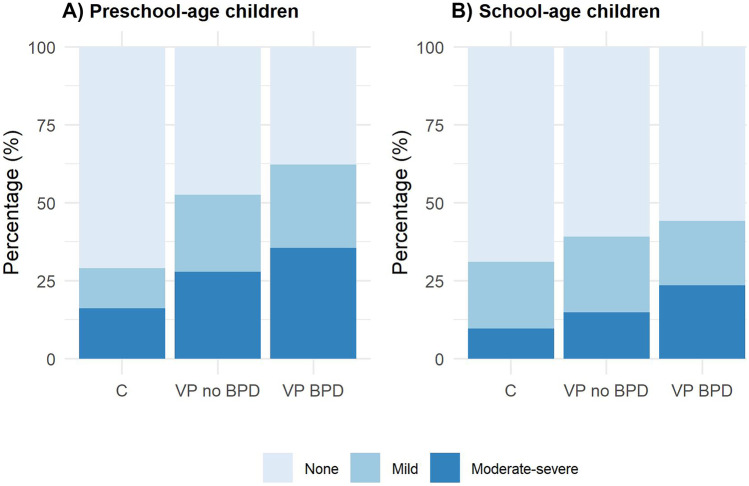
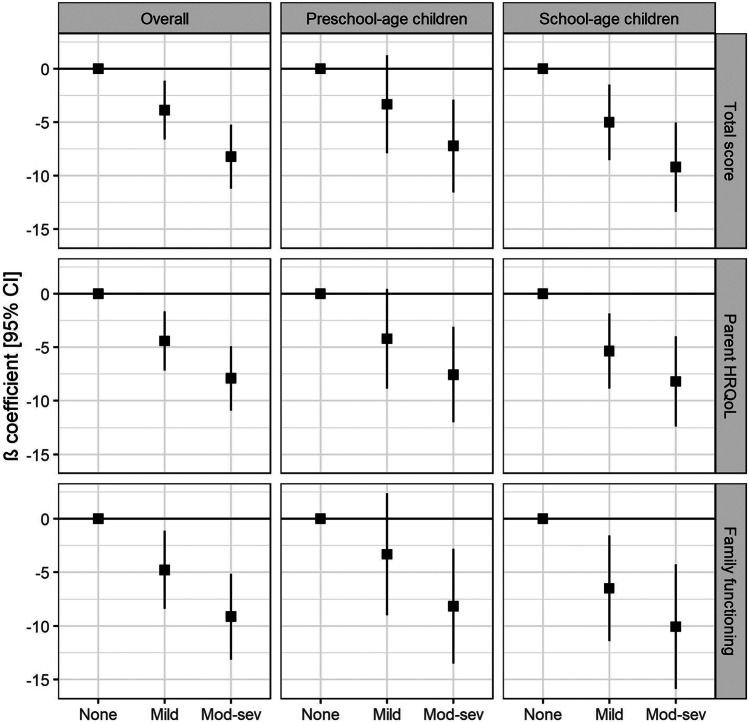
The purpose of this study is to describe the prevalence and severity of respiratory symptoms in children born very preterm and to assess their association with parents' health-related quality of life (HRQoL) and family functioning. We conducted a cross-sectional study and recruited children born less than 32 weeks' gestation between January 2006 and December 2019, in the greater Zurich area, Switzerland. Between May and December 2021, parents were invited to complete an online survey for their preterm child and for a control term born (≥ 37 weeks' gestation) sibling aged 1 to 18 years. We used a validated questionnaire to assess respiratory symptoms and the Pediatrics Quality of Life Family Impact Module (PedsQL FIM) to assess parents' HRQoL and family functioning. The survey was completed for 616 very preterm children (99 with bronchopulmonary dysplasia (BPD)) and 180 controls. Girls made up 45% (46% in controls) of the sample, and 63% (60% in controls) of participants were aged 6 to 18 years (school-age). Very preterm children reported a higher risk of respiratory symptoms than controls, especially preschoolers and those with moderate-to-severe BPD. Parents of children with "mild" and "moderate-severe" respiratory symptoms had on average -3.9 (95%CI: -6.6 to -1.1) and -8.2 (-11.2 to -5.2) lower PedsQL FIM total score, respectively, than parents of children with no symptoms. The same pattern was observed after stratifying by age categories. Conclusions: Our study suggests that respiratory morbidity in very preterm children has a negative impact on parents' HRQoL and family functioning, even beyond the first years of life. What is Known: • The burden of respiratory morbidity associated with very premature birth is high and last far beyond the neonatal period. • Respiratory morbidity contributes to lower health-related quality of life (HRQoL) in parents of very preterm children in early infancy. What is New: • Respiratory morbidity in very preterm children has a negative impact on parents' HRQoL and family functioning beyond the first years of life. • Parents of very preterm children with moderate and severe respiratory symptoms are the ones who report lower scores, both for preschool and school-age children.
Keywords: Children; Family functioning; Health-related quality of life; Parents; Premature birth; Respiratory symptoms.
© 2023. The Author(s).
Conflict of interest statement
Gabriela P. Peralta was the recipient of the Long-Term Research Fellowship 2020 from the European Respiratory Society and received a conference fee from Menarini. Mark Adams receives a salary as a network coordinator for the Swiss Neonatal Network. The other authors declare no conflicts of interest related to this work.
Figures
References
-
- Blencowe H, Cousens S, Oestergaard MZ, et al. National, regional, and worldwide estimates of preterm birth rates in the year 2010 with time trends since 1990 for selected countries: a systematic analysis and implications. Lancet. 2012;379:2162–2172. doi: 10.1016/S0140-6736(12)60820-4. - DOI - PubMed
MeSH terms
LinkOut - more resources
Full Text Sources
