Review
. 2023 Mar;42(1):161-182.
doi: 10.1007/s10555-022-10075-x. Epub 2023 Jan 6.

Liquid biopsy for monitoring of tumor dormancy and early detection of disease recurrence in solid tumors

Affiliations
Review

Liquid biopsy for monitoring of tumor dormancy and early detection of disease recurrence in solid tumors

Isabel Heidrich et al. Cancer Metastasis Rev. 2023 Mar.

Abstract

Cancer is one of the three leading causes of death worldwide. Even after successful therapy and achieving remission, the risk of relapse often remains. In this context, dormant residual cancer cells in secondary organs such as the bone marrow constitute the cellular reservoir from which late tumor recurrences arise. This dilemma leads the term of minimal residual disease, which reflects the presence of tumor cells disseminated from the primary lesion to distant organs in patients who lack any clinical or radiological signs of metastasis or residual tumor cells left behind after therapy that eventually lead to local recurrence. Disseminated tumor cells have the ability to survive in a dormant state following treatment and linger unrecognized for more than a decade before emerging as recurrent disease. They are able to breakup their dormant state and to readopt their proliferation under certain circumstances, which can finally lead to distant relapse and cancer-associated death. In recent years, extensive molecular and genetic characterization of disseminated tumor cells and blood-based biomarker has contributed significantly to our understanding of the frequency and prevalence of tumor dormancy. In this article, we describe the clinical relevance of disseminated tumor cells and highlight how latest advances in different liquid biopsy approaches can be used to detect, characterize, and monitor minimal residual disease in breast cancer, prostate cancer, and melanoma patients.

Keywords: Breast cancer; Circulating tumor DNA; Circulating tumor cells; Disseminated tumor cells; Melanoma; Minimal residual disease; Prostate cancer.


Conflict of interest statement

The authors do not declare any conflict of interest that are directly or indirectly related to this publication.

Figures
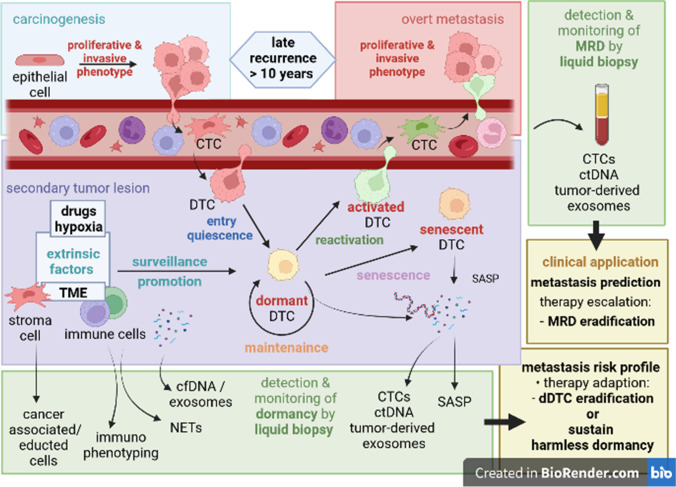
Fig. 1
Fig. 1
Dormancy. Dissemination and tumor dormancy—MRD and dormancy biomarkers indicating late tumor recurrence. TME tumor microenvironment, CTC circulating tumor cell, ctDNA circulating tumor DNA, MRD minimal residual disease, NETs neutrophil extracellular traps, SASP senescence-associated secretory phenotype, DTC disseminated tumor cell, dDTC dormant disseminated tumor cell. During carcinogenesis, tumor cells undergo different adaptions enabling malignancies to invasive growth, escape of immune surveillance, epithelial–mesenchymal transition, and induction of tumor vascularization. Often, intravasation and dissemination were achieved before solid malignancies were clinically captured or have been detected by radiographic diagnostics. Minimal residual disease (MRD) tracking with liquid biopsy might be a more suitable diagnostic instrument for detection of early blood dissemination. Enhanced by metastatic niche preparation, disseminated tumor cells (DTC) extravasate and colonize secondary organs and form immediately overt metastasis. However, some entities tent to endure in a tumor dormant status. Previously invasive and proliferative tumor cells switch therefore into a quiescent cell state in which these cells resist immunity for years. Driven by a plethora of partly unknown processes and programs, dormant disseminated tumor cells (dDTCs) awake and re-gain proliferative phenotypes. For early prediction of disease progression, there is an urgent need for the exploration and clinical introduction of blood-based liquid biopsy biomarkers indicating early dynamics in MRD. On the other side, detection of dormant DTCs resting in cell cycle arrest and in metabolic quiescence circumventing invasive procedures like bone marrow punctation might be challenging and requires complementary and comprehensive tumor-derived and microenvironment biomarkers
Fig. 2
Fig. 2
Methods. Technologies for enrichment, detection, and characterization of circulating tumor cells (CTCs) and circulating DNA (ctDNA) detection technologies. CTCs isolated from blood samples can be enriched using marker-dependent techniques. After enrichment, the isolated CTCs can be identified using immunocytological assays. The functional properties of CTCs can also be investigated in vivo by the establishment of CTC-derived xenografts. ctDNA detection technologies: ctDNA analysis is based on the identification of tumor-specific aberrations or epigenetic marks in cfDNA samples. Ultrasensitive targeted approaches allow fast, cheap, and sensitive detection of mutations. Untargeted approaches allow the unbiased detection of genomic aberrations without requiring prespecified information about the mutation pattern of the respective primary tumor. Source: modified from Heidrich et al., Int. J. Cancer. 2021; https://doi.org/10.1002/ijc.33217

References

    1. Schuurhuis GJ, Heuser M, Freeman S, Bene MC, Buccisano F, Cloos J, et al. Minimal/measurable residual disease in AML: A consensus document from the European LeukemiaNet MRD Working Party. Blood. 2018;131(12):1275–1291. doi: 10.1182/blood-2017-09-801498. - DOI - PMC - PubMed
    1. Sosa MS, Bragado P, Aguirre-Ghiso JA. Mechanisms of disseminated cancer cell dormancy: An awakening field. Nature Reviews Cancer. 2014;14(9):611–622. doi: 10.1038/nrc3793. - DOI - PMC - PubMed
    1. Alix-Panabieres C, Pantel K. Liquid biopsy: From discovery to clinical application. Cancer Discovery. 2021;11(4):858–873. doi: 10.1158/2159-8290.CD-20-1311. - DOI - PubMed
    1. MacKie RM, Reid R, Junor B. Fatal melanoma transferred in a donated kidney 16 years after melanoma surgery. New England Journal of Medicine. 2003;348(6):567–568. doi: 10.1056/NEJM200302063480620. - DOI - PubMed
    1. Koebel CM, Vermi W, Swann JB, Zerafa N, Rodig SJ, Old LJ, et al. Adaptive immunity maintains occult cancer in an equilibrium state. Nature. 2007;450(7171):903–907. doi: 10.1038/nature06309. - DOI - PubMed

Publication types
