


A Mega-analytic Study of White Matter Microstructural Differences Across 5 Cohorts of Youths With Attention-Deficit/Hyperactivity Disorder
- PMID: 36609028
- PMCID: PMC10039962
- DOI: 10.1016/j.biopsych.2022.09.021
A Mega-analytic Study of White Matter Microstructural Differences Across 5 Cohorts of Youths With Attention-Deficit/Hyperactivity Disorder
Abstract
Background: While attention-deficit/hyperactivity disorder (ADHD) has been associated with differences in the structural connections formed by the brain's white matter tracts, studies of such differences have yielded inconsistent findings, likely reflecting small sample sizes. Thus, we conducted a mega-analysis on in vivo measures of white matter microstructure obtained through diffusion tensor imaging of more than 6000 participants from 5 cohorts.
Methods: In a mega-analysis, linear mixed models were used to test for associations between the fractional anisotropy of 42 white matter tracts and ADHD traits and diagnosis. Contrasts were made against measures of mood, anxiety, and other externalizing problems.
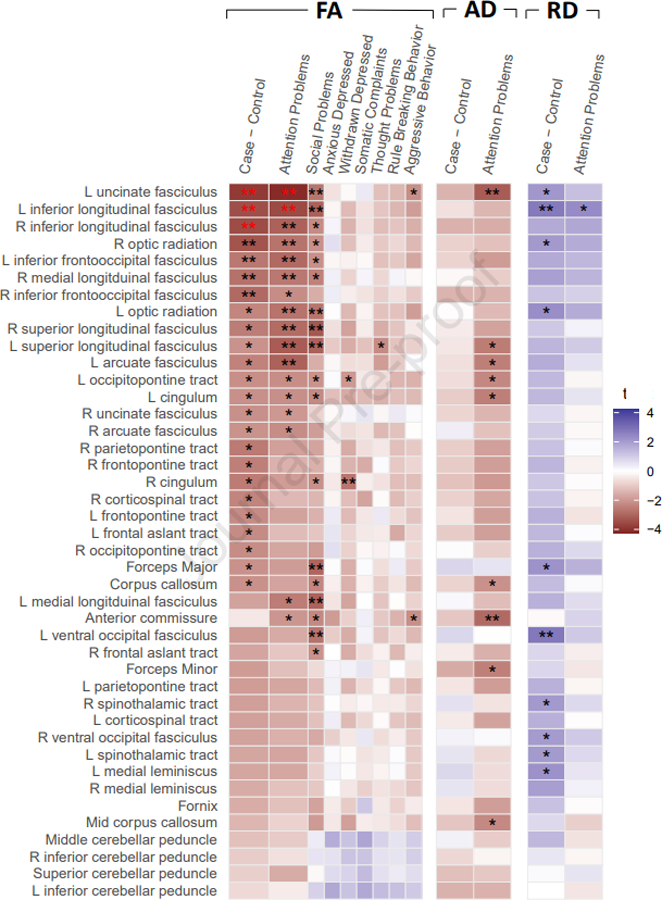
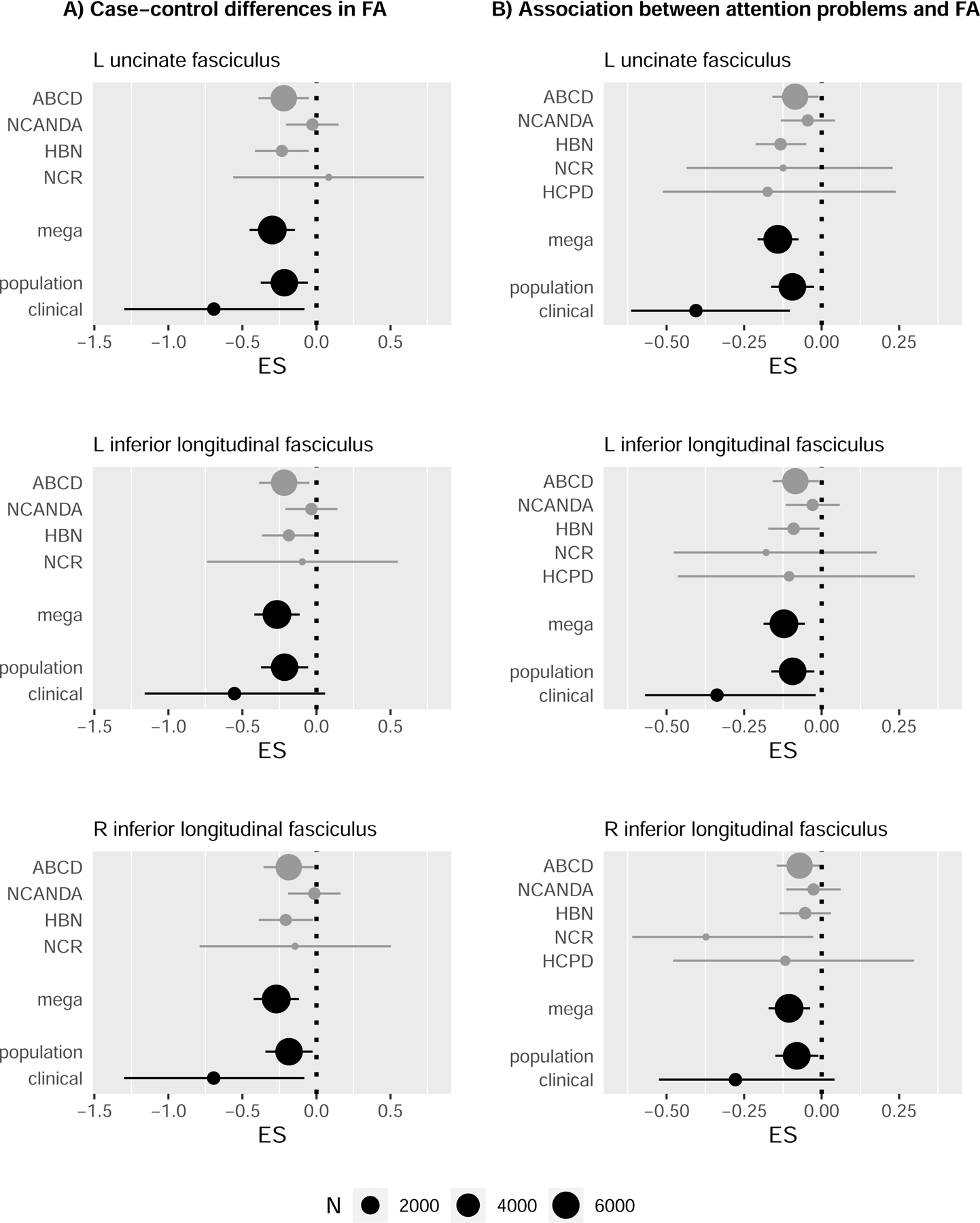
Results: Overall, 6993 participants (ages 6-18 years, mean age 10.62 years [SD 1.99]; 3368 girls, 3625 boys; 764 African American, 4146 non-Hispanic White, and 2083 other race/ethnicities) had measures of ADHD and other emotional/behavioral symptoms (N = 6933) and/or enough clinical data to allow a diagnosis of ADHD (n = 951) or its absence (n = 4884). Both the diagnosis and symptoms of ADHD were associated with lower fractional anisotropy of the inferior longitudinal and left uncinate fasciculi (at a false discovery rate-adjusted p < .05). Associated effect sizes were small (the strongest association with ADHD traits had an effect size of partial r = -0.14, while the largest case-control difference was associated with an effect size of d = -0.3). Similar microstructural anomalies were not present for anxiety, mood, or externalizing problems. Findings held when ADHD cases and control subjects were matched on in-scanner motion.
Conclusions: While present across cohorts, ADHD-associated microstructural differences had small effects, underscoring the limited clinical utility of this imaging modality used in isolation.
Trial registration: ClinicalTrials.gov NCT01721720.
Keywords: ADHD; Big data; Diffusion tensor imaging; Fractional anisotropy; Mega-analysis; White matter tracts.
Published by Elsevier Inc.
Conflict of interest statement
Figures
References
-
- van Ewijk H, Heslenfeld DJ, Zwiers MP, Buitelaar JK, Oosterlaan J (2012): Diffusion tensor imaging in attention deficit/hyperactivity disorder: A systematic review and meta-analysis. Neuroscience & Biobehavioral Reviews 36:1093–1106. - PubMed
-
- Aoki Y, Cortese S, Castellanos FX (2018): Research Review: Diffusion tensor imaging studies of attention‐deficit/hyperactivity disorder: meta‐analyses and reflections on head motion. Journal of Child Psychology and Psychiatry 59:193–202. - PubMed
-
- Chen L, Hu X, Ouyang L, He N, Liao Y, Liu Q, et al. (2016): A systematic review and meta-analysis of tract-based spatial statistics studies regarding attention-deficit/hyperactivity disorder. Neurosci Biobehav Rev 68:838–847. - PubMed
Publication types
MeSH terms
Associated data
Grants and funding
- Z99 HG999999/ImNIH/Intramural NIH HHS/United States
- U24 DA041147/DA/NIDA NIH HHS/United States
- U01 DA051039/DA/NIDA NIH HHS/United States
- U01 AA021696/AA/NIAAA NIH HHS/United States
- U01 DA051018/DA/NIDA NIH HHS/United States
- U01 AA021681/AA/NIAAA NIH HHS/United States
- U24 DA041123/DA/NIDA NIH HHS/United States
- U01 AA021695/AA/NIAAA NIH HHS/United States
- U01 AA021692/AA/NIAAA NIH HHS/United States
- U01 DA051037/DA/NIDA NIH HHS/United States
- U01 DA051016/DA/NIDA NIH HHS/United States
- U01 DA041148/DA/NIDA NIH HHS/United States
- U01 AA021697/AA/NIAAA NIH HHS/United States
- U01 DA041174/DA/NIDA NIH HHS/United States
- U01 DA041120/DA/NIDA NIH HHS/United States
- U24 AA021697/AA/NIAAA NIH HHS/United States
- U01 DA041093/DA/NIDA NIH HHS/United States
- U01 MH109589/MH/NIMH NIH HHS/United States
- U01 AA021691/AA/NIAAA NIH HHS/United States
- U01 DA051038/DA/NIDA NIH HHS/United States
- ZIA HG200378/ImNIH/Intramural NIH HHS/United States
- U01 DA041134/DA/NIDA NIH HHS/United States
- U01 DA041022/DA/NIDA NIH HHS/United States
- U01 DA041156/DA/NIDA NIH HHS/United States
- U01 DA050987/DA/NIDA NIH HHS/United States
- U01 DA041025/DA/NIDA NIH HHS/United States
- U01 DA050989/DA/NIDA NIH HHS/United States
- U01 DA041089/DA/NIDA NIH HHS/United States
- U01 DA050988/DA/NIDA NIH HHS/United States
- U01 AA021690/AA/NIAAA NIH HHS/United States
- U01 DA041106/DA/NIDA NIH HHS/United States
- U24 AA021695/AA/NIAAA NIH HHS/United States
- U01 DA041117/DA/NIDA NIH HHS/United States
- U01 DA041028/DA/NIDA NIH HHS/United States
- U01 DA041048/DA/NIDA NIH HHS/United States
LinkOut - more resources
Full Text Sources
Medical
