


Perceptions of Water Safety and Tap Water Taste and Their Associations With Beverage Intake Among U.S. Adults
- PMID: 36609168
- PMCID: PMC10239313
- DOI: 10.1177/08901171221150093
Perceptions of Water Safety and Tap Water Taste and Their Associations With Beverage Intake Among U.S. Adults
Abstract
Objectives: Examine differences in perceptions of tap water (TW) and bottled water (BW) safety and TW taste and their associations with plain water (PW) and sugar-sweetened beverage (SSB) intake.
Design: Quantitative, cross-sectional study.
Setting: United States.
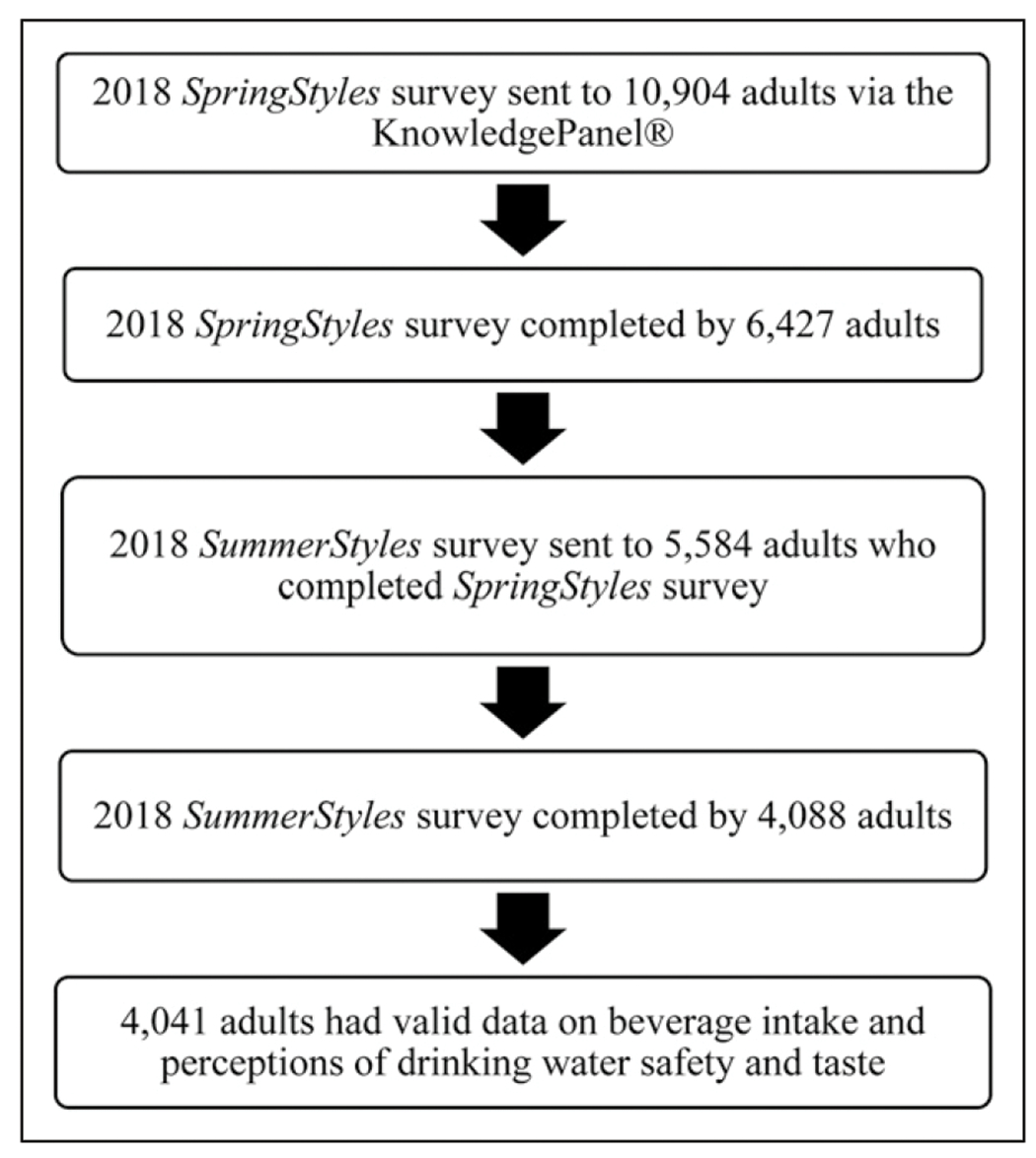
Subjects: 4,041 U.S. adults (≥18 years) in the 2018 SummerStyles survey data.
Measures: Outcomes were intake of TW, BW, PW (tap and bottled water), and SSB. Exposures were perceptions of TW and BW safety and TW taste (disagree, neutral, or agree). Covariates included sociodemographics.
Analysis: We used chi-square analysis to examine sociodemographic differences in perceptions and multivariable logistic regressions to estimate adjusted odds ratios (AOR) for consuming TW ≤ 1 cup/day, BW > 1 cup/day, PW ≤ 3 cups/day, and SSB ≥ 1 time/day by water perceptions.
Results: One in 7 (15.1%) of adults did not think their home TW was safe to drink, 39.0% thought BW was safer than TW, and 25.9% did not think their local TW tasted good. Adults who did not think local TW was safe to drink had higher odds of drinking TW ≤ 1 cup/day (AOR = 3.12) and BW >1 cup/day (AOR = 2.69). Adults who thought BW was safer than TW had higher odds of drinking TW ≤1 cup/day (AOR = 2.38), BW > 1 cup/day (AOR = 5.80), and SSB ≥ 1 time/day (AOR = 1.39). Adults who did not think TW tasted good had higher odds of drinking TW ≤ 1 cup/day (AOR = 4.39) and BW > 1 cup/day (AOR = 2.91).
Conclusions: Negative perceptions of TW safety and taste and a belief BW is safer than TW were common and associated with low TW intake. Perceiving BW is safer than TW increased the likelihood of daily SSB intake. These findings can guide programs and services to support water quality to improve perceptions of TW safety and taste, which might increase TW intake and decrease SSB intake.
Keywords: bottled water; characteristics; plain water; sociodemographic; sugar-sweetened beverages; tap water; water perception.
Conflict of interest statement
Declaration of Conflicting Interests
The author(s) declared no potential conflicts of interest with respect to the research, authorship, and/or publication of this article.
Figures
References
-
- Hernández-Cordero S, Barquera S, Rodríguez-Ramírez S, et al. Substituting water for sugar-sweetened beverages reduces circulating triglycerides and the prevalence of metabolic syndrome in obese but not in overweight Mexican women in a randomized controlled trial. J Nutr. 2014;144(11):1742–1752. - PMC - PubMed
-
- An R, McCaffrey J. Plain water consumption in relation to energy intake and diet quality among US adults, 2005-2012. J Hum Nutr Diet. 2016;29(5):624–632. - PubMed
-
- U.S. Department of Agriculture U.S. Department of Health and Human Services. Dietary Guidelines for Americans, 2020-2025. 9th Edition; 2020. https://www.dietaryguidelines.gov/sites/default/files/2020-12/Dietary_Gu....
-
- Bowman SA, Clemens JC, Friday JE, LaComb RP, Paudel D, Shimizu M, Added sugars in adults’ diet: what we eat in America, NHANES 2015-2016. Food Surveys Research Group. Dietary Data Brief No 24; 2019.
MeSH terms
Substances
Grants and funding
LinkOut - more resources
Full Text Sources
Medical
Miscellaneous
