. 2023 Mar:268:119867.
doi: 10.1016/j.neuroimage.2023.119867. Epub 2023 Jan 5.

Whose emotion is it? Perspective matters to understand brain-body interactions in emotions

Affiliations

Whose emotion is it? Perspective matters to understand brain-body interactions in emotions

Tahnée Engelen et al. Neuroimage. 2023 Mar.

Abstract

Feeling happy, or judging whether someone else is feeling happy are two distinct facets of emotions that nevertheless rely on similar physiological and neural activity. Differentiating between these two states, also called Self/Other distinction, is an essential aspect of empathy, but how exactly is it implemented? In non-emotional cognition, the transient neural response evoked at each heartbeat, or heartbeat evoked response (HER), indexes the self and signals Self/Other distinction. Here, using electroencephalography (n = 32), we probe whether HERs' role in Self/Other distinction extends also to emotion - a domain where brain-body interactions are particularly relevant. We asked participants to rate independently validated affective scenes, reporting either their own emotion (Self) or the emotion expressed by people in the scene (Other). During the visual cue indicating to adopt the Self or Other perspective, before the affective scene, HERs distinguished between the two conditions, in visual cortices as well as in the right frontal operculum. Physiological reactivity (facial electromyogram, skin conductance, heart rate) during affective scene co-varied as expected with valence and arousal ratings, but also with the Self- or Other- perspective adopted. Finally, HERs contributed to the subjective experience of valence in the Self condition, in addition to and independently from physiological reactivity. We thus show that HERs represent a trans-domain marker of Self/Other distinction, here specifically contributing to experienced valence. We propose that HERs represent a form of evidence related to the 'I' part of the judgement 'To which extent do I feel happy'. The 'I' related evidence would be combined with the affective evidence collected during affective scene presentation, accounting at least partly for the difference between feeling an emotion and identifying it in someone else.

Keywords: Electroencephalography; Emotion; Empathy; Heartbeat evoked responses; Interoception; Self/other distinction.


Conflict of interest statement

Declaration of Competing Interest The authors declare no conflict of interest.

Figures
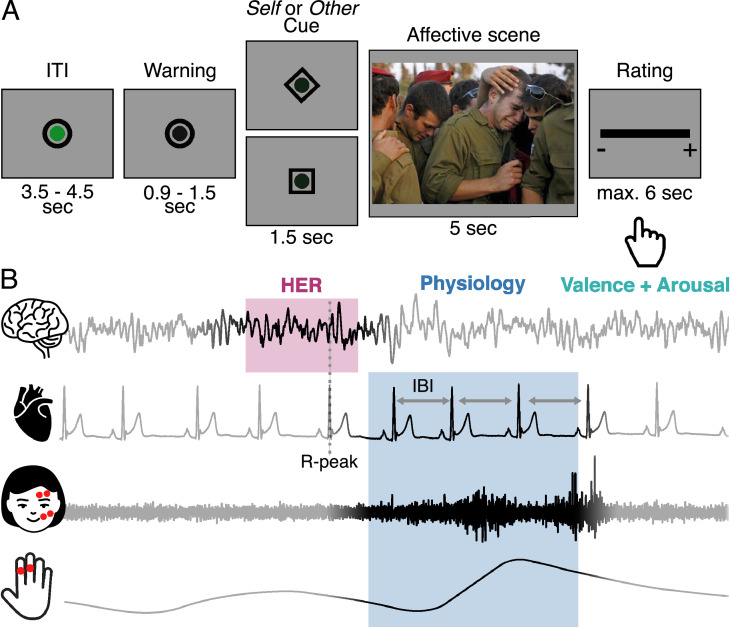
Fig 1
Fig. 1
Experimental paradigm. (A) Time course of a trial. At each trial participants were shown a symbolic cue instructing them to rate the upcoming affective scene for either their own emotion (Self condition), or the emotion of the person(s) in the image (Other condition). After stimulus presentation, participants rated valence and arousal on two successively presented continuous scales (only one displayed, order counterbalanced between participants). (B) Data acquired and rationale for data analysis. We recorded the electroencephalogram (EEG), the electrocardiogram (ECG), facial electromyogram (fEMG) of the zygomatic and corrugator muscles and skin conductance phasic response (SCR), as well as participants’ ratings. We analysed Heartbeats Evoked Responses (HERs) during cue, physiological responses (Interbeat Interval, IBI, fEMG and SCR) during affective scene presentation, and valence and arousal ratings provided by the participant at the end of each trial, on two successive scales. EEG was corrupted with saccades during stimulus presentation, during which participants were free to explore the visual scene, analysis of HERs was restricted to the time window before the onset of the images.
Fig 2
Fig. 2
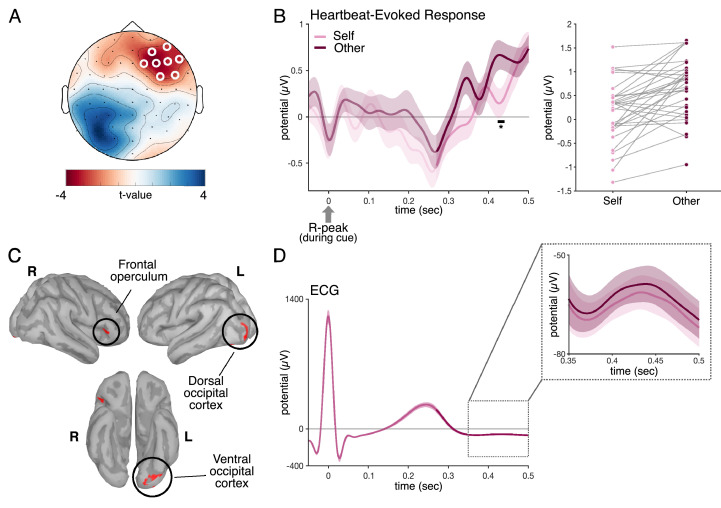
HERs during cue distinguish between Self and Other condition. (A) Topography of the cluster during which there was a significant HER difference between Self/Other condition, in the time window between 426 and 436 ms after R-peak during the cue window. (B) Timeseries of the HER in the Self and Other condition, averaged across electrodes depicted in (A) and across participants. Right panel shows individual averages for the Self and Other condition within the significant time window. (C) Brain regions mostly contributing to the Self/Other difference in the HER were localized to the frontal operculum, and dorsal and ventral occipital cortex (threshold at uncorrected p < 0.005 in a minimum of 13 adjacent vertices). (D) Time series of the Self/Other difference in the ECG. This control analysis revealed no significant differences in the ECG signal between the two conditions. Shaded areas represent the standard error of the mean.
Fig 3
Fig. 3
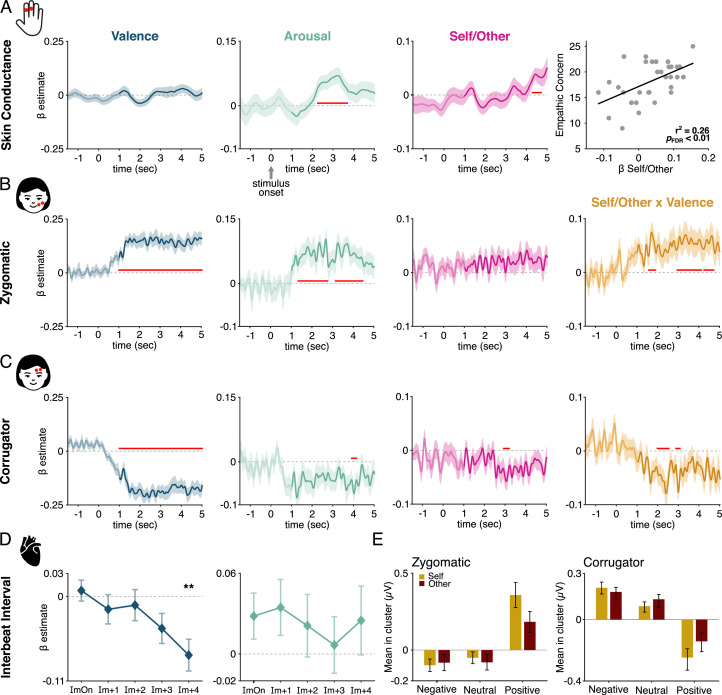
Modelling of trial-by-trial fluctuations in physiological reactivity with valence ratings, arousal ratings, Self/Other condition and interactions. (A) Skin conductance response. The first three panels show the time-course of the estimated model parameters (beta) for valence, arousal and Self/Other condition. Solid lines represent grand-average across participants and shaded areas correspond to standard error of the mean. Time-windows where those parameters significantly differed from zero are indicated in red (cluster-based permutation procedure correcting for multiple comparisons over time, Monte-Carlo p < 0.05). SCR fluctuations across trials were accounted for by arousal ratings, as expected, but also in a later time-window by the Self/Other condition. The Self/Other effect in SCR significantly accounted for 26% of variance in the Empathic Concern score measured with the IRI questionnaire. (B) Zygomatic activity was accounted for by both valence and arousal in a sustained manner throughout affective scene presentation, as well as by an interaction between Self/Other condition and valence which was significant in three transient time-windows. (C) Corrugator activity scaled negatively with valence (i.e., more contraction for negative valence) in a sustained manner, and briefly scaled negatively with arousal and Self/Other condition. Corrugator activity is also accounted for by the interaction between Self/Other condition and valence. (D) Interbeat intervals (IBIs) were measured from the IBI around Image Onset (ImOn) to the next subsequent ones (Im+1 to Im+4). IBIs were shorter for negative images, at the end of the affective scene presentations (repeated measure ANOVA, main effect of Time on the valence parameter estimate, IBIIm+4 t(1,31) = −3.69, pFDR = 0.004, BF10 = 37.05). (E) Zygomatic and corrugator activity binned for valence (negative, neutral, positive) separately for Self and Other shows that, particularly for positive valence, there are stronger contractions/relaxations when the Self perspective is adopted. Details on latencies of each cluster are provided in Table 1.
Fig 4
Fig. 4
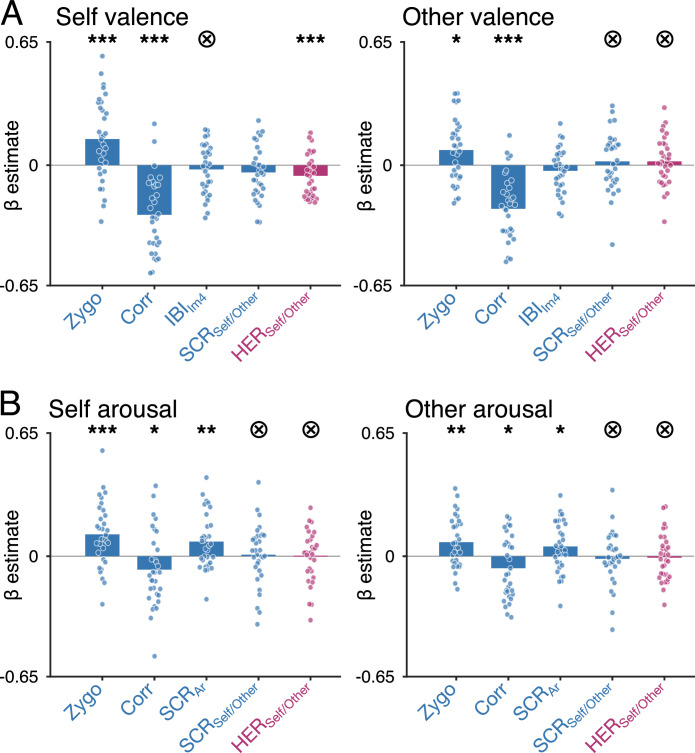
HERs before affective scene presentation account for valence ratings in the Self condition. (A) Parameter estimates of models accounting for valence ratings, in the Self (left) and Other (right) conditions. HERs significantly contribute to valence ratings in the Self condition, but do not contribute to valence ratings in the Other condition. (B) Parameter estimates of models accounting for arousal ratings, in the Self (left) and Other (right) conditions. HERs do not significantly contribute to arousal ratings, neither in the Self nor in the Other condition. ***: p < 0.001, **: p < 0.01, *: p < 0.05, ⊗: BF10 < 0.33, indicating moderate evidence for the null hypothesis.

References

    1. Al E., Iliopoulos F., Forschack N., Nierhaus T., Grund M., Motyka P.…Villringer A. Heart-brain interactions shape somatosensory perception and evoked potentials. Proc. Natl. Acad. Sci. U.S.A. 2020;117(29):17448. doi: 10.1073/pnas.2012463117. - DOI - PMC - PubMed
    1. Al E., Iliopoulos F., Nikulin V.V., Villringer A. Heartbeat and somatosensory perception. Neuroimage. 2021;238(June) doi: 10.1016/j.neuroimage.2021.118247. - DOI - PubMed
    1. Azzalini D., Buot A., Palminteri S., Tallon-Baudry C. Responses to heartbeats in ventromedial prefrontal cortex contribute to subjective preference-based decisions. J. Neurosci. 2021;41(23):5102–5114. doi: 10.1523/JNEUROSCI.1932-20.2021. - DOI - PMC - PubMed
    1. Azzalini D., Rebollo I., Tallon-Baudry C. Visceral signals shape brain dynamics and cognition. Trends Cogn. Sci. 2019;23(6):488–509. doi: 10.1016/j.tics.2019.03.007. (Regul. Ed.) - DOI - PubMed
    1. Babo-Rebelo M., Buot A., Tallon-Baudry C. Neural responses to heartbeats distinguish self from other during imagination. Neuroimage. 2019;191(January):10–20. doi: 10.1016/j.neuroimage.2019.02.012. - DOI - PMC - PubMed

Publication types