


Arf-like Protein 2 (ARL2) Controls Microtubule Neogenesis during Early Postnatal Photoreceptor Development
- PMID: 36611941
- PMCID: PMC9818799
- DOI: 10.3390/cells12010147
Arf-like Protein 2 (ARL2) Controls Microtubule Neogenesis during Early Postnatal Photoreceptor Development
Abstract
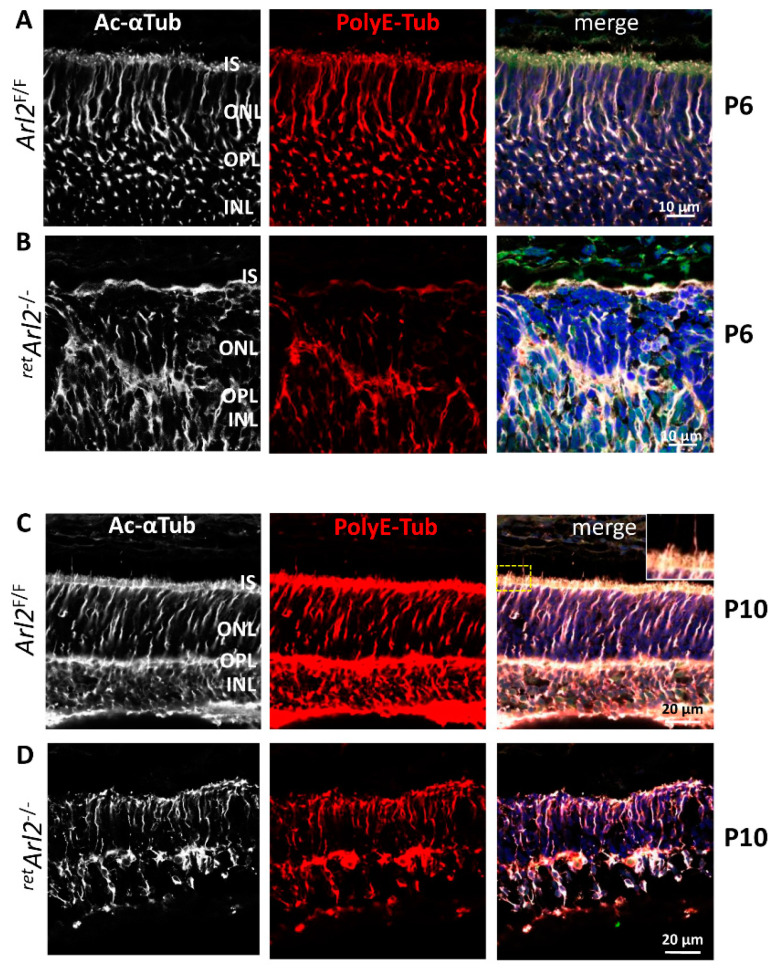
Arf-like protein 2 (ARL2) is a ubiquitously expressed small GTPase with multiple functions. In a cell culture, ARL2 participates with tubulin cofactor D (TBCD) in the neogenesis of tubulin αβ-heterodimers, the building blocks of microtubules. To evaluate this function in the retina, we conditionally deleted ARL2 in mouse retina at two distinct stages, either during the embryonic development (retArl2-/-) or after ciliogenesis specifically in rods (rodArl2-/-). retArl2-/- retina sections displayed distorted nuclear layers and a disrupted microtubule cytoskeleton (MTC) as early as postnatal day 6 (P6). Rod and cone outer segments (OS) did not form. By contrast, the rod ARL2 knockouts were stable at postnatal day 35 and revealed normal ERG responses. Cytoplasmic dynein is reduced in retArl2-/- inner segments (IS), suggesting that dynein may be unstable in the absence of a normal MTC. We investigated the microtubular stability in the absence of either ARL2 (retARL2-/-) or DYNC1H1 (retDync1h1-/-), the dynein heavy chain, and found that both the retArl2-/- and retDync1h1-/- retinas exhibited reduced microtubules and nuclear layer distortion. The results suggest that ARL2 and dynein depend on each other to generate a functional MTC during the early photoreceptor development.
Keywords: Arf-like protein 2 (ARL2); dynein heavy chain (DYNC1H1); microtubule cytoskeleton (MTC); retina; rod photoreceptors; tubulin αβ-heterodimers.
Conflict of interest statement
The authors declare no conflict of interest.
Figures



References
-
- Cavenagh M.M., Breiner M., Schurmann A., Rosenwald A.G., Terui T., Zhang C., Randazzo P.A., Adams M., Joost H.G., Kahn R.A. ADP-ribosylation factor (ARF)-like 3, a new member of the ARF family of GTP-binding proteins cloned from human and rat tissues. J. Biol. Chem. 1994;269:18937–18942. doi: 10.1016/S0021-9258(17)32257-3. - DOI - PubMed
-
- Schurmann A., Breiner M., Becker W., Huppertz C., Kainulainen H., Kentrup H., Joost H.G. Cloning of two novel ADP-ribosylation factor-like proteins and characterization of their differential expression in 3T3-L1 cells. J. Biol. Chem. 1994;269:15683–15688. doi: 10.1016/S0021-9258(17)40735-6. - DOI - PubMed
Publication types
MeSH terms
Substances
Grants and funding
LinkOut - more resources
Full Text Sources
Molecular Biology Databases
Research Materials
