Review
. 2022 Dec 22;15(1):52.
doi: 10.3390/cancers15010052.

Highlights on the Role of Galectin-3 in Colorectal Cancer and the Preventive/Therapeutic Potential of Food-Derived Inhibitors

Affiliations
Review

Highlights on the Role of Galectin-3 in Colorectal Cancer and the Preventive/Therapeutic Potential of Food-Derived Inhibitors

Anna Aureli et al. Cancers (Basel). .

Abstract

Colorectal cancer (CRC) is a leading cause of death worldwide. Despite advances in surgical and therapeutic management, tumor metastases and resistance to therapy still represent major hurdles. CRC risk is highly modifiable by lifestyle factors, including diet, which strongly influences both cancer incidence and related mortality. Galectin-3 (Gal-3) is a multifaceted protein involved in multiple pathophysiological pathways underlying chronic inflammation and cancer. Its versatility is given by the ability to participate in a wide range of tumor-promoting processes, including cell-cell/cell-matrix interactions, cell growth regulation and apoptosis, and the immunosuppressive tumor microenvironment. This review provides an updated summary of preclinical and observational human studies investigating the pathogenetic role of Gal-3 in intestinal inflammation and CRC, as well as the potential of Gal-3 activity inhibition by plant-source food-derived bioactive compounds to control CRC onset/growth. These studies highlight both direct and immuno-mediated effects of Gal-3 on tumor growth and invasiveness and its potential role as a CRC prognostic biomarker. Substantial evidence indicates natural food-derived Gal-3 inhibitors as promising candidates for CRC prevention and therapy. However, critical issues, such as their bioavailability and efficacy, in controlled human studies need to be addressed to translate research progress into clinical applications.

Keywords: bioactive food compounds; colorectal cancer; galectin-3; immunosuppression; intestinal inflammation; non-digestible carbohydrates; polyphenols; tumor microenvironment.


Conflict of interest statement

The authors declare no conflict of interest.

Figures
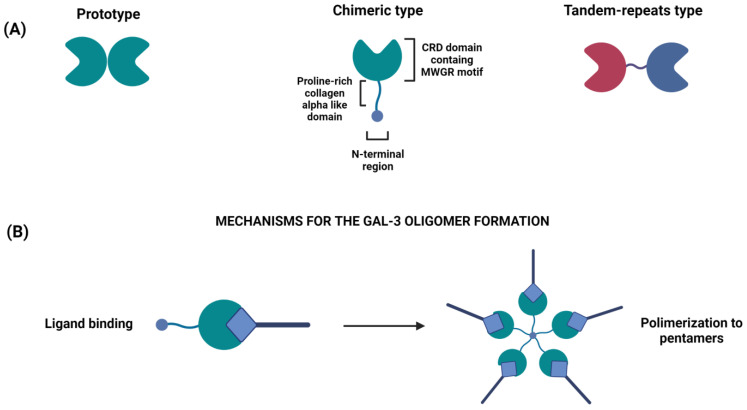
Figure 1
Figure 1
(A) Classification of the different types of galectins: prototype (Gal-1, -2, -5,-7,- 20,-11, -13, -14, -15 and -16), chimeric type (Gal-3), tandem-repeat type (Gal-4, -6,-8,-9 and -12). Prototype galectins have one CRD that can dimerize; tandem-repeat galectins have two different CRDs (red and blue colors are used to distinguish them) linked by a linker domain; chimera-type galectin (Gal-3) has a single C-terminal CRD and a N-terminal oligomerization domain. (B) Gal-3 oligomerization: upon oligosaccharide binding by the C-terminal domain, the non-lectin domains of Gal-3 oligomerize, thereby cross-linking ligands of the cell surface.
Figure 2
Figure 2
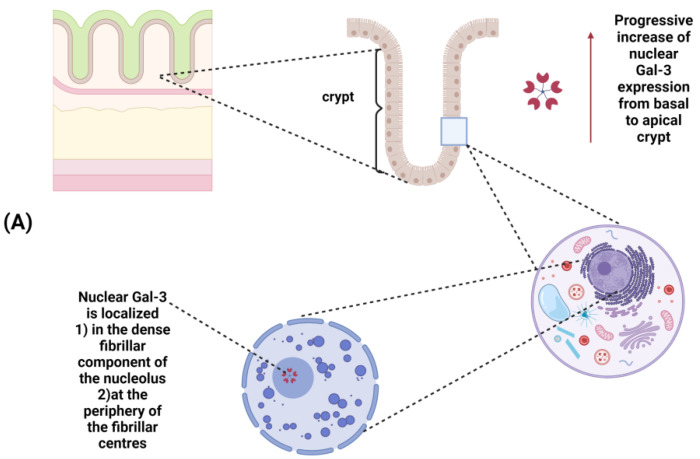
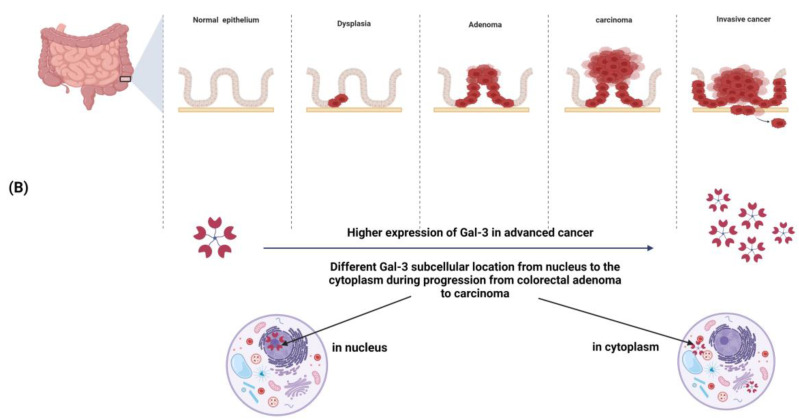
(A) Galectin-3 expression in normal colonic mucosa: a progressive increase in Gal-3 expression occurs from the basal to the apical side of the crypt; within the nucleus, Gal-3 is localized in the dense fibrillar components of the nucleolus as well as in the periphery of the fibrillar centers.(B) Changes in Gal-3 expression and/or subcellular localization during colorectal cancer progression: Gal-3 expression is increased in advanced cancer. A different subcellular localization (from the nucleus to the cytoplasm) is observed during progression from colorectal adenoma to carcinoma.
Figure 2
Figure 2
(A) Galectin-3 expression in normal colonic mucosa: a progressive increase in Gal-3 expression occurs from the basal to the apical side of the crypt; within the nucleus, Gal-3 is localized in the dense fibrillar components of the nucleolus as well as in the periphery of the fibrillar centers.(B) Changes in Gal-3 expression and/or subcellular localization during colorectal cancer progression: Gal-3 expression is increased in advanced cancer. A different subcellular localization (from the nucleus to the cytoplasm) is observed during progression from colorectal adenoma to carcinoma.
Figure 3
Figure 3
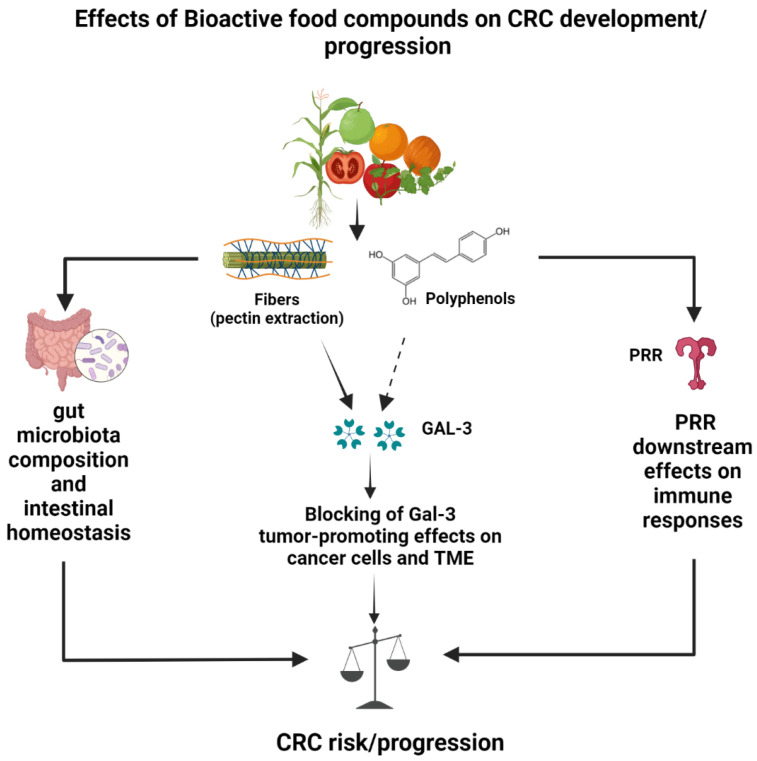
Schematic model of galectin-3-dependent and -independent effects of dietary fibers and polyphenols potentially leading to reduced CRC risk and progression. Galectin-3-independent protective effects occur through modulation of gut microbiota and attenuation of inflammatory responses induced by pattern recognition receptor (PRR) triggering in immune cells. Galectin-3-dependent protective effects on CRC have been demonstrated for pectin (full arrow) and, so far, only suggested for polyphenols (dotted arrow).

References

    1. Arnold M., Sierra M.S., Laversanne M., Soerjomataram I., Jemal A., Bray F. Global Patterns and Trends in Colorectal Cancer Incidence and Mortality. Gut. 2017;66:683–691. doi: 10.1136/gutjnl-2015-310912. - DOI - PubMed
    1. Sung H., Ferlay J., Siegel R.L., Laversanne M., Soerjomataram I., Jemal A., Bray F. Global Cancer Statistics 2020: GLOBOCAN Estimates of Incidence and Mortality Worldwide for 36 Cancers in 185 Countries. CA Cancer. J. Clin. 2021;71:209–249. doi: 10.3322/caac.21660. - DOI - PubMed
    1. Pan X., Wang H., Zheng Z., Huang X., Yang L., Liu J., Wang K., Zhang Y. Pectic Polysaccharide from Smilax China L. Ameliorated Ulcerative Colitis by Inhibiting the Galectin-3/NLRP3 Inflammasome Pathway. Carbohydr. Polym. 2022;277:118864. doi: 10.1016/j.carbpol.2021.118864. - DOI - PubMed
    1. Zhou E., Rifkin S. Colorectal Cancer and Diet: Risk Versus Prevention, is Diet an Intervention? Gastroenterol. Clin. North Am. 2021;50:101–111. doi: 10.1016/j.gtc.2020.10.012. - DOI - PubMed
    1. Morrow L., Greenwald B. Healthy Food Choices, Physical Activity, and Screening Reduce the Risk of Colorectal Cancer. Gastroenterol. Nurs. 2022;45:113–119. doi: 10.1097/SGA.0000000000000615. - DOI - PubMed

LinkOut - more resources