Review
. 2022 Dec 21;24(1):65.
doi: 10.3390/ijms24010065.

p53 Family in Resistance to Targeted Therapy of Melanoma

Affiliations
Review

p53 Family in Resistance to Targeted Therapy of Melanoma

Ignacija Vlašić et al. Int J Mol Sci. .

Abstract

Metastatic melanoma is one of the most aggressive tumors, with frequent mutations affecting components of the MAPK pathway, mainly protein kinase BRAF. Despite promising initial response to BRAF inhibitors, melanoma progresses due to development of resistance. In addition to frequent reactivation of MAPK or activation of PI3K/AKT signaling pathways, recently, the p53 pathway has been shown to contribute to acquired resistance to targeted MAPK inhibitor therapy. Canonical tumor suppressor p53 is inactivated in melanoma by diverse mechanisms. The TP53 gene and two other family members, TP63 and TP73, encode numerous protein isoforms that exhibit diverse functions during tumorigenesis. The p53 family isoforms can be produced by usage of alternative promoters and/or splicing on the C- and N-terminus. Various p53 family isoforms are expressed in melanoma cell lines and tumor samples, and several of them have already shown to have specific functions in melanoma, affecting proliferation, survival, metastatic potential, invasion, migration, and response to therapy. Of special interest are p53 family isoforms with increased expression and direct involvement in acquired resistance to MAPK inhibitors in melanoma cells, implying that modulating their expression or targeting their functional pathways could be a potential therapeutic strategy to overcome resistance to MAPK inhibitors in melanoma.

Keywords: MAPK inhibitors; melanoma; p53; p53 family isoforms; p63; p73; resistance.


Conflict of interest statement

The authors declare no conflict of interest.

Figures
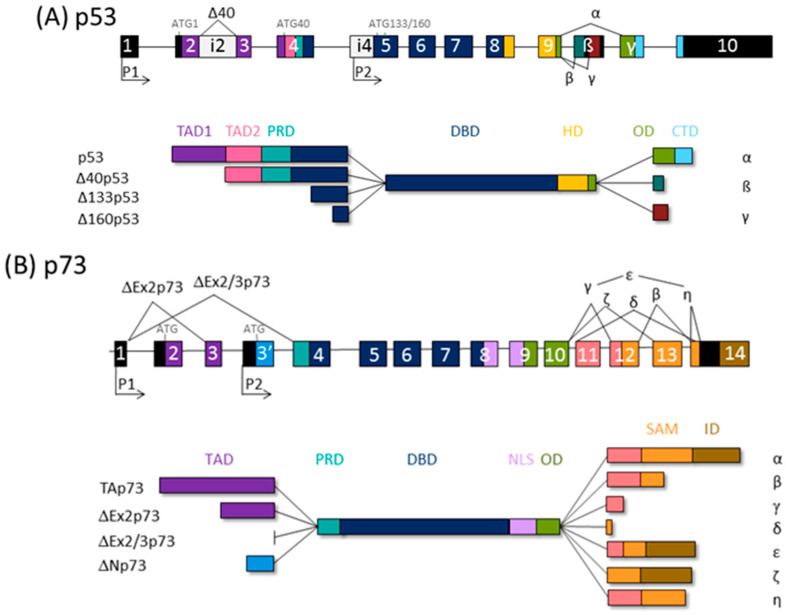
Figure 1
Figure 1
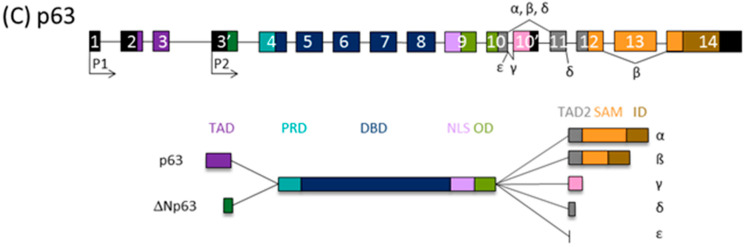
The p53 family gene architecture and generation of the protein isoforms. The scheme of the (A) human TP53, (B) TP73, and (C) TP63 gene (upper) and protein (lower panels). TAD, transactivation domain; PRD, proline-rich domain; DBD, DNA binding domain; ID, inhibitory domain; HD, hinge domain; NLS, nuclear localization signal: OD, oligomerization domain; CTD, C-terminal domain; SAM, sterile alpha motif; ID, inhibitory domain (model adapted from [39]).
Figure 1
Figure 1
The p53 family gene architecture and generation of the protein isoforms. The scheme of the (A) human TP53, (B) TP73, and (C) TP63 gene (upper) and protein (lower panels). TAD, transactivation domain; PRD, proline-rich domain; DBD, DNA binding domain; ID, inhibitory domain; HD, hinge domain; NLS, nuclear localization signal: OD, oligomerization domain; CTD, C-terminal domain; SAM, sterile alpha motif; ID, inhibitory domain (model adapted from [39]).
Figure 2
Figure 2
Genetic alterations of TP53, TP63, BRAF, and NRAS in 696 melanoma patients/samples (downloaded data from cBioPortal Oncoprint view, https://www.cbioportal.org/, accessed on 27 October 2022) [56,57,58].
Figure 3
Figure 3
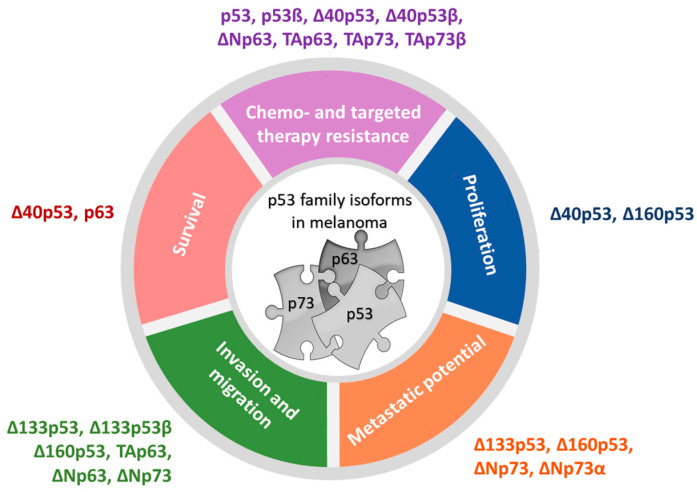
Biological functions of p53 family isoforms in melanoma (model adapted from [39]).

References

    1. Saginala K., Barsouk A., Aluru J., Rawla P., Barsouk A. Epidemiology of Melanoma. Med. Sci. 2021;9:63. doi: 10.3390/medsci9040063. - DOI - PMC - PubMed
    1. Reddy B.Y., Miller D.M., Tsao H. Somatic Driver Mutations in Melanoma. Cancer. 2017;123:2104–2117. doi: 10.1002/cncr.30593. - DOI - PubMed
    1. Hawryluk E.B., Tsao H. Melanoma: Clinical Features and Genomic Insights. Cold Spring Harb. Perspect. Med. 2014;4:a015388. doi: 10.1101/cshperspect.a015388. - DOI - PMC - PubMed
    1. Hodis E., Watson I.R., Kryukov G.V., Arold S.T., Imielinski M., Theurillat J.P., Nickerson E., Auclair D., Li L., Place C., et al. A Landscape of Driver Mutations in Melanoma. Cell. 2012;150:251–263. doi: 10.1016/j.cell.2012.06.024. - DOI - PMC - PubMed
    1. Davies H., Bignell G.R., Cox C., Stephens P., Edkins S., Clegg S., Teague J., Woffendin H., Garnett M.J., Bottomley W., et al. Mutations of the BRAF Gene in Human Cancer. Nature. 2002;417:949–954. doi: 10.1038/nature00766. - DOI - PubMed

MeSH terms

Substances