


Application of In Vitro Plant Tissue Culture Techniques to Halophyte Species: A Review
- PMID: 36616255
- PMCID: PMC9824063
- DOI: 10.3390/plants12010126
Application of In Vitro Plant Tissue Culture Techniques to Halophyte Species: A Review
Abstract
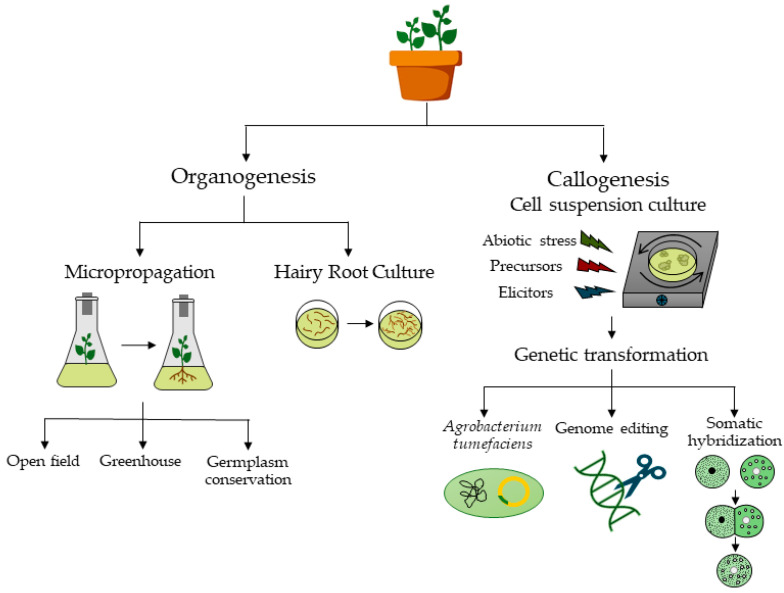
Halophytes are plants able to thrive in environments characterized by severe abiotic conditions, including high salinity and high light intensity, drought/flooding, and temperature fluctuations. Several species have ethnomedicinal uses, and some are currently explored as sources of food and cosmetic ingredients. Halophytes are considered important alternative cash crops to be used in sustainable saline production systems, due to their ability to grow in saline conditions where conventional glycophyte crops cannot, such as salt-affected soils and saline irrigation water. In vitro plant tissue culture (PTC) techniques have greatly contributed to industry and agriculture in the last century by exploiting the economic potential of several commercial crop plants. The application of PTC to selected halophyte species can thus contribute for developing innovative production systems and obtaining halophyte-based bioactive products. This work aimed to put together and review for the first time the most relevant information on the application of PTC to halophytes. Several protocols were established for the micropropagation of different species. Various explant types have been used as starting materials (e.g., basal shoots and nodes, cotyledons, epicotyls, inflorescence, internodal segments, leaves, roots, rhizomes, stems, shoot tips, or zygotic embryos), involving different micropropagation techniques (e.g., node culture, direct or indirect shoot neoformation, caulogenesis, somatic embryogenesis, rooting, acclimatization, germplasm conservation and cryopreservation, and callogenesis and cell suspension cultures). In vitro systems were also used to study physiological, biochemical, and molecular processes in halophytes, such as functional and salt-tolerance studies. Thus, the application of PTC to halophytes may be used to improve their controlled multiplication and the selection of desired traits for the in vitro production of plants enriched in nutritional and functional components, as well as for the study of their resistance to salt stress.
Keywords: biochemical applications; callogenesis; caulogenesis; micropropagation; plant biotechnology; salt-tolerant plants; somatic embryogenesis; suspension cultures; transgenesis.
Conflict of interest statement
The authors declare no conflict of interest.
Figures
References
-
- Custódio M., Villasante S., Cremades J., Calado R., Lillebø A.I. Unravelling the potential of halophytes for marine integrated multi-trophic aquaculture (IMTA) a perspective on performance, opportunities and challenges. Aquac. Environ. Interact. 2017;9:445–460. doi: 10.3354/aei00244. - DOI
-
- Hasanuzzaman M., Shabala S., Fujita M. Halophytes and Climate Change: Adaptive Mechanisms and Potential Uses. CABI Digital Library; Dhaka, Bangladesh: 2019. p. 408.
-
- Gulzar B., Mujib A., Qadir Malik M., Mamgain J., Syeed R., Zafar N. Transgenic Technology Based Value Addition in Plant Biotechnology. Elsevier; Amsterdam, The Netherlands: 2020. Plant tissue culture: Agriculture and industrial applications; pp. 25–49.
Publication types
Grants and funding
LinkOut - more resources
Full Text Sources
