


Systemic oncological treatments in patients with advanced pancreatic cancer: a scoping review and evidence map
- PMID: 36622453
- PMCID: PMC9829581
- DOI: 10.1007/s00520-022-07564-8
Systemic oncological treatments in patients with advanced pancreatic cancer: a scoping review and evidence map
Abstract
Purpose: To identify, describe, and organise currently available evidence regarding systemic oncological treatments (SOTs) (chemotherapy, targeted/biological therapies, and immunotherapy) compared to best supportive care (BSC) for patients with advanced pancreatic cancer (PC).
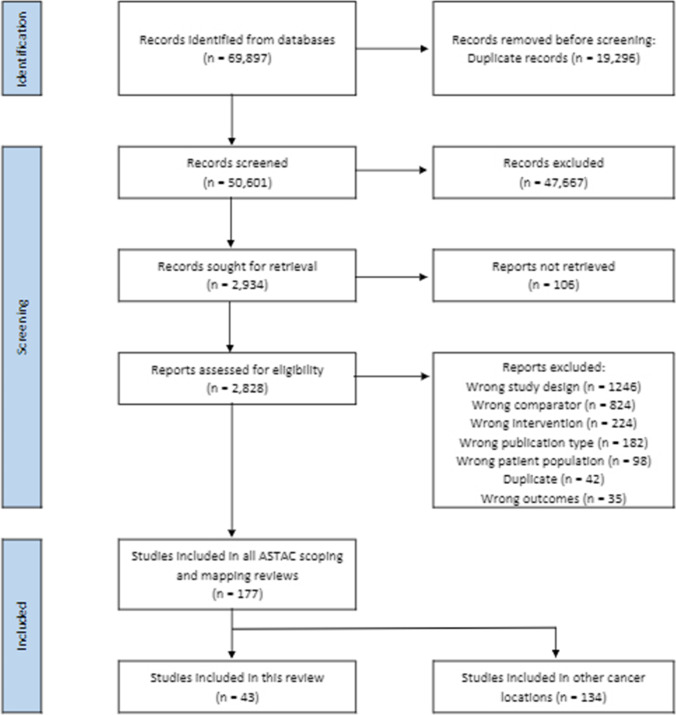
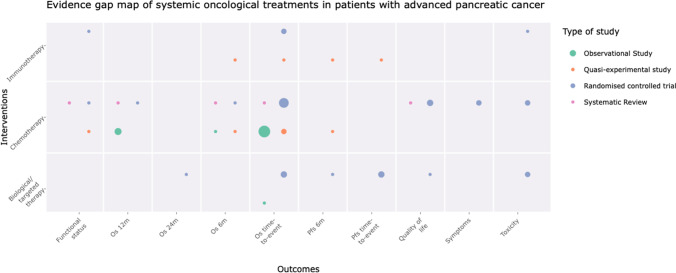
Methods: We conducted a scoping review and evidence mapping, adhering to PRISMA-ScR checklist. We searched MEDLINE, EMBASE, Cochrane Library, Epistemonikos, PROSPERO, and clinicaltrials.gov for eligible studies. We included systematic reviews (SRs), randomised controlled trials (RCTs), quasi-experimental, and observational studies evaluating SOTs compared to BSC or no treatment in patients with advanced PC. Two independent reviewers performed the screening process and data extraction. We developed evidence maps as an interactive visualization display, including the assessed interventions and outcomes.
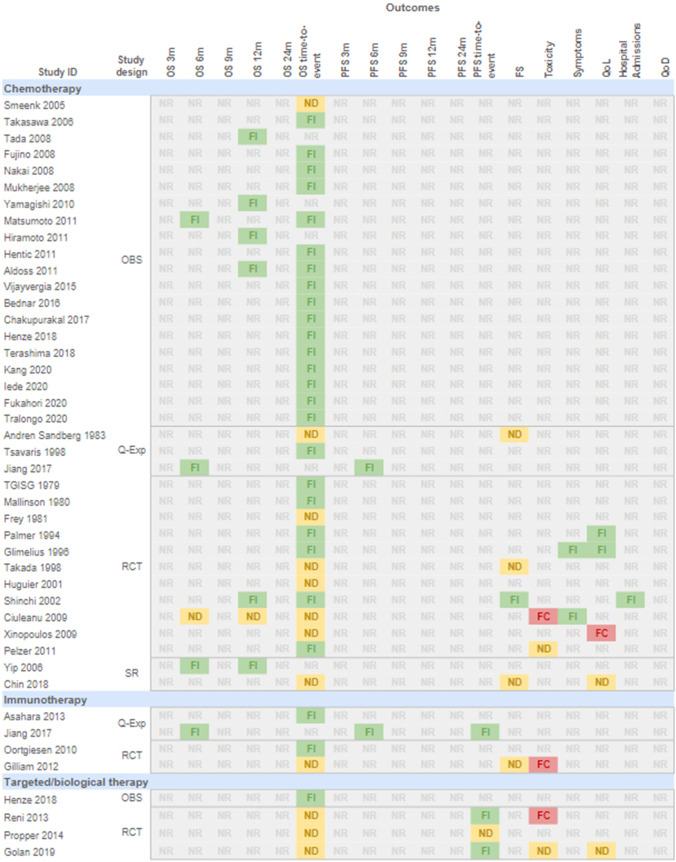
Results: Of the 50,601 records obtained from our search, we included 43 studies: 2 SRs, 16 RCTs, 4 quasi-experimental studies, 20 observational studies, and 1 protocol for a quasi-experimental study. Forty-two studies reported survival-related outcomes and most favoured SOTs, while five reported toxicity and most favoured BSC. Other patient-centred outcomes, such as quality of life, were scarcely reported.
Conclusions: This study highlights the current evidence gaps in studies assessing treatments for patients with advanced PC, mainly the lack of reports of non-survival-related outcomes, pointing out research areas that need further attention to make better recommendations for these patients.
Keywords: Antineoplastic agents; Immunotherapy; Pancreatic neoplasms; Review literature as topic.
© 2023. The Author(s).
Conflict of interest statement
The authors declare no competing interests.
Figures
References
-
- National Cancer Institute. Surveillance Research Program, SEER*Explorer: An interactive website for SEER cancer statistics, US National Institutes of Health. Retreived April 6, 2022 from https://seer.cancer.gov/explorer/
-
- Hui D, Nooruddin Z, Didwaniya N, Dev R, De La Cruz M, Kim SH, Kwon JH, Hutchins R, Liem C, Bruera E. Concepts and definitions for "actively dying," "end of life," "terminally ill," "terminal care," and "transition of care": a systematic review. J Pain Symptom Manage. 2014;47(1):77–89. doi: 10.1016/j.jpainsymman.2013.02.021. - DOI - PMC - PubMed
-
- PDQ Supportive and Palliative Care Editorial Board. (2022). Planning the Transition to End-of-Life Care in Advanced Cancer (PDQ®): Health Professional Version. In PDQ Cancer Information Summaries. National Cancer Institute (US). - PubMed
-
- Mossman B, Perry LM, Walsh LE, Gerhart J, Malhotra S, Horswell R, Chu S, Raines AM, Lefante J, Blais CM, Miele L, Melancon B, Alonzi S, Voss H, Freestone L, Dunn A, Hoerger M. Anxiety, depression, and end-of-life care utilization in adults with metastatic cancer. Psychooncology. 2021;30(11):1876–1883. doi: 10.1002/pon.5754. - DOI - PubMed
Publication types
MeSH terms
Grants and funding
LinkOut - more resources
Full Text Sources
Medical
