Review
. 2023 Jun;17(2):498-501.
doi: 10.1007/s12105-022-01519-5. Epub 2023 Jan 9.

Respiratory Epithelial Adenomatoid Hamartoma

Affiliations
Review

Respiratory Epithelial Adenomatoid Hamartoma

Ashley F Schemel et al. Head Neck Pathol. 2023 Jun.

Abstract

Background: Respiratory Epithelial Adenomatoid Hamartoma (REAH) is an uncommon, benign tumor of the sinonasal tract. It can, however, be confused with a sinonasal malignancy causing undo morbidity to patients. Therefore, the clinical as well as histological diagnosis is crucial in order to correctly care for patients.

Methods: This review of a patient, to include their clinical pictures, radiologic pictures, and histologic pictures, allow for the clinician to accurately evaluate and diagnose REAH.

Results: Our patient presented with a classic bilateral olfactory cleft mass on endoscopic exam. CT was obtained showing a non-enhancing homogenous mass, widening the olfactory cleft, with no evidence of skull base defects or bony erosion. MRI was additionally obtained, given the location, showing a homogenous cribriform mass with clearly defined borders with post-contrast enhancement on T1-weighted images and hyperintense T2-weighted images. A biopsy in clinic was done, showing small to medium, round to oval shaped glands lined with ciliated respiratory epithelium and separated by stroma. The surface epithelium extends into the submucosa, communicating with the proliferating glands.

Conclusion: Our patient, presented in this case report, shows a classic presentation of REAH. Using these findings, patients can be better counseled on this benign entity, ranging from observation to surgical intervention.

Keywords: Nasal cavity mass; Respiratory epithelial adenomatoid hamartoma; Sinonasal mass.


Conflict of interest statement

The authors declare that they have no conflict of interest.

Figures
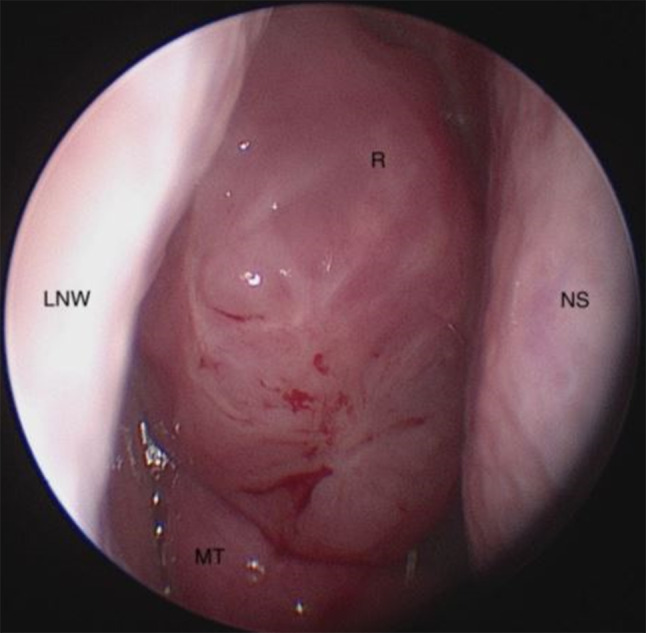
Fig. 1
Fig. 1
Endoscopic view of the patient's right nasal cavity showing REAH (R) anterior and medial to the middle turbinate (MT), filling the olfactory cleft with the nasal septum (NS) and lateral Nasal Wall (LNW) visible
Fig. 2
Fig. 2
Coronal non-contrasted computed tomography (A), coronal T1 magnetic resonance imaging (MRI) with a mass isointense to brain (B), coronal T2 short tau inversion recovery MRI with homogenous hyperintensity (C), and coronal T1 post-contrast fat suppressed MRI with homogeneous enhancement (D) demonstrating a mass symmetrically filling and expanding the olfactory recesses and extending inferiorly into the nasal cavity (asterisk 2A) with no evidence of intracranial extension
Fig. 3
Fig. 3
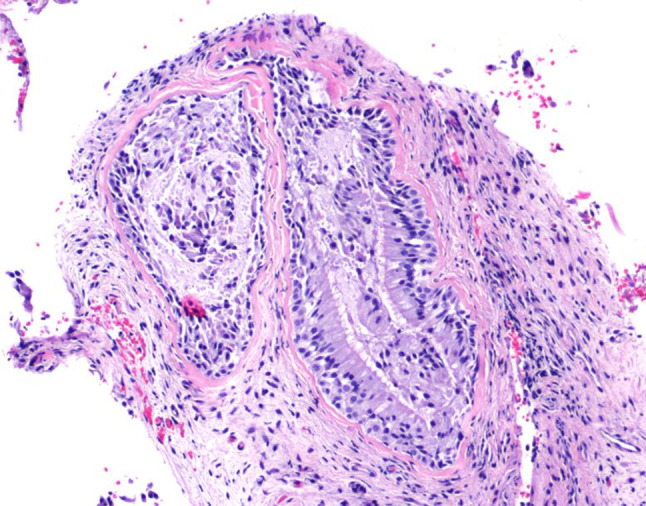
Medium power hematoxylin and eosin (H&E) view of glandular elements within fibrous connective tissue lined by enlarged respiratory epithelium with prominent cilia
Fig. 4
Fig. 4
High power H&E view of glandular element within fibrous connective tissue lined by enlarged respiratory epithelium with prominent cilia

References

    1. Fitzhugh VA, Mirani N. Respiratory epithelial adenomatoid hamartoma: a review. Head Neck Pathol. 2008;2:203–208. doi: 10.1007/s12105-008-0064-3. - DOI - PMC - PubMed
    1. Davison WL, Pearlman AN, Donatelli LA, Conley LM. Respiratory epithelial adenomatoid hamartomas: an increasingly common diagnosis in the setting of nasal polyps. Am J Rhinol Allergy. 2016;30(4):139–146. doi: 10.2500/ajra.2016.30.4338. - DOI - PubMed
    1. Schertzer JS, Levy JM, Wise SK, Magliocca KR, DelGaudio JM. Is respiratory epithelial adenomatoid hamartoma related to central compartment atopic disease? Int Forum Allergy Rhinol. 2020;34(5):610–617. doi: 10.1177/1945892420914212. - DOI - PubMed
    1. Bullock MJ. Low-grade epithelial proliferations of the sinonasal tract. Head Neck Pathol. 2016;10:47–59. doi: 10.1007/s12105-016-0691-z. - DOI - PMC - PubMed
    1. Ozolek JA, Hunt JL. Tumor suppressor gene alterations in respiratory epithelial adenomatoid hamartoma (REAH): comparison to sinonasal adenocarcinoma and inflamed sinonasal mucosa. Am J Surg Pathol. 2006;30:1576–1580. doi: 10.1097/01.pas.0000213344.55605.77. - DOI - PubMed

LinkOut - more resources