


Degradation rates influence the ability of composite samples to represent 24-hourly means of SARS-CoV-2 and other microbiological target measures in wastewater
- PMID: 36623667
- PMCID: PMC9817413
- DOI: 10.1016/j.scitotenv.2023.161423
Degradation rates influence the ability of composite samples to represent 24-hourly means of SARS-CoV-2 and other microbiological target measures in wastewater
Abstract
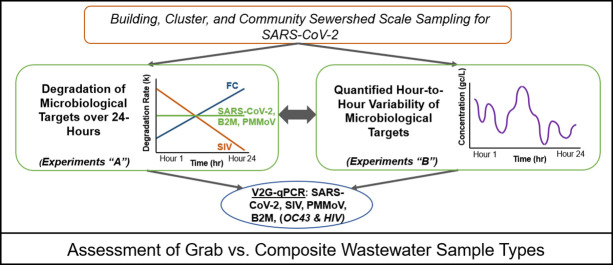
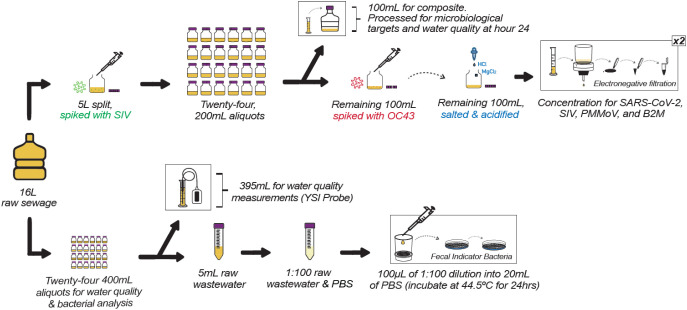
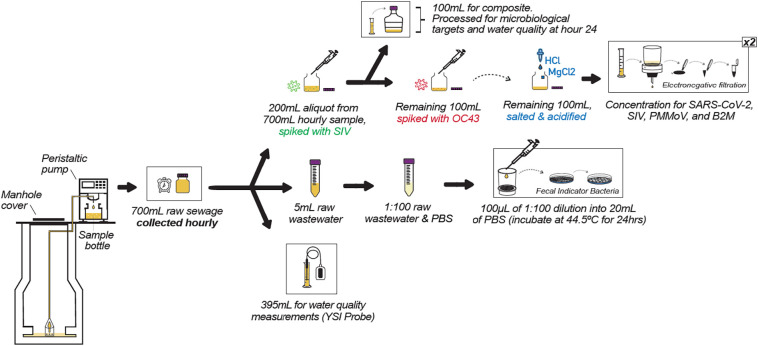
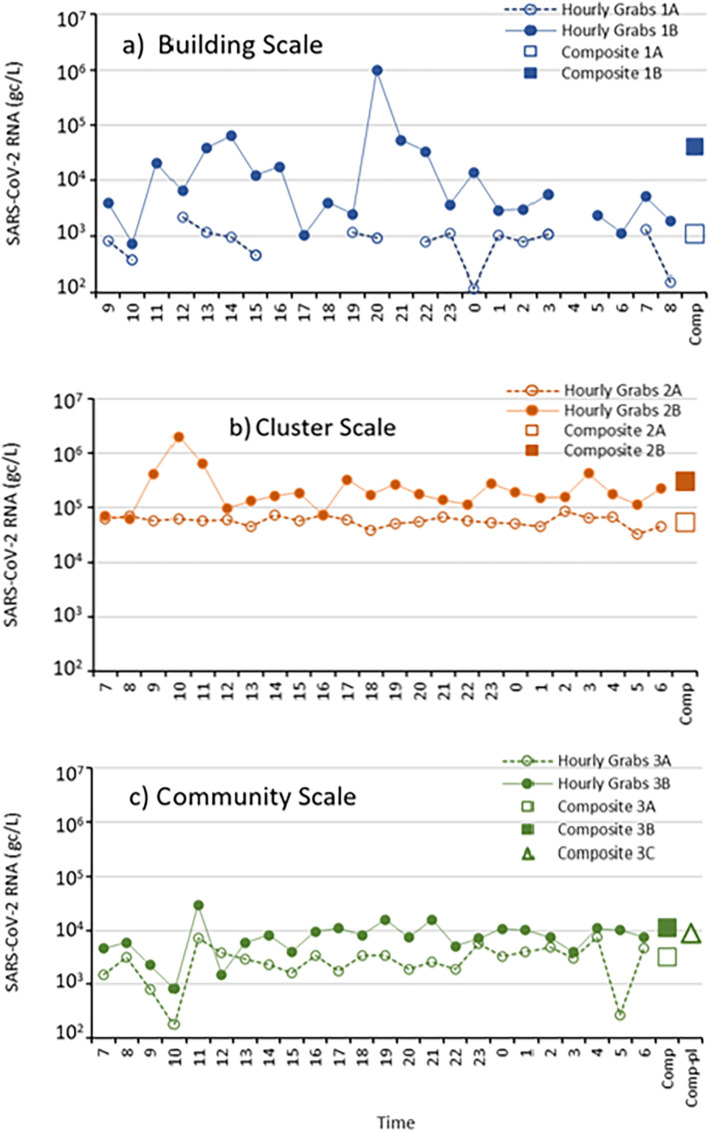
The utility of using severe-acute respiratory syndrome coronavirus-2 (SARS-CoV-2) RNA for assessing the prevalence of COVID-19 within communities begins with the design of the sample collection program. The objective of this study was to assess the utility of 24-hour composites as representative samples for measuring multiple microbiological targets in wastewater, and whether normalization of SARS-CoV-2 by endogenous targets can be used to decrease hour to hour variability at different watershed scales. Two sets of experiments were conducted, in tandem with the same wastewater, with samples collected at the building, cluster, and community sewershed scales. The first set of experiments focused on evaluating degradation of microbiological targets: SARS-CoV-2, Simian Immunodeficiency Virus (SIV) - a surrogate spiked into the wastewater, plus human waste indicators of Pepper Mild Mottle Virus (PMMoV), Beta-2 microglobulin (B2M), and fecal coliform bacteria (FC). The second focused on the variability of these targets from samples, collected each hour on the hour. Results show that SARS-CoV-2, PMMoV, and B2M were relatively stable, with minimal degradation over 24-h. SIV, which was spiked-in prior to analysis, degraded significantly and FC increased significantly over the course of 24 h, emphasizing the possibility for decay and growth within wastewater. Hour-to-hour variability of the source wastewater was large between each hour of sampling relative to the variability of the SARS-CoV-2 levels calculated between sewershed scales; thus, differences in SARS-CoV-2 hourly variability were not statistically significant between sewershed scales. Results further provided that the quantified representativeness of 24-h composite samples (i.e., statistical equivalency compared against hourly collected grabs) was dependent upon the molecular target measured. Overall, improvements made by normalization were minimal within this study. Degradation and multiplication for other targets should be evaluated when deciding upon whether to collect composite or grab samples in future studies.
Keywords: Composite; Degradation; Grab; Hour-to-hour variability; Normalization; SARS-CoV-2.
Copyright © 2023 Elsevier B.V. All rights reserved.
Conflict of interest statement
Declaration of competing interest The authors declare that they have no known competing financial interests or personal relationships that could have appeared to influence the work reported in this paper.
Figures
References
-
- Abdelzaher A.M., Solo-Gabriele H.M., Wright M.E., Palmer C.J. Sequential concentration of bacteria and viruses from marine waters using a dual membrane system. J. Environ. Qual. 2008;37(4):1648–1655. - PubMed
-
- Abdelzaher A.M., Solo-Gabriele H.M., Palmer C.J., Scott T.M. Simultaneous concentration of Enterococci and coliphage from marine waters using a dual layer filtration system. J. Environ. Qual. 2009;38(6):2468–2473. - PubMed
-
- Ahmed W., Bertsch P.M., Bibby K., Haramoto E., Hewitt J., Huygens F., Gyawali P., Korajkic A., Riddell S., Sherchan S.P., Simpson S.L., Sirikanchana K., Symonds E.M., Verhagen R., Vasan S.S., Kitajima M., Bivins A. Decay of SARS-CoV-2 and surrogate murine hepatitis virus RNA in untreated wastewater to inform application in wastewater-based epidemiology. Environ. Res. 2020;191 - PMC - PubMed
-
- Ahmed W., Bivins A., Bertsch P.M., Bibby K., Choi P.M., Farkas K., Gyawali P., Hamilton K.A., Haramoto E., Kitajima M., Simpson S.L., Tandukar S., Thomas K., Mueller J.F. Surveillance of SARS-CoV-2 RNA in wastewater: methods optimisation and quality control are crucial for generating reliable public health information. Curr. Opin. Environ. Sci. Health. 2020;17:82–93. - PMC - PubMed
-
- Ahmed W., Bivins A., Bertsch P.M., Bibby K., Gyawali P., Sherchan S.P., Simpson S.L., Thomas K.V., Verhagen R., Kitajima M., Mueller J.F., Korajkic A. Intraday variability of indicator and pathogenic viruses in 1-h and 24-h composite wastewater samples: implications for wastewater-based epidemiology. Environ. Res. 2021;193 - PMC - PubMed
MeSH terms
Substances
Supplementary concepts
Grants and funding
LinkOut - more resources
Full Text Sources
Medical
Research Materials
Miscellaneous
