. 2023 Jan 9;20(1):5.
doi: 10.1186/s12985-023-01965-9.

Enterovirus B types cause severe infection in infants aged 0-3 months

Affiliations

Enterovirus B types cause severe infection in infants aged 0-3 months

Xiaohan Yang et al. Virol J. .

Abstract

Background: Enterovirus (EV) infections are being increasingly seen in younger infants, often being more severe than in older children. The risk factors of EV infection in infants have been inadequately investigated till date.

Methods: We conducted a retrospective study on hospitalized children with laboratory-confirmed EV infection (50 infants aged 0-3 months and 65 older than 3 months) at a tertiary care center in China. Prevalence, clinical characteristics, and genetic features of the virus were analyzed, and independent predictors for severe infection were assessed.

Results: Clinical findings showed that severe infection was more common in infants aged 0-3 months than in older children (78.0% vs. 35.4%, p < 0.001), with higher morbidity of pneumonia, meningitis, and sepsis (p < 0.01). EV-B types were detected more frequently in infants aged 0-3 months than in older children (88.0% vs. 7.7%, p < 0.001). Echovirus 11 was the most identified EV-B, and it recombined with E6 in P2 and P3 regions. Risk factors for severe EV infection included EV-B types infection, age less than 3 months, elevated alanine aminotransferase level, abnormal platelet count, and abnormal cerebrospinal fluid characteristics.

Conclusions: Our data indicated that EV-B types mainly cause severe infection in infants aged 0-3 months. Therefore, knowledge about EV-B types could have implications in designing effective intervention and prevention strategies for young infants with severe EV infection.

Keywords: Enterovirus B; Infant; Recombination; Severe infection.


Conflict of interest statement

The authors declare that they have no competing interests.

Figures

Fig. 1
Fig. 1
Flow diagram of children hospitalized with EV infections in Guangzhou, China during January–December 2019
Fig. 2
Fig. 2
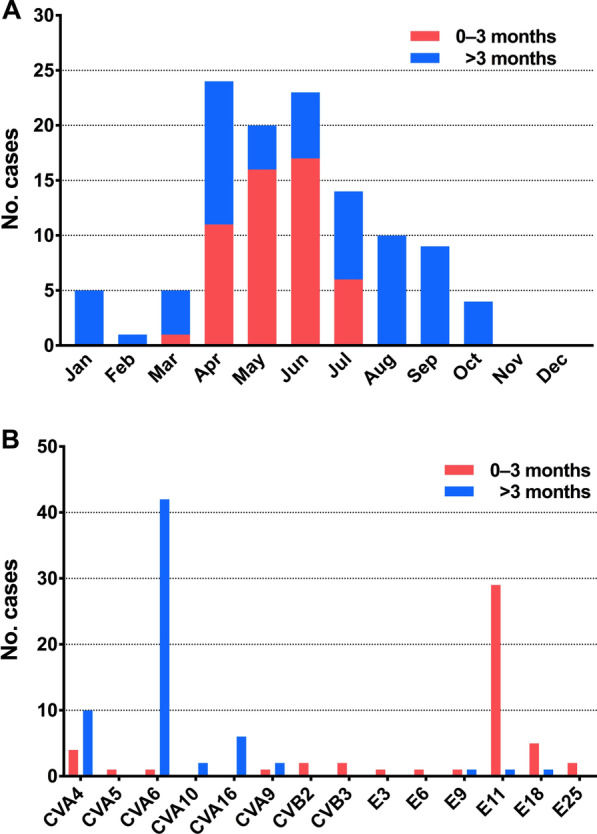
Children hospitalized with EV infections, as per age group, month, and EV types. a Number of children hospitalized with EV infections, by age group and month. b Number of children hospitalized with EV infections by age group and EV types
Fig. 3
Fig. 3
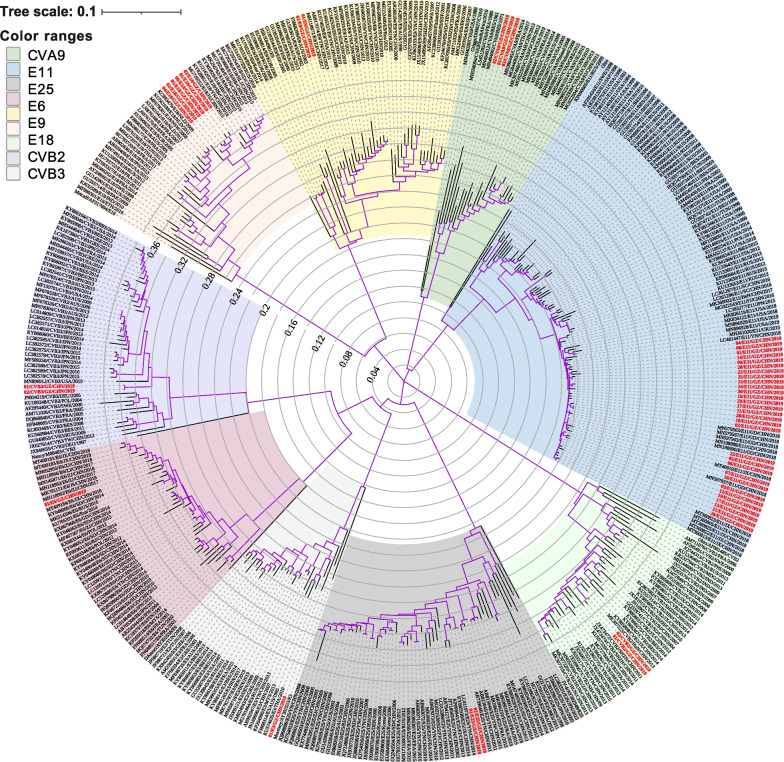
Neighbor-joining tree of the partial VP1 gene of the EV-B strains in Guangzhou, China. The 44 EV-B strains obtained from infants aged 0–3 months and 5 EV-B strains obtained from children older than 3 months, in this study, are shown in red. Scale bar indicates the number of nucleotide substitutions per site. Bootstrap values were calculated on 1000 replicates. Phylogenetic nodes with bootstrap values over 80 are marked as purple lines
Fig. 4
Fig. 4
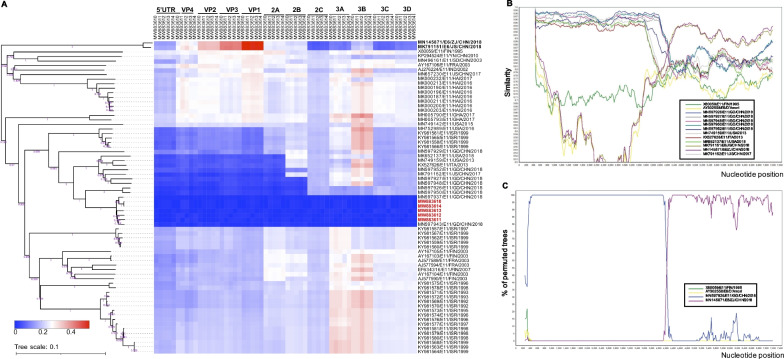
Recombination analysis of E11 genomes in Guangzhou, China during January–December 2019. a Heatmap representation of evolutionary divergences between 64 reference strains and 5 E11 strains (MW883610–MW883614) obtained. Scale bars indicate the number of nucleotide substitutions per site, and bootstrap values were calculated on 1000 replicates. Red squares show positive correlation, and blue squares show negative correlation across the different regions of E6 and E11. b Similarity plot analysis comparing the 5 E11 strains (MW883610–MW883614), obtained in this study, with other closely related EV-B reference strains using Simplot software version 3.5.1 with a window size of 500 nt and step size of 20 bp. c Bootscan analysis comparing 5 E11 strains (MW883610–MW883614) obtained in this study with other closely related EV-B reference strains, using a window size of 500 nt and step size of 20 bp, and genetic distance of the Kirmura 2-parameter model. The arbitrary recombinant threshold was 70%

References

    1. Nasri D, Bouslama L, Pillet S, Bourlet T, Aouni M, Pozzetto B. Basic rationale, current methods and future directions for molecular typing of human enterovirus. Expert Rev Mol Diagn. 2007;7:419–434. doi: 10.1586/14737159.7.4.419. - DOI - PubMed
    1. Simmonds P, Gorbalenya AE, Harvala H, Hovi T, Knowles NJ, Lindberg AM, Oberste MS, Palmenberg AC, Reuter G, Skern T, et al. Recommendations for the nomenclature of enteroviruses and rhinoviruses. Arch Virol. 2020;165:793–797. doi: 10.1007/s00705-019-04520-6. - DOI - PMC - PubMed
    1. Pons-Salort M, Parker EP, Grassly NC. The epidemiology of non-polio enteroviruses: recent advances and outstanding questions. Curr Opin Infect Dis. 2015;28:479–487. doi: 10.1097/QCO.0000000000000187. - DOI - PMC - PubMed
    1. Berardi A, Sandoni M, Toffoli C, Boncompagni A, Gennari W, Bergamini MB, Lucaccioni L, Iughetti L. Clinical characterization of neonatal and pediatric enteroviral infections: an Italian single center study. Ital J Pediatr. 2019;45:94. doi: 10.1186/s13052-019-0689-8. - DOI - PMC - PubMed
    1. Abzug MJ. Presentation, diagnosis, and management of enterovirus infections in neonates. Paediatr Drugs. 2004;6:1–10. doi: 10.2165/00148581-200406010-00001. - DOI - PubMed

Publication types

LinkOut - more resources