


Unexplained mismatch repair deficiency: Case closed
- PMID: 36624813
- PMCID: PMC9823207
- DOI: 10.1016/j.xhgg.2022.100167
Unexplained mismatch repair deficiency: Case closed
Abstract
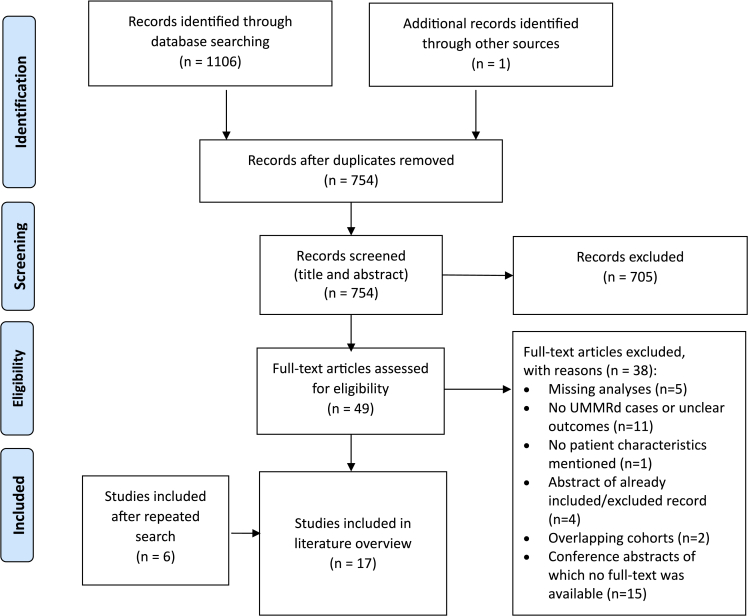
To identify Lynch syndrome (LS) carriers, DNA mismatch repair (MMR) immunohistochemistry (IHC) is performed on colorectal cancers (CRCs). Upon subsequent LS diagnostics, MMR deficiency (MMRd) sometimes remains unexplained (UMMRd). Recently, the importance of complete LS diagnostics to explain UMMRd, involving MMR methylation, germline, and somatic analyses, was stressed. To explore why some MMRd CRCs remain unsolved, we performed a systematic review of the literature and mapped patients with UMMRd diagnosed in our center. A systematic literature search was performed in Ovid Medline, Embase, Web of Science, Cochrane CENTRAL, and Google Scholar for articles on UMMRd CRCs after complete LS diagnostics published until December 15, 2021. Additionally, UMMRd CRCs diagnosed in our center since 1993 were mapped. Of 754 identified articles, 17 were included, covering 74 patients with UMMRd. Five CRCs were microsatellite stable. Upon complete diagnostics, 39 patients had single somatic MMR hits, and six an MMR germline variant of unknown significance (VUS). Ten had somatic pathogenic variants (PVs) in POLD1, MLH3, MSH3, and APC. The remaining 14 patients were the only identifiable cases in the literature without a plausible identified cause of the UMMRd. Of those, nine were suspected to have LS. In our center, complete LS diagnostics in approximately 5,000 CRCs left seven MMRd CRCs unexplained. All had a somatic MMR hit or MMR germline VUS, indicative of a missed second MMR hit. In vitually all patients with UMMRd, complete LS diagnostics suggest MMR gene involvement. Optimizing detection of currently undetectable PVs and VUS interpretation might explain all UMMRd CRCs, considering UMMRd a case closed.
Keywords: Lynch syndrome; UMMRd; colorectal cancer; genetic testing; unexplained mismatch repair deficiency.
© 2022 The Authors.
Conflict of interest statement
The authors declare no competing interests.
Figures

References
-
- Bronner C.E., Baker S.M., Morrison P.T., Warren G., Smith L.G., Lescoe M.K., Kane M., Earabino C., Lipford J., Lindblom A., et al. Mutation in the DNA mismatch repair gene homologue hMLH1 is associated with hereditary non-polyposis colon cancer. Nature. 1994;368:258–261. doi: 10.1038/368258a0. - DOI - PubMed
-
- Akiyama Y., Sato H., Yamada T., Nagasaki H., Tsuchiya A., Abe R., Yuasa Y. Germ-line mutation of the hMSH6/GTBP gene in an atypical hereditary nonpolyposis colorectal cancer kindred. Cancer Res. 1997;57:3920–3923. - PubMed
-
- Ligtenberg M.J.L., Kuiper R.P., Chan T.L., Goossens M., Hebeda K.M., Voorendt M., Lee T.Y.H., Bodmer D., Hoenselaar E., Hendriks-Cornelissen S.J.B., et al. Heritable somatic methylation and inactivation of MSH2 in families with Lynch syndrome due to deletion of the 3' exons of TACSTD1. Nat. Genet. 2009;41:112–117. doi: 10.1038/ng.283. - DOI - PubMed
Publication types
MeSH terms
Supplementary concepts
LinkOut - more resources
Full Text Sources
Medical
Research Materials
