. 2023 May;72(5):918-928.
doi: 10.1136/gutjnl-2022-328406. Epub 2023 Jan 10.

Gestational diabetes is driven by microbiota-induced inflammation months before diagnosis

Affiliations

Gestational diabetes is driven by microbiota-induced inflammation months before diagnosis

Yishay Pinto et al. Gut. 2023 May.

Abstract

Objective: Gestational diabetes mellitus (GDM) is a condition in which women without diabetes are diagnosed with glucose intolerance during pregnancy, typically in the second or third trimester. Early diagnosis, along with a better understanding of its pathophysiology during the first trimester of pregnancy, may be effective in reducing incidence and associated short-term and long-term morbidities.

Design: We comprehensively profiled the gut microbiome, metabolome, inflammatory cytokines, nutrition and clinical records of 394 women during the first trimester of pregnancy, before GDM diagnosis. We then built a model that can predict GDM onset weeks before it is typically diagnosed. Further, we demonstrated the role of the microbiome in disease using faecal microbiota transplant (FMT) of first trimester samples from pregnant women across three unique cohorts.

Results: We found elevated levels of proinflammatory cytokines in women who later developed GDM, decreased faecal short-chain fatty acids and altered microbiome. We next confirmed that differences in GDM-associated microbial composition during the first trimester drove inflammation and insulin resistance more than 10 weeks prior to GDM diagnosis using FMT experiments. Following these observations, we used a machine learning approach to predict GDM based on first trimester clinical, microbial and inflammatory markers with high accuracy.

Conclusion: GDM onset can be identified in the first trimester of pregnancy, earlier than currently accepted. Furthermore, the gut microbiome appears to play a role in inflammation-induced GDM pathogenesis, with interleukin-6 as a potential contributor to pathogenesis. Potential GDM markers, including microbiota, can serve as targets for early diagnostics and therapeutic intervention leading to prevention.

Keywords: INTESTINAL MICROBIOLOGY.


Conflict of interest statement

Competing interests: None declared.

Figures
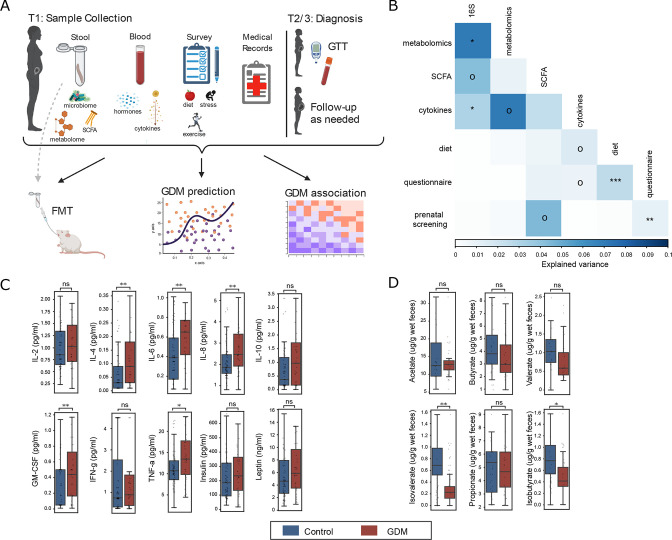
Figure 1
Figure 1
First trimester blood and faecal biomarkers in women later diagnosed with GDM. (A) Sampling strategy and study design. Samples were collected in first trimester (T1). Stool was collected to profile gut microbiome (GDM: n=28, control: n=236), metabolome (n=15 age/BMI-matched pairs) and SCFAs (n=20 age-matched pairs) and to validate results when transplanted into germ-free mice. Blood samples were used to profile cytokines and hormones (GDM: n=35, control: n=78). Lifestyle surveys and medical records were collected from all participants. (B) Variance explained (square of the Mantel statistic) between all pairs of data types (Mantel test). (C) Serum levels of cytokines and hormones for GDM and control women (false discovery rate (FDR)-corrected Mann-Whitney U tests). (D) Concentration of faecal short-chain fatty acids (FDR-corrected Mann-Whitney U tests). Boxplots indicate the median and IQR; whiskers show IQR×1.5. oP<0.1, *p<0.05, **p<0.01, ***p<0.001. BMI, body mass index; FMT, faecal microbiota transplant; GDM, gestational diabetes mellitus; GM-CSF, granulocyte-macrophage colony-stimulating factor; GTT, glucose tolerance test; IFN, interferon; IL, interleukin; ns, not significant; SCFA, short-chain fatty acid; TNF, tumour necrosis factor.
Figure 2
Figure 2
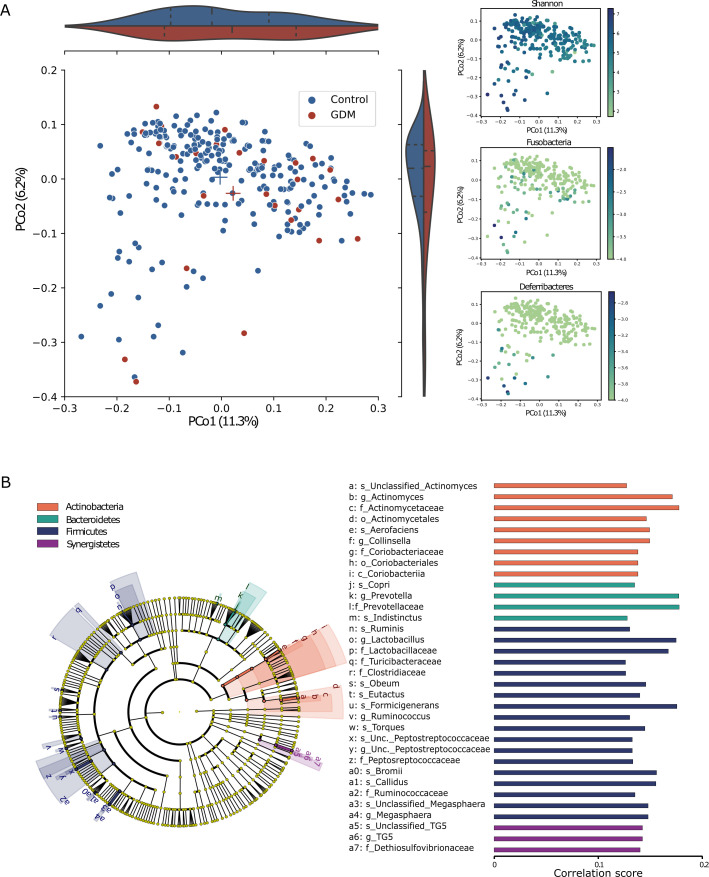
Differences in faecal microbiome composition in first trimester between women who would and would not develop GDM later. (A) Principal coordinate analysis based on 16S rRNA gene sequence profiling of the microbiome (GDM: n=28, control: n=236) using the unweighted UniFrac dissimilarity metric coloured by GDM/control (left; p=0.06, PERMANOVA); violin plots represent the distribution of GDM/control on each axis; Shannon diversity (top right; R2=0.24 with PCo1) and two phyla that mostly explain the PCo1 and PCo2 variance: Fusobacteria (R2=0.08 with PCo2) and Deferribacteres (R2=0.3 with PCo2). (B) The cladogram represents the microbial features associated with the disease state, while controlling for the main risk factors, BMI and age, at all taxonomic ranks. Spearman’s rank correlation for each association: a positive association (all associations found), implies over-represented features in the healthy control group. Cladogram and bars are coloured by phylum. BMI, body mass index; GDM, gestational diabetes mellitus; Unc., unclassified; PERMANOVA, permutational multivariate analysis of variance.
Figure 3
Figure 3
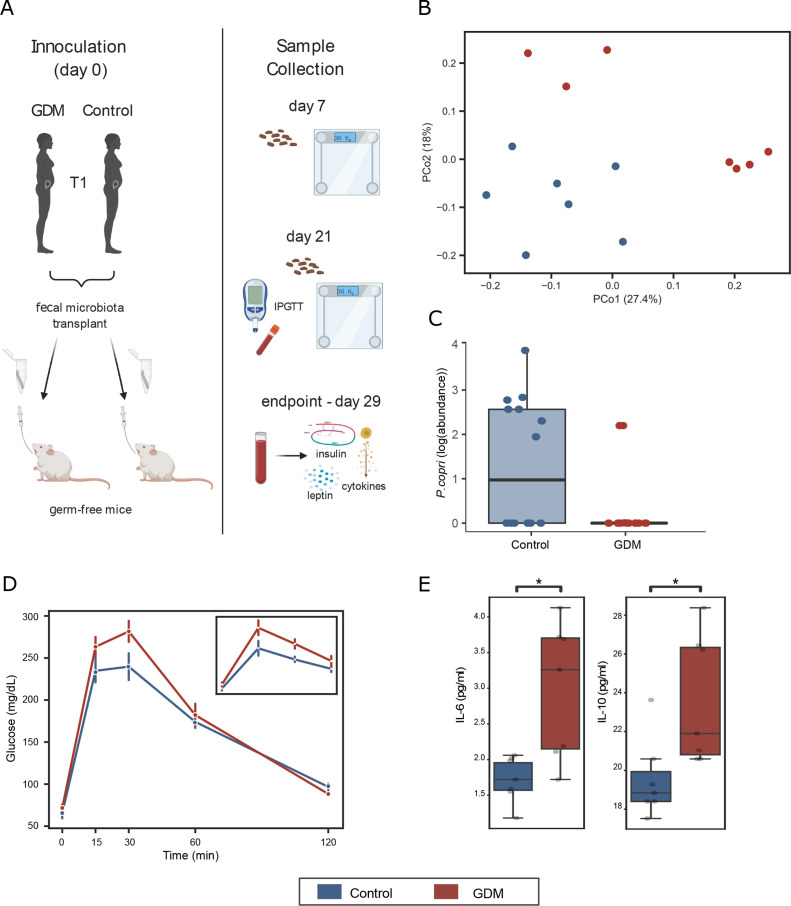
Phenotype transfer via first trimester (T1) FMT to germ-free mice. (A) Study design. (B) PCoA using the unweighted UniFrac metric. Mice receiving FMT from women with GDM exhibit different microbial profiles from mice receiving FMT from the control group (p=0.005, PERMANOVA test, n=7 age/BMI-matched FMT donor pairs). (C) Prevotella copri, which was found to be negatively associated with women with GDM, is negatively associated with GDM-transplanted mice as well (p=0.04, linear mixed-effects model). (D) Intraperitoneal glucose tolerance test (ipGTT) revealed impaired glucose sensitivity in mice transplanted with faeces from women with GDM in this study and in the Finnish cohort (insert) (error bars represent ±SEM; *p<0.05 one-tailed Mann-Whitney U test). (E) Serum cytokine level in transplanted mice (*p<0.05 Mann-Whitney U test). Boxplots indicate the median and IQR; whiskers show IQR×1.5. BMI, body mass index; FMT, faecal microbiota transplant; GDM, gestational diabetes mellitus; IL, interleukin; PCoA, principal coordinate analysis; PERMANOVA, permutational multivariate analysis of variance.
Figure 4
Figure 4
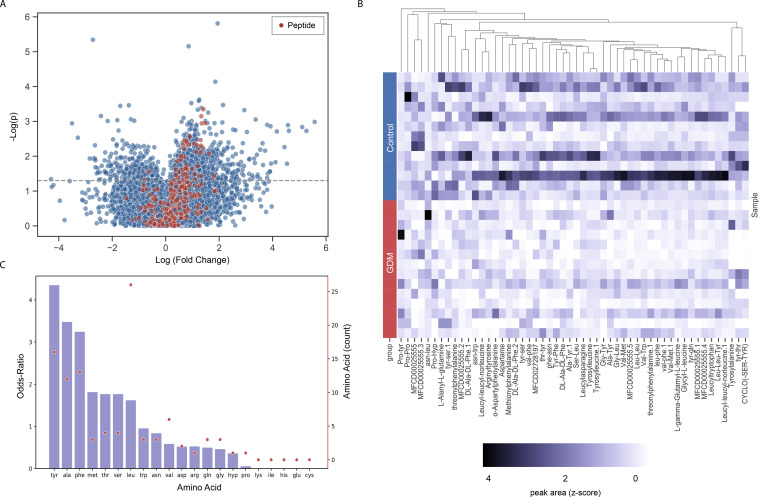
Analysis of first trimester human faecal metabolomics exhibits lower levels of dipeptides for women with GDM. (A) Volcano plot of all metabolites examined in this study, comparing age/BMI-matched metabolite profiles of women who would and would not later develop GDM (n=20 pairs); peptides are coloured in red. (B) Heatmap of the 52 differentially expressed peptides. Each row denotes a sample (grouped by disease state) and each column denotes a peptide. Z-scores were calculated per column. Peptides (columns) were hierarchically clustered based on Euclidean distances. (C) Amino acid composition of the differentially abundant peptides. Bars (left y-axis) represent odds ratios (OR) for each amino acid, and dots (right y-axis) represent the amino acid count in the differentially abundant peptides. BMI, body mass index; GDM, gestational diabetes mellitus.
Figure 5
Figure 5
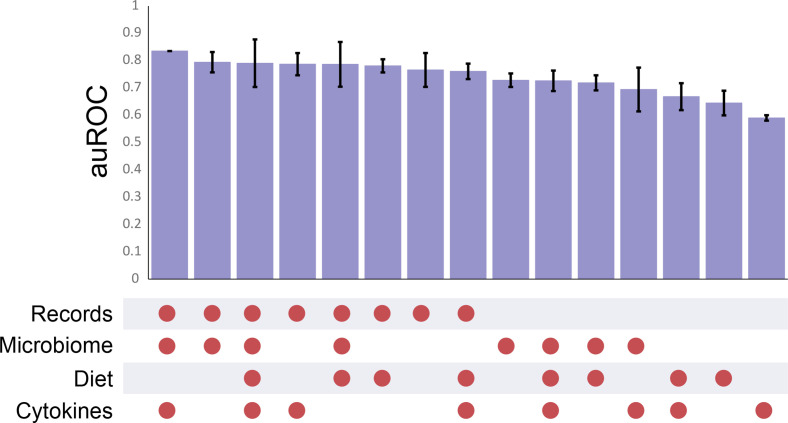
Highly accurate prediction of future disease onset among pregnant women during their first trimester. Area under the receiver operating characteristic curve (auROC) for each combination of features. Error bars represent ±SD.

References

    1. Baz B, Riveline J-P, Gautier J-F. Endocrinology of pregnancy: gestational diabetes mellitus: definition, aetiological and clinical aspects. Eur J Endocrinol 2016;174:R43–51. 10.1530/EJE-15-0378 - DOI - PubMed
    1. Plows JF, Stanley JL, Baker PN, et al. . The pathophysiology of gestational diabetes mellitus. Int J Mol Sci 2018;19. 10.3390/ijms19113342. [Epub ahead of print: 26 Oct 2018]. - DOI - PMC - PubMed
    1. Lende M, Rijhsinghani A. Gestational diabetes: overview with emphasis on medical management. Int J Environ Res Public Health 2020;17. 10.3390/ijerph17249573. [Epub ahead of print: 21 Dec 2020]. - DOI - PMC - PubMed
    1. Zhu Y, Zhang C. Prevalence of gestational diabetes and risk of progression to type 2 diabetes: a global perspective. Curr Diab Rep 2016;16:7. 10.1007/s11892-015-0699-x - DOI - PMC - PubMed
    1. Eades CE, Cameron DM, Evans JMM. Prevalence of gestational diabetes mellitus in Europe: a meta-analysis. Diabetes Res Clin Pract 2017;129:173–81. 10.1016/j.diabres.2017.03.030 - DOI - PubMed

Publication types