. 2023 Jan 10;14(1):145.
doi: 10.1038/s41467-023-35863-z.

Doubled strength and ductility via maraging effect and dynamic precipitate transformation in ultrastrong medium-entropy alloy

Affiliations

Doubled strength and ductility via maraging effect and dynamic precipitate transformation in ultrastrong medium-entropy alloy

Hyun Chung et al. Nat Commun. .

Abstract

Demands for ultrahigh strength in structural materials have been steadily increasing in response to environmental issues. Maraging alloys offer a high tensile strength and fracture toughness through a reduction of lattice defects and formation of intermetallic precipitates. The semi-coherent precipitates are crucial for exhibiting ultrahigh strength; however, they still result in limited work hardening and uniform ductility. Here, we demonstrate a strategy involving deformable semi-coherent precipitates and their dynamic phase transformation based on a narrow stability gap between two kinds of ordered phases. In a model medium-entropy alloy, the matrix precipitate acts as a dislocation barrier and also dislocation glide media; the grain-boundary precipitate further contributes to a significant work-hardening via dynamic precipitate transformation into the type of matrix precipitate. This combination results in a twofold enhancement of strength and uniform ductility, thus suggesting a promising alloy design concept for enhanced mechanical properties in developing various ultrastrong metallic materials.


Conflict of interest statement

The authors declare no competing interests.

Figures
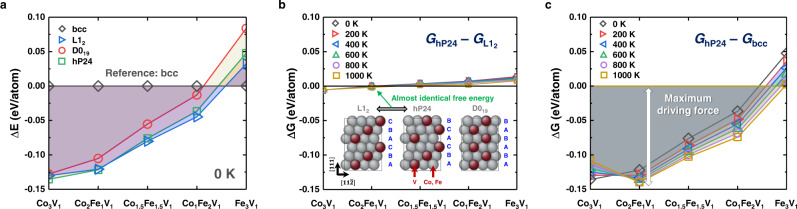
Fig. 1
Fig. 1. First-principles density functional theory (DFT) calculation of phase stability in A3B1-type (A: (Fe,Co), B: V).
a Stability of candidate ordered precipitates (hP24, L12, and D019) with respect to disordered body-centred cubic (bcc) solid solution at 0 K predicted via DFT calculation. Temperature dependence of Gibbs free energy (G) difference between (b) hP24 and L12, and (c) hP24 and disordered bcc solid solution, approximated by Debye–Grüneisen model. Schematics of configurations are shown in the inset. Connecting lines between symbols are only for visual guidance.
Fig. 2
Fig. 2. Characterisation of precipitates upon ageing conditions.
a Phase identification via X-ray diffraction (XRD) analysis for SA, 1H, and 24H alloys. b–d Scanning electron microscopy (SEM) images and electron-backscatter diffraction (EBSD) phase maps for different ageing times, (e–i) transmission electron microscopy (TEM) images and atom probe tomography (APT) reconstruction and proximity histogram across precipitates and bcc matrix for 1H alloy. The 50 at% Co iso-concentration surface shows the reference phase boundary. j,k,m,n TEM images, (l,o) corresponding fast Fourier-transform (FFT) images, (p,q) APT reconstruction and proximity histogram for 24H alloy.
Fig. 3
Fig. 3. Room-temperature mechanical properties of the alloys.
a Engineering tensile stress–strain curves of SA (black), 1H (red), and 24H (blue) alloys (eu: uniform elongation). b Work-hardening rate versus true strain for SA, 1H, and 24H alloys. c Comparison of yield strength versus uniform elongation for the FeCo0.8V0.2 MEAs and other single or multiphase high-/medium-entropy alloys and maraging steels.
Fig. 4
Fig. 4. Deformation mechanisms of 24H alloy.
a–f Transmission electron microscopy (TEM) images of deformed microstructure. a Dislocations bowing when bypassing the cross-section of hP24 marked by red arrows. b Massive dislocation interactions and homogeneous deformation substructures indicated by a blue arrow. c An enlarged image of the marked area in (b) showing hP24 acting as obstacles. d Highly faulted hP24 precipitates with more evident hcp diffraction pattern of hP24 structure. e Partial dislocations emitted from grain boundaries (GBs) leading to extended stacking faults (SFs) in L12. f L12 transforming to hP24 with the aid of deformation-induced SFs.
Fig. 5
Fig. 5. Schematic drawings illustrating the microstructure evolutions.
a Martensitic microstructure with hierarchical substructures and high dislocation density. b Massive precipitation of hP24 within matrix and L12 along grain boundaries after ageing treatment. c Magnified illustration showing highly faulted structure of rod-like hP24 and defect-free L12 with flat interfaces and (d) evolved precipitates upon plastic deformation, hP24 possess denser SFs and L12 is also introduced with SFs leading to local dynamic precipitate transformation to hP24.

References

    1. Bowles JS, Mackenzie JK. The crystallography of martensite transformations I. Acta Metall. 1954;2:129–137. doi: 10.1016/0001-6160(54)90102-9. - DOI
    1. Jiang S, et al. Ultrastrong steel via minimal lattice misfit and high-density nanoprecipitation. Nature. 2017;544:460–464. doi: 10.1038/nature22032. - DOI - PubMed
    1. Niu, M. C. et al. Synergistic alloying effects on nanoscale precipitation and mechanical properties of ultrahigh-strength steels strengthened by Ni3Ti, Mo-enriched, and Cr-rich co-precipitates. Acta Mater. 209, 116788 (2021).
    1. Morris JW. Maraging steels: Making steel strong and cheap. Nat. Mater. 2017;16:787–789. doi: 10.1038/nmat4949. - DOI - PubMed
    1. Sun L, et al. A novel ultra-high strength maraging steel with balanced ductility and creep resistance achieved by nanoscale β-NiAl and Laves phase precipitates. Acta Mater. 2018;149:285–301. doi: 10.1016/j.actamat.2018.02.044. - DOI
