. 2023 Jan 10;13(1):62.
doi: 10.1038/s41598-022-24834-x.

Mental health of UK firefighters

Affiliations

Mental health of UK firefighters

Taylor A M Wolffe et al. Sci Rep. .

Abstract

Exposure to trauma, high-stress situations, and disrupted sleep are well known risk factors affecting firefighters' mental health. Little is known about the association between firefighters' exposure to fire contaminants and mental health disorders. The UK Firefighter Contamination Survey assessed firefighters' health and capacity for occupational exposure to contaminants. Participants were invited to anonymously complete its 64 questions online. Logistic regression analyses assessed the associations between self-reported mental health disorders and proxies of contaminant exposure. Results found that firefighters who notice soot in their nose/throat for more than a day after attending fires (Odds Ratio (OR) = 1.8, 1.4-2.4), and those who remain in their personal protective equipment (PPE) for over 4 h after fires (OR = 1.9, 1.2-3.1), were nearly twice as likely to report mental health disorders. Significantly increased odds ratios for all three outcomes of interest (anxiety, depression and/or any mental health disorders) were also found among firefighters who take PPE home to clean. Sleeping problems were reported by 61% of firefighters. These firefighters were 4.2 times more likely to report any mental health disorder (OR = 4.2, 3.7-4.9), 2.9 times more likely to report anxiety (OR = 2.9, 2.4-3.5) and 2.3 times more likely to report depression (OR = 2.3, 1.9-2.8) when compared to firefighters who did not report sleep issues. Effective decontamination measures within UK Fire and Rescue Services, together with firefighters' wellness, may play a crucial role in protecting firefighters' mental health.


Conflict of interest statement

The authors declare that they have no known competing interests. AC and LT are PhD Researchers, who were affiliated with UCLan at the time the survey was conducted.

Figures
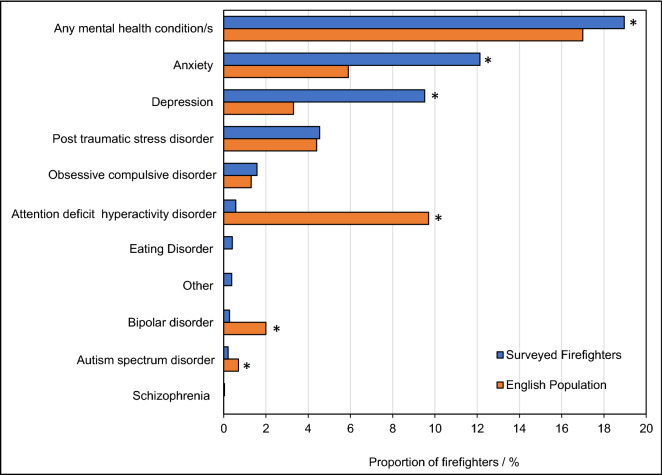
Figure 1
Figure 1
Firefighters’ Mental Health Conditions. The proportion of total surveyed firefighters with any, or specific, mental health disorders (blue). The prevalence of mental health disorders in the general English population is displayed for comparison (orange). “Any mental health condition”, “anxiety” and “depression” among surveyed firefighters is compared to “any common mental disorder”, “generalised anxiety disorder” and “depressive episode” in the general English population, respectively. * indicates a p-value of < 0.05 for differences in proportions between firefighters and English population.
Figure 2
Figure 2
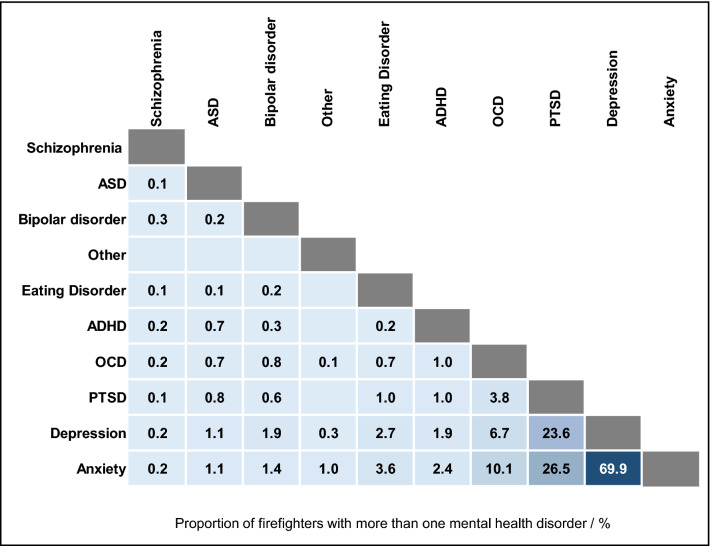
Firefighters’ Co-occurring Mental Health Conditions. Proportion of firefighters with more than one mental health condition (n = 878), who reported the co-occurrence of specific mental health conditions. Blank cells indicate that mental health conditions did not co-occur among surveyed firefighters.
Figure 3
Figure 3
Firefighters’ Mental Health Conditions by Demographics. (a) The proportion of firefighters with any mental health condition, anxiety, or depression in each demographic category. (b) Odds ratios (with 95% confidence intervals) for specific demographic groups having any mental health condition, anxiety, or depression. Note that the proportions of surveyed firefighters in each demographic category are presented in Wolffe et al., . The results of underpowered demographic groups (e.g. sex = “Other” for which there was a total of 4 firefighters) should be interpreted cautiously. Odds ratios were adjusted for various mental health risk factors (Supplementary File S2).
Figure 4
Figure 4
Firefighters’ Sleeping Problems. (a) The proportion of total surveyed firefighters who indicated whether they had sleeping problems. (b) The proportion of firefighters with sleeping problems listing the reasons for their sleep disturbances. Note that firefighters were able to select more than one reason. (c) Adjusted odds ratios (with 95% confidence intervals) for firefighters’ mental health conditions due to sleeping problems. (d) Adjusted odds ratios (with 95% confidence intervals) for firefighters sleeping problems due to demographic variables. Note that odds ratios presented in (c) and (d) were adjusted for a variety of disturbed sleep risk factors (Supplementary File S2).
Figure 5
Figure 5
Firefighters’ Exposure to Contaminants During/After Fires and Mental Health Odds Ratios. Odds ratios (with 95% Confidence Intervals) were adjusted for various mental health risk factors (Supplementary File S2).
Figure 6
Figure 6
Firefighters’ PPE/Workplace Contamination and Mental Health Odds Ratios. Odds ratios (with 95% confidence intervals) were adjusted for various mental health risk factors (Supplementary File S2).
Figure 7
Figure 7
Firefighters Training/Culture and Mental Health Odds Ratios. Odds ratios (with 95% confidence intervals) were adjusted for various mental health risk factors (Supplementary File S2).

References

    1. Regehr C, Hill J, Knott T, Sault B. Social support, self-efficacy and trauma in new recruits and experienced firefighters. Stress Health. 2003;19:189–193. doi: 10.1002/smi.974. - DOI
    1. Paulus DJ, Vujanovic AA, Schuhmann BB, Smith LJ, Tran J. Main and interactive effects of depression and posttraumatic stress in relation to alcohol dependence among urban male firefighters. Psychiatry Res. 2017;251:69–75. doi: 10.1016/j.psychres.2017.02.011. - DOI - PubMed
    1. Stanley IH, Hom MA, Hagan CR, Joiner TE. Career prevalence and correlates of suicidal thoughts and behaviors among firefighters. J. Affect. Disord. 2015;187:163–171. doi: 10.1016/j.jad.2015.08.007. - DOI - PubMed
    1. Boffa JW, et al. Posttraumatic stress disorder symptoms and suicide risk in male firefighters. J. Nerv. Ment. Dis. 2018;206:179–186. doi: 10.1097/NMD.0000000000000779. - DOI - PMC - PubMed
    1. Hom MA, et al. The association between sleep disturbances and depression among firefighters: Emotion dysregulation as an explanatory factor. J. Clin. Sleep Med. 2016;12:235–245. doi: 10.5664/jcsm.5492. - DOI - PMC - PubMed

Publication types