. 2023 Mar 1;80(3):220-229.
doi: 10.1001/jamapsychiatry.2022.4533.

Utility of Wrist-Wearable Data for Assessing Pain, Sleep, and Anxiety Outcomes After Traumatic Stress Exposure

Affiliations

Utility of Wrist-Wearable Data for Assessing Pain, Sleep, and Anxiety Outcomes After Traumatic Stress Exposure

Laura D Straus et al. JAMA Psychiatry. .

Abstract

Importance: Adverse posttraumatic neuropsychiatric sequelae after traumatic stress exposure are common and have higher incidence among socioeconomically disadvantaged populations. Pain, depression, avoidance of trauma reminders, reexperiencing trauma, anxiety, hyperarousal, sleep disruption, and nightmares have been reported. Wrist-wearable devices with accelerometers capable of assessing 24-hour rest-activity characteristics are prevalent and may have utility in measuring these outcomes.

Objective: To evaluate whether wrist-wearable devices can provide useful biomarkers for recovery after traumatic stress exposure.

Design, setting, and participants: Data were analyzed from a diverse cohort of individuals seen in the emergency department after experiencing a traumatic stress exposure, as part of the Advancing Understanding of Recovery After Trauma (AURORA) study. Participants recruited from 27 emergency departments wore wrist-wearable devices for 8 weeks, beginning in the emergency department, and completed serial assessments of neuropsychiatric symptoms. A total of 19 019 patients were screened. Of these, 3040 patients met study criteria, provided informed consent, and completed baseline assessments. A total of 2021 provided data from wrist-wearable devices, completed the 8-week assessment, and were included in this analysis. The data were randomly divided into 2 equal parts (n = 1010) for biomarker identification and validation. Data were collected from September 2017 to January 2020, and data were analyzed from May 2020 to November 2022.

Exposures: Participants were recruited for the study after experiencing a traumatic stress exposure (most commonly motor vehicle collision).

Main outcomes and measures: Rest-activity characteristics were derived and validated from wrist-wearable devices associated with specific self-reported symptom domains at a point in time and changes in symptom severity over time.

Results: Of 2021 included patients, 1257 (62.2%) were female, and the mean (SD) age was 35.8 (13.0) years. Eight wrist-wearable device biomarkers for symptoms of adverse posttraumatic neuropsychiatric sequelae exceeded significance thresholds in the derivation cohort. One of these, reduced 24-hour activity variance, was associated with greater pain severity (r = -0.14; 95% CI, -0.20 to -0.07). Changes in 6 rest-activity measures were associated with changes in pain over time, and changes in the number of transitions between sleep and wake over time were associated with changes in pain, sleep, and anxiety. Simple cutoffs for these biomarkers identified individuals with good recovery for pain (positive predictive value [PPV], 0.85; 95% CI, 0.82-0.88), sleep (PPV, 0.63; 95% CI, 0.59-0.67, and anxiety (PPV, 0.76; 95% CI, 0.72-0.80) with high predictive value.

Conclusions and relevance: These findings suggest that wrist-wearable device biomarkers may have utility as screening tools for pain, sleep, and anxiety symptom outcomes after trauma exposure in high-risk populations.


Conflict of interest statement

Conflict of Interest Disclosures: Dr An has received grants from the National Institute of Mental Health during the conduct of the study. Dr McLean has received grants from the National Institute of Mental Health and Mayday Fund, nonfinancial support from Verily Life Sciences and Mindstrong during the conduct of the study, and personal fees from Walter Reed Army Institute for Research and Arbor Medical Innovations outside the submitted work. Dr Neylan has received research support from the National Institutes of Health, Veterans Affairs, and Rainwater Charitable Foundation as well as personal fees from Jazz Pharmaceuticals outside the submitted work. Dr Clifford has received research funding from the National Science Foundation, National Institutes of Health, Nextsense, LifeBell AI, and Otsuka UA as well as unrestricted donations from AliveCor, Amazon Research, the Center for Discovery, the Gates Foundation, Google, the Gordon and Betty Moore Foundation, MathWorks, Microsoft Research, One Mind Foundation, the Rett Research Foundation, and Samsung Research; owns equity in AliveCor and Nextsense; and is the CTO of MindChild Medical and CSO of LifeBell AI. Dr House has received grants from the National Institute of Mental Health during the conduct of the study. Dr Stevens has received grants from the National Institute of Mental Health during the conduct of the study. Dr Linnstaedt has received grants from the National Institutes of Health during the conduct of the study. Dr Rauch has received grants from the National Institutes of Health during the conduct of the study; personal fees from the Society of Biological Psychiatry, Veterans Affairs, Community Psych/Mindpath Health, National Association of Behavioral Healthcare, Anxiety and Depression Association of America, and National Network of Depression Centers; and royalties from Oxford University Press, American Psychiatric Publishing, and Springer Publishing outside the submitted work. Dr Storrow has received grants from the National Institutes of Health during the conduct of the study. Dr Sheikh has received grants from the National Institutes of Health during the conduct of the study as well as research funding from the Florida Medical Malpractice Joint Underwriter’s Association, Allergan Foundation, Jacksonville Aging Studies Center, Substance Abuse and Mental Health Services Administration, and the Florida Blue Foundation. Dr Jones has received grants from the National Institute of Mental Health during the conduct of the study and has been an investigator on studies funded by AstraZeneca, Vapotherm, Abbott, and Ophirex. Dr Datner serves as medical advisor for Cayaba Care. Dr Peak has received grants from the National Institutes of Health during the conduct of the study. Dr Joormann has received personal fees from Janssen Pharmaceuticals. Dr Barch has received grants from the National Institute of Mental Health, National Institute on Drug Abuse, and American Foundation for Suicide Prevention as well as personal fees from Boehringer Ingelheim during the conduct of the study. Dr Pizzagalli has received grants from the National Institute of Mental Health and Takeda Pharmaceuticals; personal fees from Albright Stonebridge Group, Boehringer Ingelheim, Compass Pathways, Concert Pharmaceuticals, Engrail Therapeutics, Neumora Therapeutics, Neurocrine Biosciences, Neuroscience Software, Otsuka Pharmaceuticals, Sunovion Pharmaceuticals, Takeda Pharmaceuticals, Psychonomic Society, and Alkermes; and owns stock in Compass Pathways, Engrail Therapeutics, Neumora Therapeutics, and Neuroscience Software outside the submitted work. Dr Harte has received personal fees from the University of North Carolina at Chapel Hill during the conduct of the study; grants from the National Institutes of Health, Arbor Medical Innovations, and Aptinyx; and personal fees from Aptinyx, Heron Therapeutics, and Memorial Sloan Kettering Cancer Center outside the submitted work; and has a patent for US9307906B2 issued. Dr Elliott has received research support from the National Institutes of Health and personal fees from Medbridge and Orofacial Therapeutics outside the submitted work. Dr Kessler has received personal fees from Cambridge Health Alliance, Canandaigua VA Medical Center, Datastat, Holmusk, RallyPoint Networks, and Sage Therapeutics and owns stock in Mirah, PYM, and Roga Sciences. Dr Ressler has received grants from Alto Neuroscience as well as personal fees from Sage Therapeutics, Jazz Pharmaceuticals, Acer Therapeutics, and BioXcel outside the submitted work. Dr Koenen has received research support from the Robert Wood Johnson Foundation, the Kaiser Family Foundation, the Harvard Center on the Developing Child, Stanley Center for Psychiatric Research at the Broad Institute of MIT and Harvard, the National Institutes of Health, One Mind, the Anonymous Foundation, and Cohen Veterans Bioscience; personal fees from Baker Hostetler, Discovery Vitality, the Department of Justice, Chan Zuckerberg Foundation, the University of Cape Town, Capita Ireland, American Psychological Association, European Central Bank. Sigmund Freud University–Milan, Cambridge Health Alliance, and Coverys; and royalties from Guilford Press and Oxford University Press. No other disclosures were reported.

Figures

Figure.
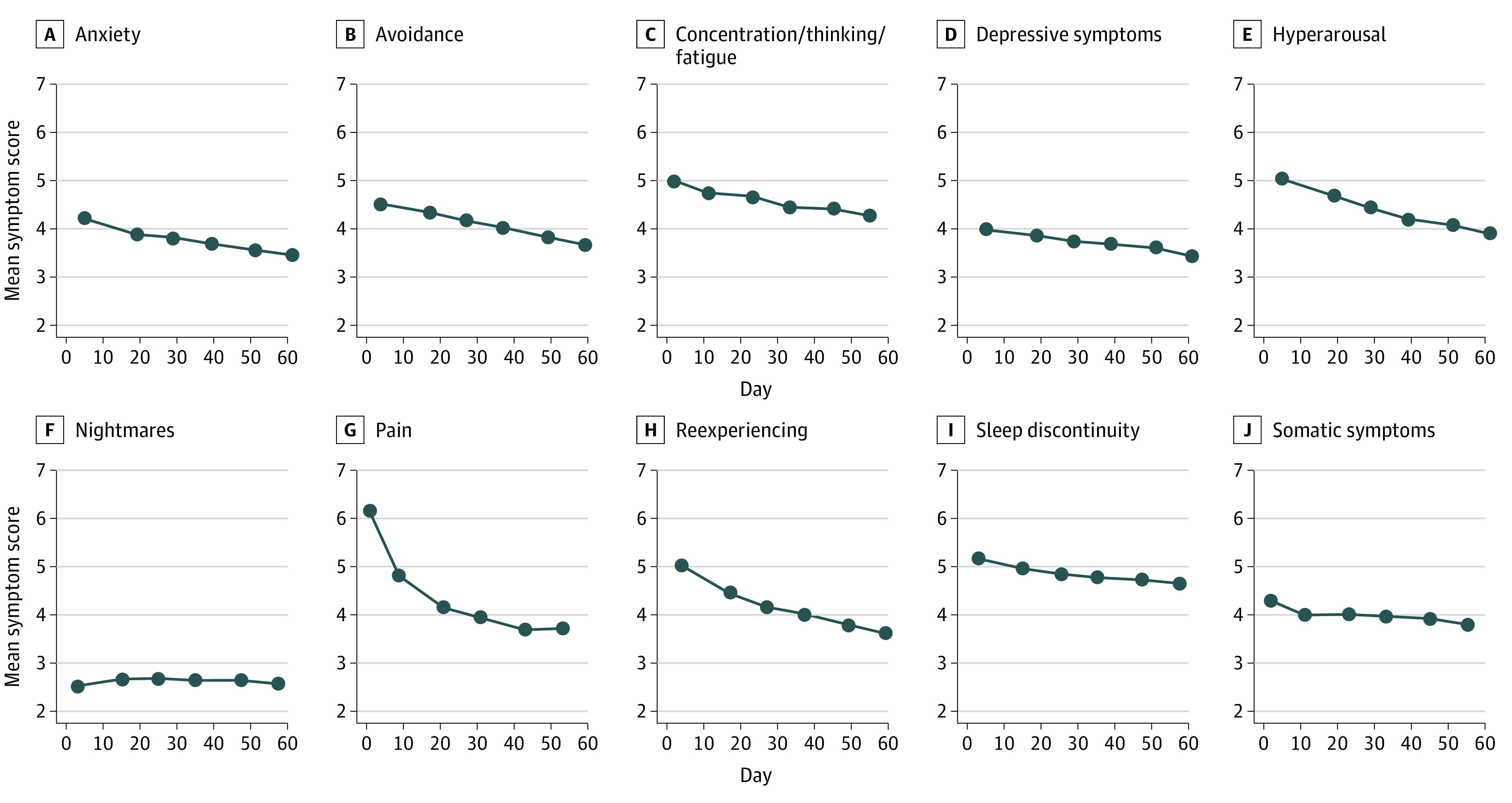
Figure.. Trajectory of Median Symptom Scores Over the First 8 Weeks After Trauma

Comment in

References

    1. Kilpatrick DG, Resnick HS, Milanak ME, Miller MW, Keyes KM, Friedman MJ. National estimates of exposure to traumatic events and PTSD prevalence using DSM-IV and DSM-5 criteria. J Trauma Stress. 2013;26(5):537-547. doi: 10.1002/jts.21848 - DOI - PMC - PubMed
    1. McLean SA, Ressler K, Koenen KC, et al. The AURORA study: a longitudinal, multimodal library of brain biology and function after traumatic stress exposure. Mol Psychiatry. 2020;25(2):283-296. doi: 10.1038/s41380-019-0581-3 - DOI - PMC - PubMed
    1. Momartin S, Silove D, Manicavasagar V, Steel Z. Comorbidity of PTSD and depression: associations with trauma exposure, symptom severity and functional impairment in Bosnian refugees resettled in Australia. J Affect Disord. 2004;80(2-3):231-238. doi: 10.1016/S0165-0327(03)00131-9 - DOI - PubMed
    1. Dobie DJ, Kivlahan DR, Maynard C, Bush KR, Davis TM, Bradley KA. Posttraumatic stress disorder in female veterans: association with self-reported health problems and functional impairment. Arch Intern Med. 2004;164(4):394-400. doi: 10.1001/archinte.164.4.394 - DOI - PubMed
    1. Clapp JD, Beck GJ, Palyo SA, Grant DM. An examination of the synergy of pain and PTSD on quality of life: additive or multiplicative effects? Pain. 2008;138(2):301-309. doi: 10.1016/j.pain.2008.01.001 - DOI - PMC - PubMed

Publication types