Video-Based Telemedicine for Kidney Disease Care: A Scoping Review
- PMID: 36630403
- PMCID: PMC8729490
- DOI: 10.2215/CJN.06660521
Video-Based Telemedicine for Kidney Disease Care: A Scoping Review
Abstract
Background and objectives: Video-based telemedicine provides an alternative health care delivery model for patients with CKD. The objective was to provide an overview of the available evidence on the implementation and outcomes of adopting video-based telemedicine in nephrology.
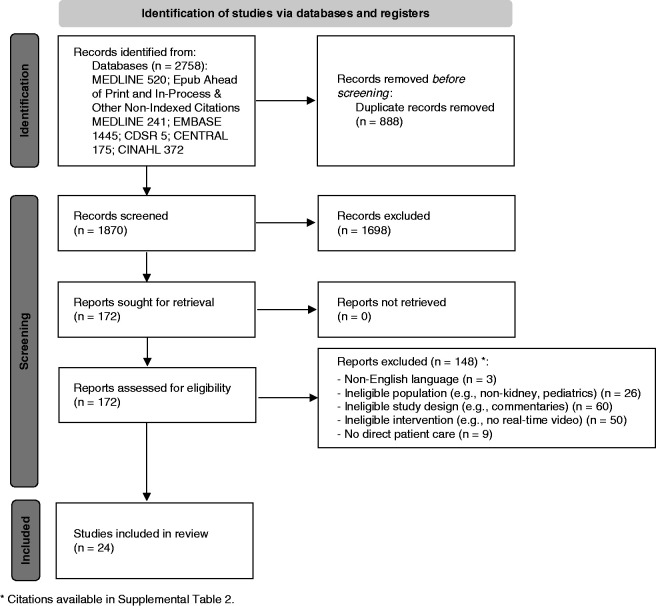
Design, setting, participants, & measurements: MEDLINE, EMBASE, Cochrane Database of Systematic Reviews, Cochrane Central Register of Controlled Trials, and CINAHL were searched in December 2019 and again in January 2021 for studies using video-based telemedicine for adults across the spectrum of kidney disease. Study types included peer-reviewed clinical trials, observational studies, and descriptive studies available in full text. Search results were independently screened by two authors, who then independently reviewed and extracted data from the eligible studies. Results were synthesized in tabular format, summarizing study characteristics by area within nephrology; the video-based interventions used; and clinical, health care utilization, and patient-reported outcomes.
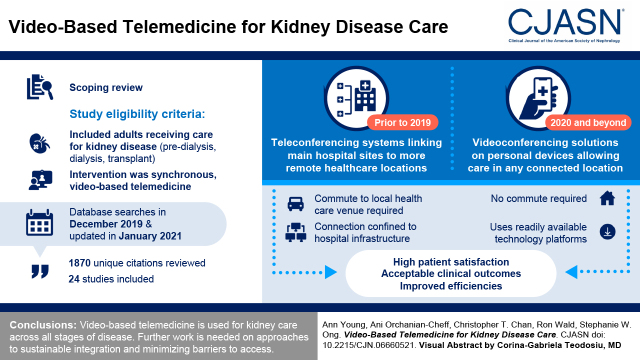
Results: After reviewing 1870 unique citations, 24 studies were included (four randomized controlled trials, six cohort studies, five pre-post intervention studies, seven case series, and two qualitative studies). Video-based technology was used to facilitate care across all stages of CKD. Although earlier studies used a range of institution-specific technologies that linked main hospital sites to more remote health care locations, more recent studies used technology platforms that allowed patients to receive care in a location of their choice. Video-based care was well received, with the studies reporting high patient satisfaction and acceptable clinical outcomes.
Conclusions: Video-based telemedicine is being used for kidney care and has evolved to be less reliant on specialized telemedicine equipment. As its use continues to grow, further primary studies and systematic reviews of outcomes associated with the latest innovations to video-based care in nephrology can address knowledge gaps, such as approaches to sustainable integration and minimization of barriers to access.
Keywords: chronic kidney disease; communications media; digital health; health services delivery model; review; telemedicine; virtual care.
Copyright © 2021 by the American Society of Nephrology.
Figures
Comment in
-
Telehealth and Kidney Disease Care: Role after the Public Health Emergency?Clin J Am Soc Nephrol. 2021 Dec;16(12):1784-1786. doi: 10.2215/CJN.13651021. Epub 2021 Dec 7. Clin J Am Soc Nephrol. 2021. PMID: 36630402 Free PMC article. No abstract available.
References
-
- Eckardt K-U, Coresh J, Devuyst O, Johnson RJ, Köttgen A, Levey AS, Levin A: Evolving importance of kidney disease: From subspecialty to global health burden. Lancet 382: 158–169, 2013 - PubMed
-
- Smart NA, Titus TT: Outcomes of early versus late nephrology referral in chronic kidney disease: A systematic review. Am J Med 124: 1073–80.e2, 2011 - PubMed
-
- Shaw J, Jamieson T, Agarwal P, Griffin B, Wong I, Bhatia RS: Virtual care policy recommendations for patient-centred primary care: Findings of a consensus policy dialogue using a nominal group technique. J Telemed Telecare 24: 608–615, 2018 - PubMed
-
- Page MJ, McKenzie JE, Bossuyt PM, Boutron I, Hoffmann TC, Mulrow CD, Shamseer L, Tetzlaff JM, Akl EA, Brennan SE, Chou R, Glanville J, Grimshaw JM, Hróbjartsson A, Lalu MM, Li T, Loder EW, Mayo-Wilson E, McDonald S, McGuinness LA, Stewart LA, Thomas J, Tricco AC, Welch VA, Whiting P, Moher D: The PRISMA 2020 statement: An updated guideline for reporting systematic reviews. BMJ 372: n71, 2021 - PMC - PubMed
Publication types
MeSH terms
Grants and funding
LinkOut - more resources
Full Text Sources
Medical