Randomized Controlled Trial
. 2023 Jan 17;4(1):100895.
doi: 10.1016/j.xcrm.2022.100895. Epub 2023 Jan 10.

Brief structured respiration practices enhance mood and reduce physiological arousal

Affiliations
Randomized Controlled Trial

Brief structured respiration practices enhance mood and reduce physiological arousal

Melis Yilmaz Balban et al. Cell Rep Med. .

Abstract

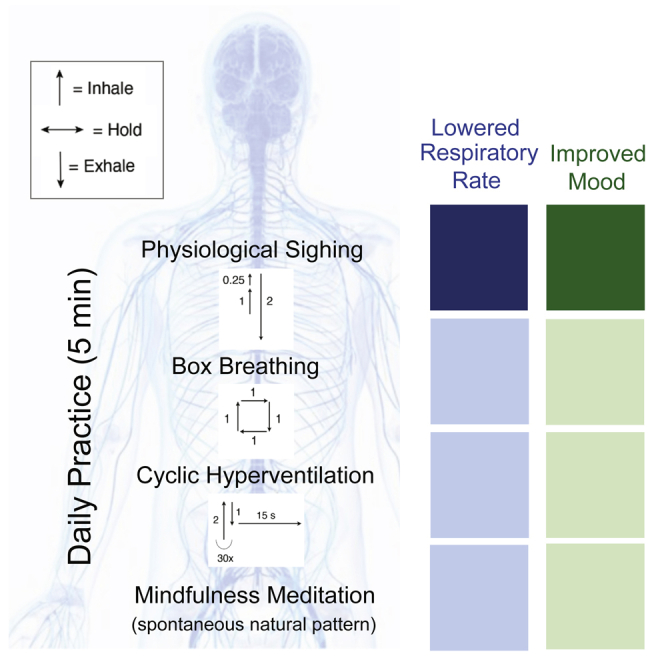
Controlled breathwork practices have emerged as potential tools for stress management and well-being. Here, we report a remote, randomized, controlled study (NCT05304000) of three different daily 5-min breathwork exercises compared with an equivalent period of mindfulness meditation over 1 month. The breathing conditions are (1) cyclic sighing, which emphasizes prolonged exhalations; (2) box breathing, which is equal duration of inhalations, breath retentions, and exhalations; and (3) cyclic hyperventilation with retention, with longer inhalations and shorter exhalations. The primary endpoints are improvement in mood and anxiety as well as reduced physiological arousal (respiratory rate, heart rate, and heart rate variability). Using a mixed-effects model, we show that breathwork, especially the exhale-focused cyclic sighing, produces greater improvement in mood (p < 0.05) and reduction in respiratory rate (p < 0.05) compared with mindfulness meditation. Daily 5-min cyclic sighing has promise as an effective stress management exercise.

Keywords: anxiety; autonomic; breathwork; heart rate variability; limbic; mindfulness meditation; mood; physiology; sleep; stress; wearable.


Conflict of interest statement

Declaration of interests A.D.H. became an advisor to WHOOP in June of 2022.

Figures
None
Graphical abstract
Figure 1
Figure 1
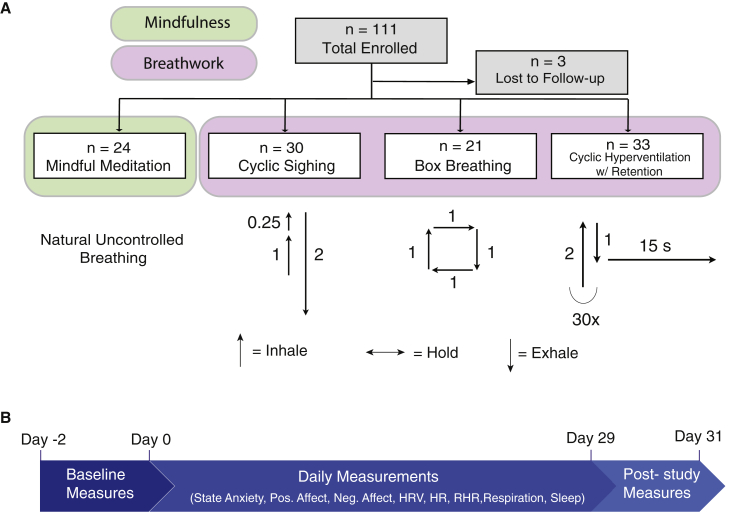
Study design (A) Chart describing study design and the mindfulness meditation and three breathing exercises tested. n = number of participants enrolled in each group. Upward arrows indicate the inhales, downward arrows indicate the exhales, and horizontal arrows indicate breath holds. The corresponding numbers indicate the approximate ratios in time of the inhales, holds, and exhales. See also Figure S1 and Tables S1 and S2. (B) Timeline describing the study. Baseline measurements were collected between day −2 and 0. Baseline measurements were STAI trait anxiety and PROMIS sleep-related daytime disturbance scores. The same measures were collected at the end of the study between days 29 and 31 (post-study measures). Daily measures included ones collected before and after the exercises, including measures of state anxiety, positive affect (PANAS) and negative affect (PANAS), as well as daily average data from the WHOOP strap including resting heart rate (RHR), respiration rate, heart rate variability (HRV; root mean square of successive differences between normal heartbeats [RMSSD]), sleep efficiency, hours of sleep, and sleep score.
Figure 2
Figure 2
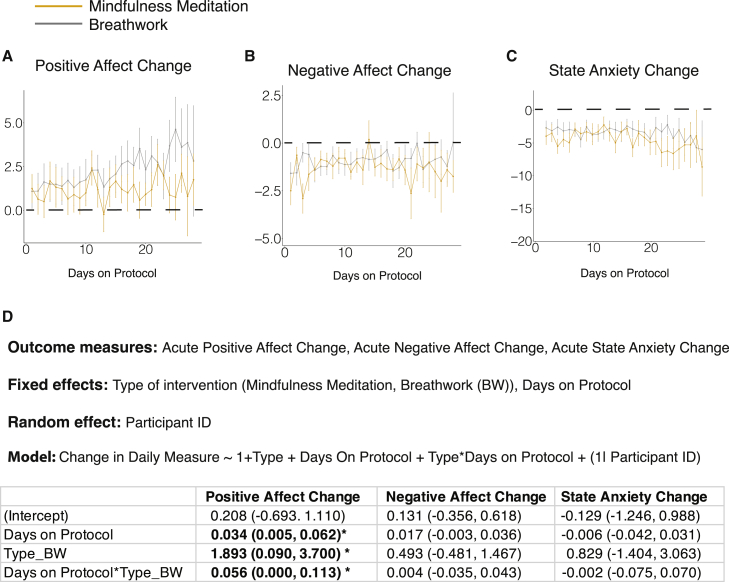
Effects of breathing exercises on daily pre- to post-change in subjective measures of anxiety and mood (A–C) Line plot showing the average daily change in PANAS positive affect (A), PANAS negative affect (B), and STAI state anxiety (C) on days 1–28 in the mindfulness meditation and breathwork groups (average rate of attrition = 2.5 participants/day for breathwork, 0.7 participants/day for mindfulness meditation, error bars = SEM). (D) Linear mixed-effects model to compare the daily psychological measures between the two types of protocols and estimate the effect of adherence to the protocol. Significant values are indicated in bold. (∗ = p < 0.05). See also Figures S2 and S4 and Table S2.
Figure 3
Figure 3
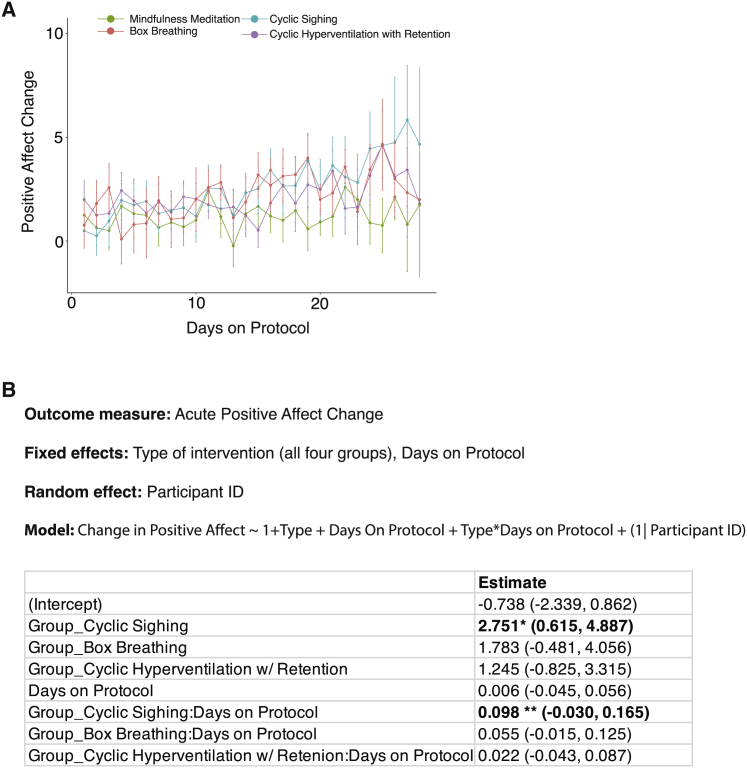
Effects of breathing exercises on daily positive affect (A) Line plot showing the average change in PANAS positive affect on days 1–28 in the mindfulness meditation and three individual breathwork groups (average rate of attrition = 0.7 participants/day for mindfulness meditation, 0.9 participants/day for cyclic sighing, 0.6 participants/day for box breathing, and 1.1 participants/day for cyclic hyperventilation, error bars = SEM). (B) Linear mixed-effects model to predict the positive affect change and with four different groups and adherence (number of days on protocol) as fixed effects. Significant values are indicated in bold. (∗ = p < 0.05, ∗∗ = p < 0.01). See also Figure S2.
Figure 4
Figure 4
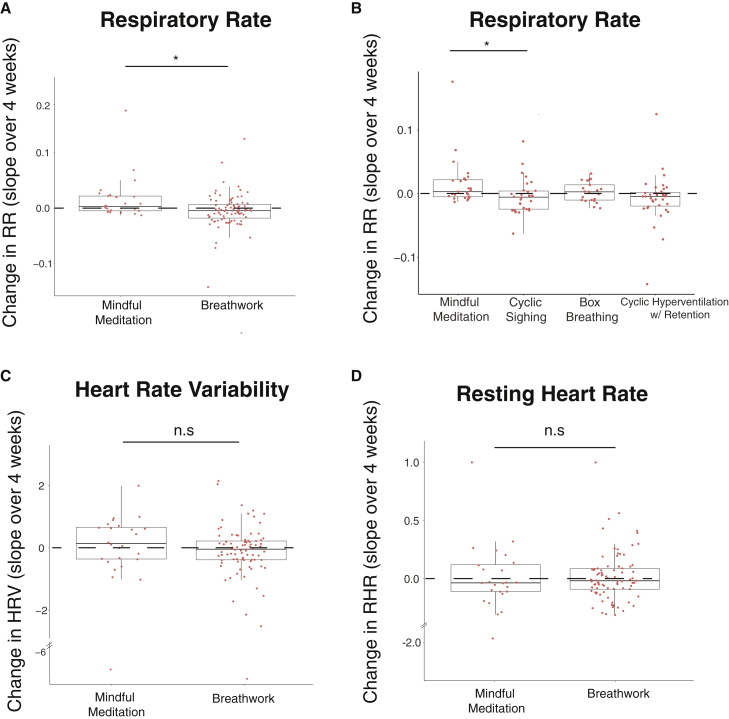
Changes in physiological measures over time Slope of respiratory rate (A), HRV (C), and RHR (D) over the course of the study in mindfulness meditation (n = 22) and all breathwork (n = 78) groups. Slope of respiratory rate in individual breathwork groups (cyclic sighing: n = 27, box breathing: n = 19, cyclic hyperventilation: n = 32) compared with mindfulness meditation (B). Each dot represents a participant (Mann-Whitney U test for comparison between two groups, Kruskal-Wallis test with Bonferroni-Holm correction for multi-group comparison, B). Upper and lower box edges represent 75th and 25th percentiles, respectively. The whiskers represent the largest and smallest data point that is less than 1.5 times the box length. See also Figures S3 and S5.

References

    1. Lavretsky H., Feldman PhD J.L. Precision medicine for breath-focused mind-body therapies for stress and anxiety: are we ready yet? Glob. Adv. Health Med. 2021;10 doi: 10.1177/2164956120986129. 2164956120986129. - DOI - PMC - PubMed
    1. Russo M.A., Santarelli D.M., O’Rourke D. The physiological effects of slow breathing in the healthy human. Breathe. 2017;13:298–309. doi: 10.1183/20734735.009817. - DOI - PMC - PubMed
    1. Bernardi L., Gabutti A., Porta C., Spicuzza L. Slow breathing reduces chemoreflex response to hypoxia and hypercapnia, and increases baroreflex sensitivity. J. Hypertens. 2001;19:2221–2229. doi: 10.1097/00004872-200112000-00016. - DOI - PubMed
    1. Li C., Chang Q., Zhang J., Chai W. Effects of slow breathing rate on heart rate variability and arterial baroreflex sensitivity in essential hypertension. Medicine (Baltim.) 2018;97:e0639. doi: 10.1097/MD.0000000000010639. - DOI - PMC - PubMed
    1. Burgess J., Ekanayake B., Lowe A., Dunt D., Thien F., Dharmage S.C. Systematic review of the effectiveness of breathing retraining in asthma management. Expert Rev. Respir. Med. 2011;5:789–807. doi: 10.1586/ers.11.69. - DOI - PubMed

Publication types