


Postmenopausal hormone therapy and mortality before and after the Women's Health Initiative study
- PMID: 36631522
- PMCID: PMC9834226
- DOI: 10.1038/s41598-023-27731-z
Postmenopausal hormone therapy and mortality before and after the Women's Health Initiative study
Abstract
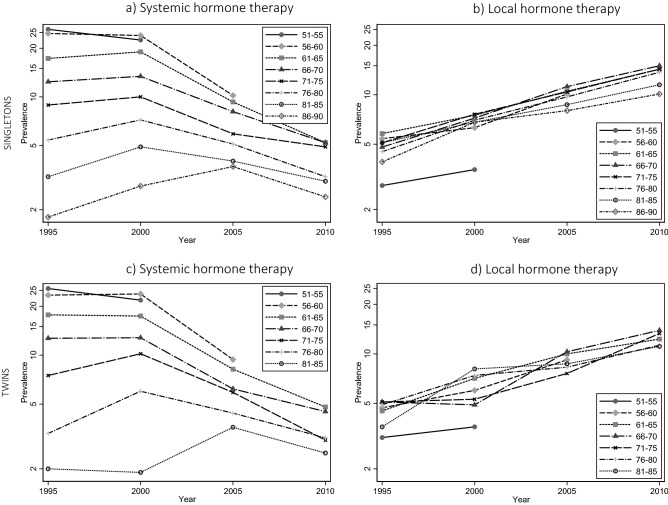
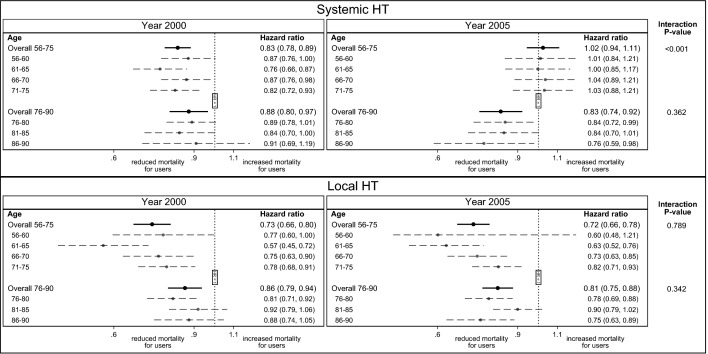
Weighing risks and benefits of postmenopausal hormone therapy (HT) has proven a balancing act. We aimed to investigate the association between HT and mortality before and after the 2002 publication from the Women's Health Initiative (WHI) study. This publication found that the risk of using HT outweighted the benefits, and thus it caused a marked reduction in systemic HT user prevalence. The 2002 WHI publication may also have caused a change in the subsequent HT user profile, as HT is no longer recommended in the prevention of chronic diseases. This cohort study included two populations followed from 1995: A 5% random sample of female singletons from the Danish general population (n = 52,388) and a sample of Danish female twins (n = 15,261). HT use was evaluated in 1995, 2000, 2005, and 2010. The association between HT, education, and mortality was investigated and controlled for potential unobserved familial confounding in a within-pair analysis. Singletons aged 56-75 using systemic HT in 2000 had a lower mortality compared to non-users (hazard ratio (HR) 0.83, 95% confidence interval (CI) 0.78-0.89). In 2005, the mortality was like that of the background population for this age group (HR 1.02, 95% CI 0.94-1.11). Recently postmenopausal twins showed a similar tendency. Systemic HT users, who had switched to local HT by 2005, had a substantially lower mortality than non-users (HR ranging from 0.42 to 0.67 depending on age group). In conclusion, we found that the prevalence of systemic HT use declined after 2002, and systemic HT users' mortality changed from lower before 2002 to similar to that of the background population after 2002. This indicates that the healthiest users decided to either drop systemic HT or switcted to local HT, as recommendations changed following the WHI publication.
© 2023. The Author(s).
Conflict of interest statement
The authors declare no competing interests.
Figures
References
Publication types
MeSH terms
Grants and funding
LinkOut - more resources
Full Text Sources
Medical
