Review
. 2023 Jan 12;19(1):e1011063.
doi: 10.1371/journal.ppat.1011063. eCollection 2023 Jan.

Potential long-term effects of SARS-CoV-2 infection on the pulmonary vasculature: Multilayered cross-talks in the setting of coinfections and comorbidities

Affiliations
Review

Potential long-term effects of SARS-CoV-2 infection on the pulmonary vasculature: Multilayered cross-talks in the setting of coinfections and comorbidities

Rahul Kumar et al. PLoS Pathog. .

Abstract

The Coronavirus Disease 2019 (COVID-19) caused by Severe Acute Respiratory Syndrome Coronavirus 2 (SARS-CoV-2) and its sublineages pose a new challenge to healthcare systems worldwide due to its ability to efficiently spread in immunized populations and its resistance to currently available therapies. COVID-19, although targeting primarily the respiratory system, is also now well established that later affects every organ in the body. Most importantly, despite the available therapy and vaccine-elicited protection, the long-term consequences of viral infection in breakthrough and asymptomatic individuals are areas of concern. In the past two years, investigators accumulated evidence on how the virus triggers our immune system and the molecular signals involved in the cross-talk between immune cells and structural cells in the pulmonary vasculature to drive pathological lung complications such as endothelial dysfunction and thrombosis. In the review, we emphasize recent updates on the pathophysiological inflammatory and immune responses associated with SARS-CoV-2 infection and their potential long-term consequences that may consequently lead to the development of pulmonary vascular diseases.


Conflict of interest statement

The authors have declared that no competing interests exist.

Figures
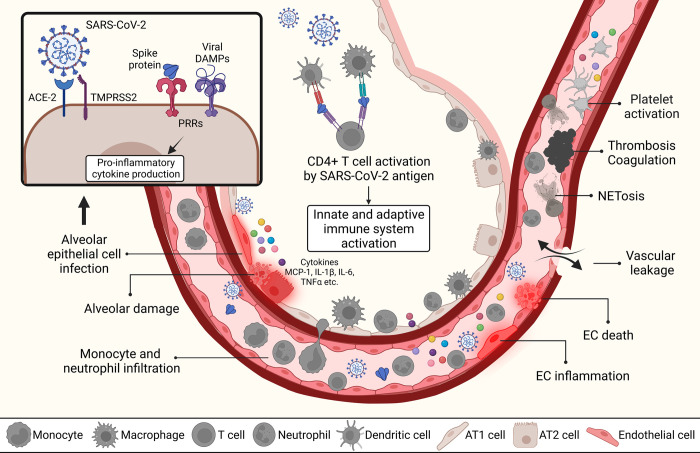
Fig 1
Fig 1. Acute response to SARS-CoV-2 infection in alveolar and vascular compartments.
SARS-CoV-2 by utilizing ACE2 and TMPRSS2 invades epithelial layers to enter in alveolar compartment. Infected cell then releases DAMPs and PAMP molecules to alert immune system. While antigen presenting cells process and present SARS-CoV-2 antigen to CD4+ T cells, activation of innate and adaptive immune systems and production of inflammatory cytokines such as MCP-1, IL-1β, IL-6, and TNFα take place. These inflammatory monocytes cause production and activation of tissue factors that induce endothelial dysfunction. EC inflammation and cell death disrupts endothelial barrier and result in vascular leakage. Vascular neutrophilic inflammation can mediate platelet activation via proinflammatory cytokines to establish immune thrombosis. NET formation can contribute to prothrombotic state in hyperinflammation. Created with BioRender.com. ACE2, angiotensin converting enzyme 2; DAMP, damage-associated molecular pattern; IL, interleukin; PAMP, pathogen-associated molecular pattern; PRR, pattern recognition receptor; SARS-CoV-2, Severe Acute Respiratory Syndrome Coronavirus 2; TMPRSS2, transmembrane serine protease 2; TNF, tumor necrosis factor.
Fig 2
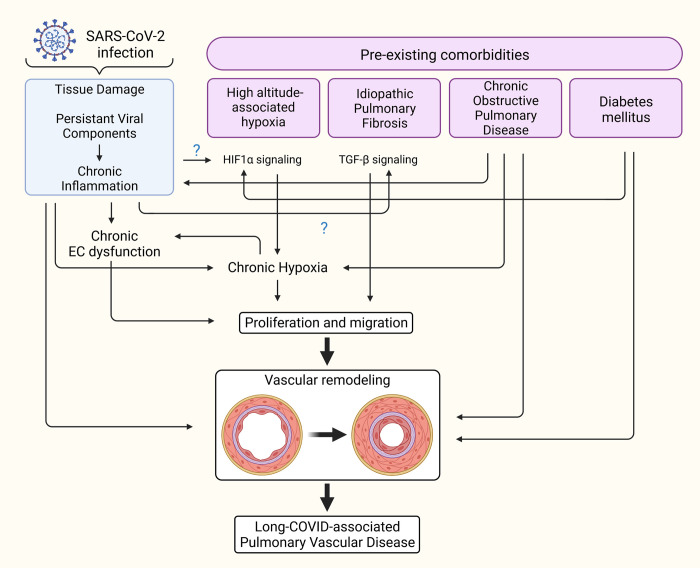
Fig 2. Comorbidities that may synergize with COVID-19 to predispose risks to PH.
The possible interactions between long COVID state and preexisting comorbidities that may contribute to pulmonary vascular remodeling and the development of PH. Created with BioRender.com. COVID-19, Coronavirus Disease 2019; HIF1-α, hypoxia-inducible factor 1-alpha; PH, pulmonary hypertension; SARS-CoV-2, Severe Acute Respiratory Syndrome Coronavirus 2; TGF-β, transforming growth factor-beta.
Fig 3
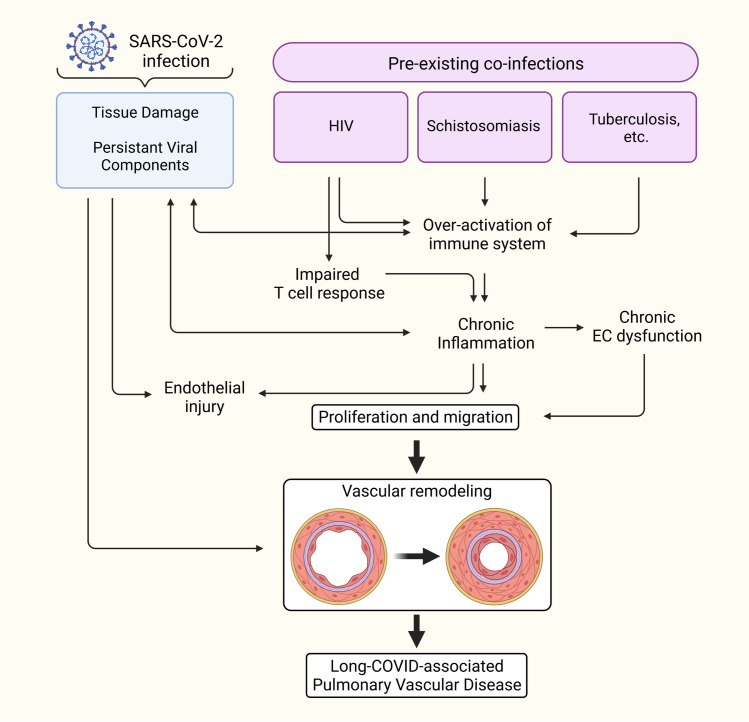
Fig 3. Coinfections that may synergize with COVID-19 to predispose risks to PH.
Preexisting chronic infections can be speculated for their contribution to prolonged inflammation in long COVID state. Created with BioRender.com. COVID-19, Coronavirus Disease 2019; PH, pulmonary hypertension; SARS-CoV-2, Severe Acute Respiratory Syndrome Coronavirus 2.
Fig 4
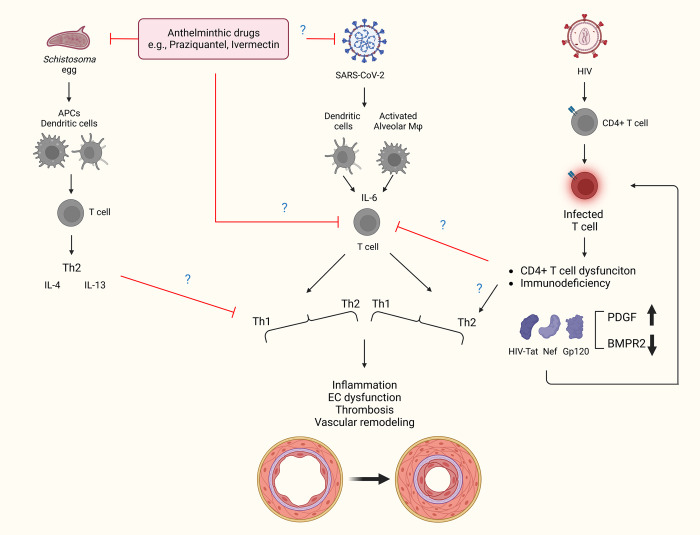
Fig 4. The schematic shows the activation of immune cells and cytokines trigged following Schistosoma, HIV, and SARS-CoV-2 infection.
Schistosoma antigen is presented to dendritic cells that activates CD4 T cells to release proinflammatory IL-IL4 and IL-13 [129,252]. On the other hand, SARS-CoV-2 antigen is processed by dendritic and alveolar macrophages with the release of IL-6 cytokine that eventually favors Th1-induced cytokine storms [253,254]. Schistosoma or SARS-CoV-2 infection results into releases of Ly6c monocytes from the bone marrow compartment that drives inflammatory process [255,256]. Of note, coinfection with both Schistosoma and SARS-CoV-2 might lead to higher severe conditions. However, based on the recent report on less prevalence of COVID-19 in Schistosoma-endemic regions, there is a possibility that anthelminthic drugs such as praziquantel might have antiviral property to block the replication of SARS-CoV-2 or dampen the accumulation and production of IL-6, although this was not observed clinically for ivermectin [257,258]. Blockade of IL-6 might be helpful in mitigating cytokine storm and endothelial damage. The other possibility could be the counterbalancing of Th1-induced cytokine storm by the predominance of Th2 immunity due to prior Schistosoma infection. The overall effect of Schistosoma and SARS-CoV-2 coinfection on downstream pathological features such as endothelial (EC) dysfunction. HIV proteins are known to cause endothelial dysfunction and vascular remodeling [152,218,219] via skewing the Th1-Th2 balance. HIV viral proteins Tat, Nef, and gp-120 were reported to reduce BMPR2 expressions, while Tat and gp120 can induce expression of PDGF and involving in pulmonary vascular remodeling. Further detailed studies are required to answer whether preexisting chronic HIV infection is associated with prolonged inflammation in long COVID phase. Created with BioRender.com. BMPR2, bone morphogenetic protein receptor type 2; COVID-19, Coronavirus Disease 2019; IL, interleukin; PDGF, platelet-derived growth factor; SARS-CoV-2, Severe Acute Respiratory Syndrome Coronavirus 2.

References

    1. Taquet M, Dercon Q, Luciano S, Geddes JR, Husain M, Harrison PJ. Incidence, co-occurrence, and evolution of long-COVID features: A 6-month retrospective cohort study of 273,618 survivors of COVID-19. PLoS Med. 2021;18:e1003773. doi: 10.1371/journal.pmed.1003773 - DOI - PMC - PubMed
    1. Mattiuzzi C, Henry BM, Sanchis-Gomar F, Lippi G. SARS-CoV-2 recurrent RNA positivity after recovering from coronavirus disease 2019 (COVID-19): a meta-analysis. Acta Biomed. 2020;91:e2020014. doi: 10.23750/abm.v91i3.10303 - DOI - PMC - PubMed
    1. Liu F, Cai Z-B, Huang J-S, Yu W-Y, Niu H-Y, Zhang Y, et al.. Positive SARS-CoV-2 RNA recurs repeatedly in a case recovered from COVID-19: dynamic results from 108 days of follow-up. Pathog Dis. 2020;78:ftaa031. doi: 10.1093/femspd/ftaa031 - DOI - PMC - PubMed
    1. Dominguez-Villar M, Hafler DA. Regulatory T cells in autoimmune disease. Nat Immunol. 2018;19:665–673. doi: 10.1038/s41590-018-0120-4 - DOI - PMC - PubMed
    1. Dejaco C, Duftner C, Grubeck-Loebenstein B, Schirmer M. Imbalance of regulatory T cells in human autoimmune diseases. Immunology. 2006;117:289–300. doi: 10.1111/j.1365-2567.2005.02317.x - DOI - PMC - PubMed

Publication types