Review
. 2023 Apr:60:102603.
doi: 10.1016/j.redox.2023.102603. Epub 2023 Jan 6.

Personalized redox medicine in inflammatory bowel diseases: an emerging role for HIF-1α and NRF2 as therapeutic targets

Affiliations
Review

Personalized redox medicine in inflammatory bowel diseases: an emerging role for HIF-1α and NRF2 as therapeutic targets

Arno R Bourgonje et al. Redox Biol. 2023 Apr.

Abstract

Inflammatory bowel diseases (IBD), encompassing Crohn's disease (CD) and ulcerative colitis (UC), are intimately associated with inflammation and overproduction of reactive oxygen species (ROS). Temporal and inter-individual variabilities in disease activity and response to therapy pose significant challenges to diagnosis and patient care. Discovery and validation of truly integrative biomarkers would benefit from embracing redox metabolomics approaches with prioritization of central regulatory hubs. We here make a case for applying a personalized redox medicine approach that aims to selectively inhibit pathological overproduction and/or altered expression of specific enzymatic sources of ROS without compromising physiological function. To this end, improved 'clinical-omics integration' may help to better understand which particular redox signaling pathways are disrupted in what patient. Pharmacological interventions capable of activating endogenous antioxidant defense systems may represent viable therapeutic options to restore local/systemic redox status, with HIF-1α and NRF2 holding particular promise in this context. Achieving the implementation of clinically meaningful mechanism-based biomarkers requires development of easy-to-use, robust and cost-effective tools for secure diagnosis and monitoring of treatment efficacy. Ultimately, matching redox-directed pharmacological interventions to individual patient phenotypes using predictive biomarkers may offer new opportunities to break the therapeutic ceiling in IBD.

Keywords: HIF-1α; Inflammatory bowel disease; NRF2; Oxidative stress; Redox medicine.


Conflict of interest statement

Declaration of competing interest The authors declare that they have no known competing financial interests or personal relationships that could have appeared to influence the work reported in this paper.

Figures
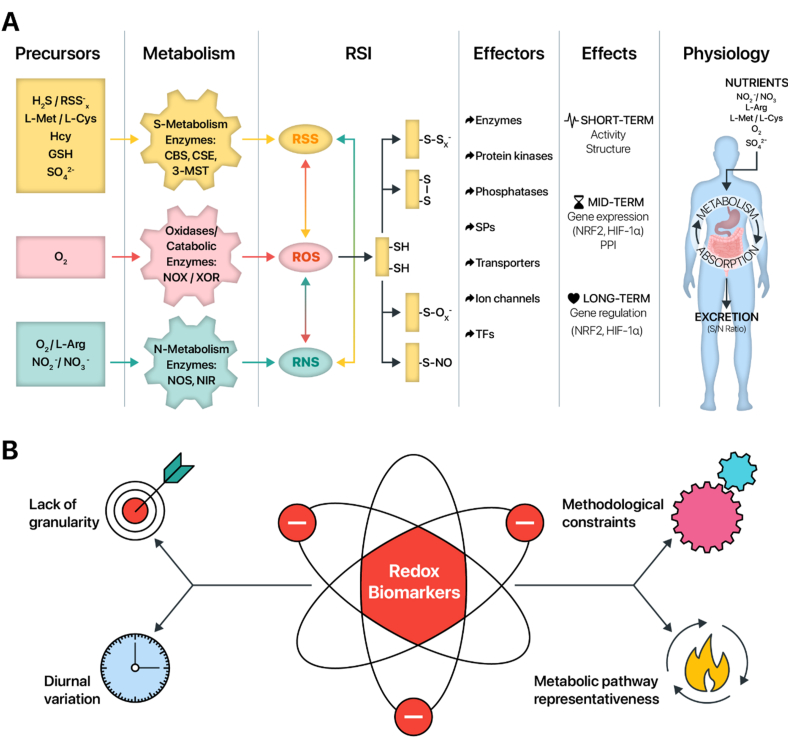
Fig. 1
Fig. 1
A conceptual framework and key considerations to foster the development of redox biomarkers for whole-body redox status in IBD. (A) Schematic overview of the key elements of the Reactive Species Interactome (RSI) which aims to describe chemical interactions among the different types of reactive species (ROS, RNS, and RSS) as well as their interactions with downstream biological targets, e.g. cysteine-based redox switches. Precursors of the RSI are mainly derived from the diet, consisting of organic (e.g. l-methionine, l-arginine) and inorganic (e.g. H2S, O2) compounds and cofactors (e.g. pyridoxal-5′-phosphate), which fuel intermediary metabolism and lead to the controlled formation of reactive species. The main biological targets of the RSI are cysteine-based redox switches, or thiols, acting as multimodal redox relays and modulating the activity of signaling molecules, leading to short-term (e.g. protein structure), mid-term (e.g. gene expression) and longer-term adaptations (e.g. gene regulation). Circulating levels of free thiols and stable end products of the RSI also serve as a communication conduit connecting the intestinal supply of RSI precursors with downstream intracellular thiol targets. (B) Key aspects considering the future of redox biomarkers in IBD, including a lack of granularity of biomarkers, methodological constraints, diurnal variation and their representativeness of redox-related metabolic pathways. Abbreviations: 3-MST, 3-mercaptopyruvate sulfurtransferase; CBS, cystathionine β-synthase; CSE, cystathionine γ-lyase; L-Arg, l-arginine; L-Cys, l-cysteine; L-Met, l-methionine; NIR, nitrite reductase; NOS, NO synthase; NOX, NADPH oxidases; RNS, reactive nitrogen species; ROS, reactive oxygen species; RSI, Reactive Species Interactome; RSS, reactive sulfur species; SPs, structural proteins; TFs, transcription factors; XOR, xanthine oxidoreductase.
Fig. 2
Fig. 2
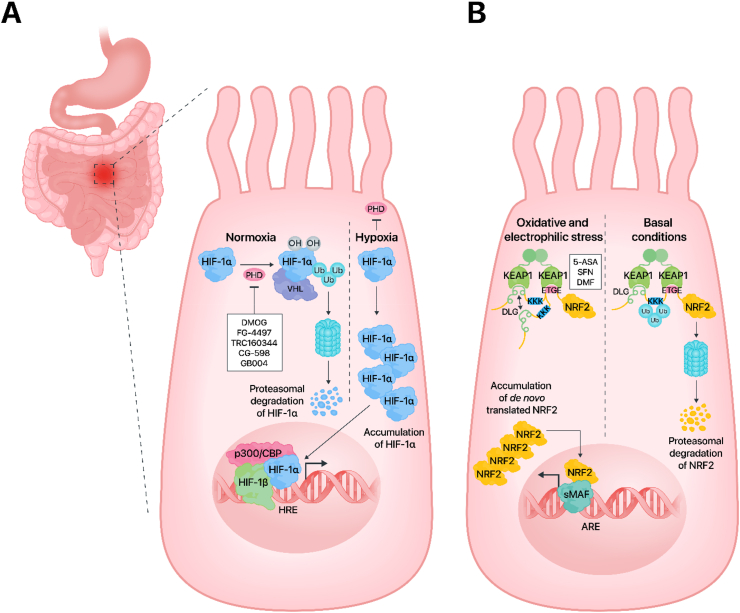
Modulation of HIF-1 and NRF2 signaling pathways. (A) Prolyl hydroxylases (PHD) are oxygen concentration-dependent enzymes, which under normoxic conditions hydroxylate the α-subunit of HIF-1 to initiate its immediate proteasomal degradation. Hypoxia and PHD inhibitors block the activity of PHDs (by reducing the hydroxylation step), which leads to HIF-1α stabilization and nuclear translocation. The complex comprising a HIF-1α/β heterodimer and p300/CBP drives the expression of hypoxia-inducible target genes. Albeit intestinal epithelial cells are shown, it is important to note that HIF is not solely restricted to these cells but is also active in immune cells like macrophages, dendritic cells, and T- and B-lymphocytes (B) Under non-stressed conditions, the binding of NRF2 to KEAP1 exposes NRF2 lysines for CUL3-dependent ubiquitination, which targets NRF2 to proteasomal degradation. In the presence of oxidative stress and/or electrophiles, such as 5-ASA, SFN and DMF, conformational changes prevent NRF2 ubiquitination. De novo synthesized NRF2 translocates into the nuclei and triggers transcription of its target genes. Abbreviations: 5-ASA, 5-aminosalicylic acid; ARE, antioxidant response element; DLG, a low affinity binding motif for KEAP1; DMF, dimethyl fumarate; DMOG, dimethyloxallyl glycine; ETGE, a high affinity binding motif for KEAP1; HIF-1, hypoxia-inducible factor 1; HRE, hypoxia response element; KEAP1, Kelch-like ECH-associated protein 1; NRF2, nuclear factor erythroid 2-related factor 2; p300/CBP, acetyltransferases p300 and CREB binding protein; PHD, prolyl hydroxylase; SFN, sulforaphane; sMAF, small musculoaponeurotic fibrosarcoma protein; Ub, ubiquitin; VHL, von Hippel-Lindau tumor suppressor protein.
Fig. 3
Fig. 3
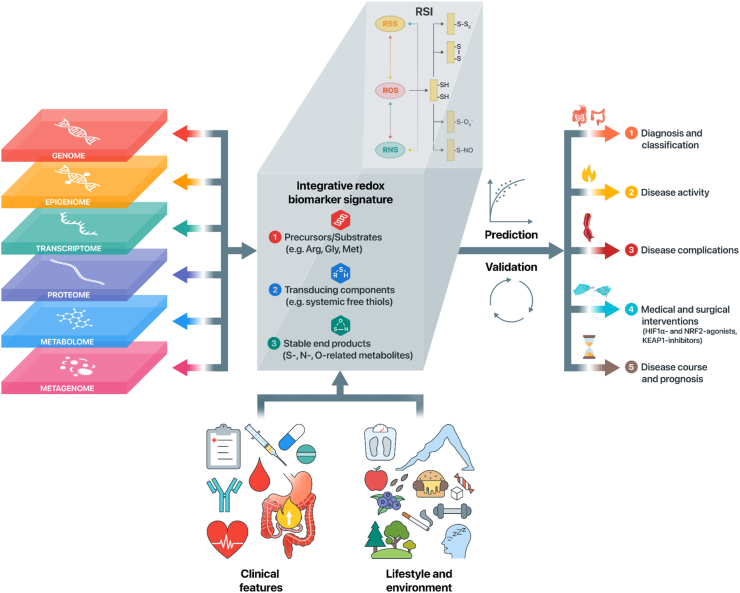
Personalized redox medicine and redox metabolomics in the context of IBD. An unbiased, data-driven multi-omics approach may help to define the key components of an integrative redox biomarker signature, while taking into account clinical features and lifestyle-related and environmental factors. Integrative redox-omics, i.e. analyzing redox biomarkers across different levels of biological organization, may help identify the key biomarkers based on the RSI. While integrating all this information, however, it is critical to allow careful phenotypic patient stratification at the same time. After the identification of predictive redox biomarker signatures, validation (both internally and externally) in independent cohorts should be pursued to reliably evaluate their utilities. Ultimately, this may lead to outcome-specific biomarker signatures that may help to (1) aid in diagnosis and improve molecular reclassification of IBD (e.g. disease location or extent), (2) to discriminate between quiescent and active disease states, (3) to discriminate between different types of disease complications (e.g. stricturing and penetrating disease phenotypes), (4) to predict individual responses to medical and surgical interventions in IBD, and (5) to help predict the risk of post-surgical disease course and, eventually, disease prognosis. Abbreviations: Arg, arginine; Gly, glycine; Met, methionine; RSI, Reactive Species Interactome.

References

    1. Chang J.T. Pathophysiology of inflammatory bowel diseases. N. Engl. J. Med. 2020;383(27):2652–2664. - PubMed
    1. de Souza H.S.P., Fiocchi C., Iliopoulos D. The IBD Interactome: an integrated view of aetiology, pathogenesis and therapy. Nat. Rev. Gastroenterol. Hepatol. 2017;14(12):739–749. - PubMed
    1. Ananthakrishnan A.N., Bernstein C.N., Iliopoulos D., Macpherson A., Neurath M.F., Ali R.A.R., et al. Environmental triggers in IBD: a review of progress and evidence. Nat. Rev. Gastroenterol. Hepatol. 2018;15(1):39–49. - PubMed
    1. Christ A., Latz E. The Western lifestyle has lasting effects on metaflammation. Nat. Rev. Immunol. 2019;19(5):267–268. - PubMed
    1. Ananthakrishnan A.N. Epidemiology and risk factors for IBD. Nat. Rev. Gastroenterol. Hepatol. 2015;12(4):205–217. - PubMed

MeSH terms

LinkOut - more resources