


Associations between HIV status and self-reported hypertension in a high HIV prevalence sub-Saharan African population: a cross-sectional study
- PMID: 36635037
- PMCID: PMC9843216
- DOI: 10.1136/bmjopen-2022-067327
Associations between HIV status and self-reported hypertension in a high HIV prevalence sub-Saharan African population: a cross-sectional study
Abstract
Objectives: This study examined whether HIV status and antiretroviral therapy (ART) exposure were associated with self-reported hypertension in Zimbabwe.
Design: Study data were taken from a cross-sectional, general population survey, which included HIV testing (July 2018-December 2019).
Setting: The data were collected in Manicaland Province, Zimbabwe.
Participants: 9780 people aged 15 years and above were included.
Outcome measure: Self-reported hypertension was the outcome measure. This was defined as reporting a previous diagnosis of hypertension by a doctor or nurse. After weighting of survey responses by age and sex using household census data, χ2 tests and logistic regression were used to explore whether HIV status and ART exposure were associated with self-reported hypertension.
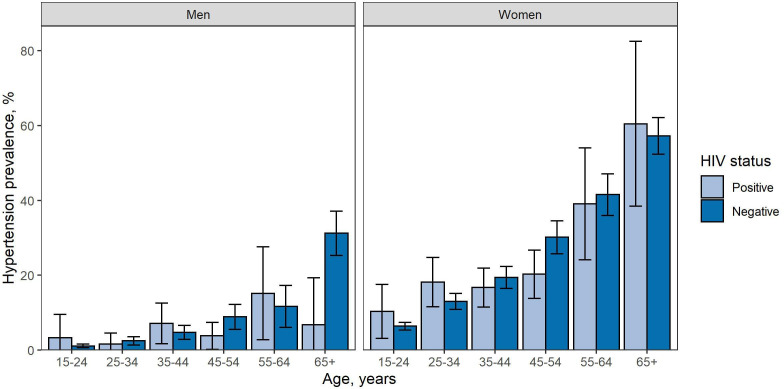
Results: The weighted prevalence of self-reported hypertension was 13.6% (95% CI 12.9% to 14.2%) and the weighted prevalence of HIV was 11.1% (10.4% to 11.7%). In univariable analyses, there was no evidence of a difference in the weighted prevalence of self-reported hypertension between people living with HIV (PLHIV) and HIV-negative people (14.1%, 11.9% to 16.3% vs 13.3%, 12.6% to 14.0%; p=0.503) or between ART-exposed and ART-naive PLHIV (14.8%, 12.0% to 17.7% vs 12.8%, 9.1% to 16.4%,p=0.388). Adjusting for socio-demographic variables in logistic regression did not alter this finding (ORs:HIV status:0.88, 0.70 to 1.10, p=0.261; ART exposure:0.83, 0.53 to 1.30, p=0.411).
Conclusions: Approximately one in seven PLHIV self-reported having hypertension, highlighting an important burden of disease. However, no associations were found between HIV status or ART exposure and self-reported hypertension, suggesting that it will be valuable to focus on managing other risk factors for hypertension in this population. These findings should be fully accounted for as Zimbabwe reorients its health system towards non-communicable disease control and management.
Keywords: HIV & AIDS; epidemiology; hypertension; public health.
© Author(s) (or their employer(s)) 2023. Re-use permitted under CC BY. Published by BMJ.
Conflict of interest statement
Competing interests: SG declares holding shares in AstraZeneca and GlaxoSmithKline. All other authors declare that no competing interests exist.
Figures

References
-
- GBD 2017 Risk Factor Collaborators . Global, regional, and national comparative risk assessment of 84 behavioural, environmental and occupational, and metabolic risks or clusters of risks for 195 countries and territories, 1990-2017: a systematic analysis for the global burden of disease study 2017. Lancet 2018;392:1923–94. 10.1016/S0140-6736(18)32225-6 - DOI - PMC - PubMed
Publication types
MeSH terms
Substances
Grants and funding
LinkOut - more resources
Full Text Sources
Medical
