


Injury incidence and risk factors in youth soccer players: a systematic literature review. Part I: epidemiological analysis
- PMID: 36636179
- PMCID: PMC9806741
- DOI: 10.5114/biolsport.2023.109961
Injury incidence and risk factors in youth soccer players: a systematic literature review. Part I: epidemiological analysis
Abstract
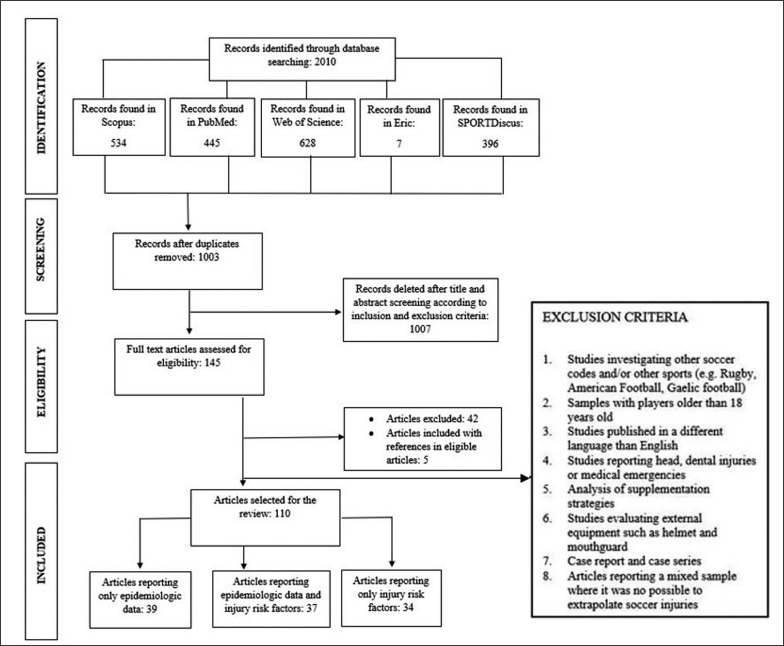
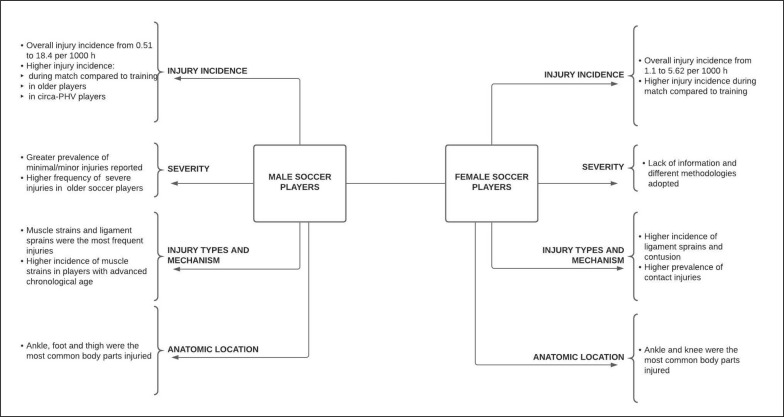
The analysis of the epidemiological data and the risk factors underlying injuries is crucial to promote prevention strategies in young soccer players. The objective of the present study was to perform a systematic literature review on the epidemiological data, described in the first part, and injury risk factors, presented in the second part. After electronic database searching, articles in line with the inclusion criteria were selected for the systematic review. Epidemiological data were extracted and discussed in this first part of the review. Data were grouped as follows: injury incidence, injury severity, and re-injury, injury types, injury mechanisms, and anatomical location. The principal findings of this first part of the review are as follows: (1) injury incidence is higher in older players and during matches than during training; (2) sex and maturity status may increase risk of injury; (3) male soccer players are more prone to muscle strains and ligament sprains while female players suffer more ligament sprains; (4) most injuries are located in the ankle and thigh in young male soccer players, and in the ankle and knee in female players; (5) severe injuries are less frequent but the incidence increases in older players. Re-injuries represent only a small percentage. Although soccer is considered a safe sport, many injuries are recorded in young soccer players every year. Injury predisposition changes in relation to age, sex, and biological age. Coaches and physical trainers should be aware of individual differences in order to promote prevention strategies and personalised training.
Keywords: Injury; Maturity; Prevention; Risk factors; Severity; Youth soccer.
Copyright © Biology of Sport 2023.
Conflict of interest statement
The authors have declared that no conflicts/competing interests exist.
Figures
References
-
- Count FB. 270 million people active in football. FIFA Commun Div Inf Serv. 2006; 31:2007.
-
- Čović N, Alić H, Manić G. Effects of recreational soccer on health status improvement. SPORT Sci. 2016; 18.
-
- Krustrup P, Nielsen JJ, Krustrup BR, Christensen JF, Pedersen H, Randers MB, Aagaard P, Petersen A-M, Nybo L, Bangsbo J. Recreational soccer is an effective health-promoting activity for untrained men. Br J Sports Med. 2009; 43(11):825–31. - PubMed
Publication types
LinkOut - more resources
Full Text Sources
