. 2022 Dec 20;4(5):689-700.
doi: 10.1016/j.jaccao.2022.11.004. eCollection 2022 Dec.

Biomarker Trends, Incidence, and Outcomes of Immune Checkpoint Inhibitor-Induced Myocarditis

Affiliations

Biomarker Trends, Incidence, and Outcomes of Immune Checkpoint Inhibitor-Induced Myocarditis

Alexi Vasbinder et al. JACC CardioOncol. .

Abstract

Background: Myocarditis is a dreaded and unpredictable complication of immune checkpoint inhibitors (ICI). We sought to determine whether routinely measured biomarkers could be helpful in monitoring for ICI myocarditis.

Objectives: The authors examined biomarker trends of patients on ICI and their association with the incidence of ICI myocarditis and outcomes.

Methods: We conducted an observational cohort study of adults who received at least one dose of ICI at Michigan Medicine between June 2014 and December 2021 and underwent systematic serial testing for aspartate aminotransferase (AST) and alanine aminotransferase (ALT), creatine phosphokinase (CPK), and lactate dehydrogenase during ICI therapy.

Results: Among 2,606 patients (mean age 64 ± 13 years; 60.7% men), 27 (1.0%) were diagnosed with ICI myocarditis. At diagnosis, patients with myocarditis had an elevated high-sensitivity troponin T (100%), ALT (88.9%), AST (85.2%), CPK (88.9%), and lactate dehydrogenase (92.6%). Findings were confirmed in an independent cohort of 30 patients with biopsy-confirmed ICI myocarditis. A total of 95% of patients with ICI myocarditis had elevations in at least 3 biomarkers compared with 5% of patients without myocarditis. Among the noncardiac biomarkers, only CPK was associated (per 100% increase) with the development of myocarditis (HR: 1.83; 95% CI: 1.59-2.10) and all-cause mortality (HR: 1.10; 95% CI: 1.01-1.20) in multivariable analysis. Elevations in CPK had a sensitivity of 99% and specificity of 23% for identifying myocarditis.

Conclusions: ICI myocarditis is associated with changes in AST, ALT, and CPK. An increase in noncardiac biomarkers during ICI treatment, notably CPK, should prompt further evaluation for ICI myocarditis.

Keywords: ALT; ALT, alanine aminotransferase; AST; AST, aspartate aminotransferase; CPK; CPK, creatine phosphokinase; ICI, immune checkpoint inhibitor; LDH, lactate dehydrogenase; ULN, upper limit of normal; biomarkers; hsTnT, high-sensitivity troponin T; immune checkpoint inhibitor; immunotherapy; irAE, immune-related adverse event; myocarditis; troponin.


Conflict of interest statement

Dr Vasbinder is supported by a National Heart, Lung, and Blood Institute funded postdoctoral fellowship (T32HL007853). Dr Hayek is supported by National Heart, Lung, and Blood Institute (R01HL153384) and the National Institute on Diabetes and Digestive and Kidney Diseases (R01-DK128012). All other authors have reported that they have no relationships relevant to the contents of this paper to disclose.

Figures
None
Graphical abstract
Figure 1
Figure 1
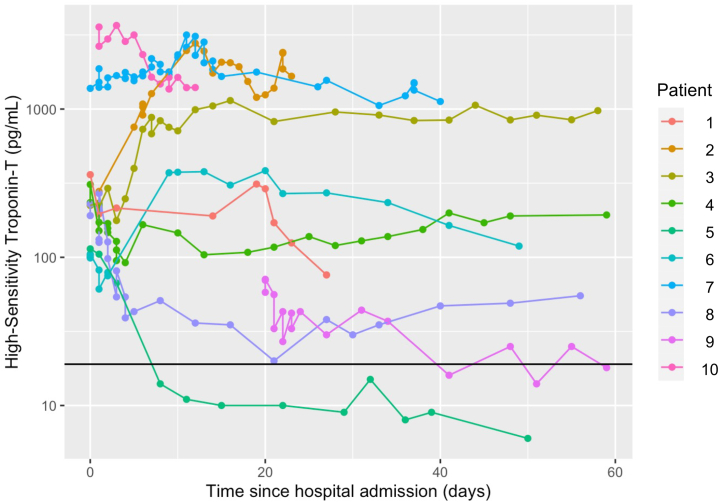
Serial High-Sensitivity Troponin T Levels Among Selected Immune Checkpoint Inhibitor–Induced Myocarditis Cases Serial high sensitivity troponin T plotted for 10 patients beginning at hospital admission for myocarditis. Patients were included if diagnosed after January 1, 2021. The black reference line indicates upper limit of normal (19 pg/mL). All but 1 patient had persistently elevated troponin for up to 60 days after diagnosis of myocarditis, likely reflecting persistent immune activation by immune checkpoint inhibitors or chronic myocarditis.
Figure 2
Figure 2
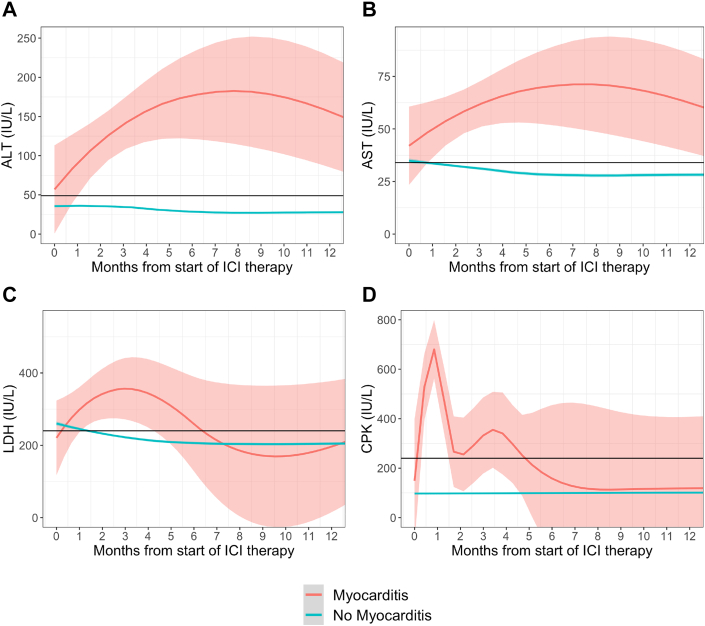
Longitudinal Biomarkers After ICI Comparing Patients With and Without Myocarditis Average concentration of biomarkers over 12 months beginning at the start of immune checkpoint inhibitor (ICI) therapy for patients with (red) and without (blue) myocarditis for the following biomarkers: (A) alanine aminotransferase (ALT) (reference: 49 IU/L), (B) aspartate aminotransferase (AST) (reference: 34 IU/L), (C) lactate dehydrogenase (LDH) (reference: 240 IU/L), and (D) creatine phosphokinase (CPK) (reference: 240 IU/L). Patients with myocarditis had higher average concentrations of ALT, AST, LDH, and CPK over 12 months after ICI therapy initiation compared with patients without myocarditis.
Figure 3
Figure 3
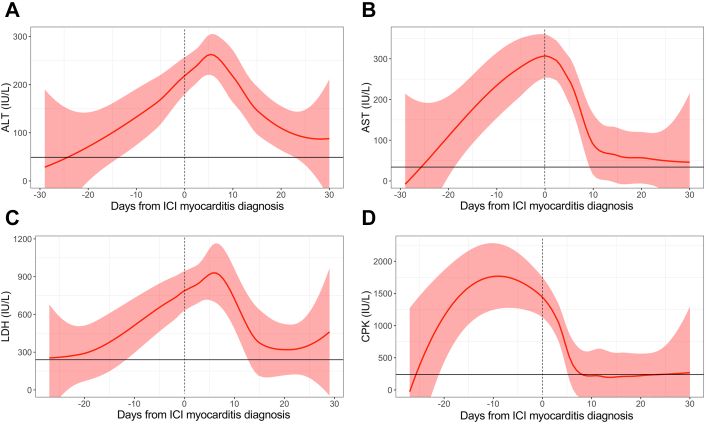
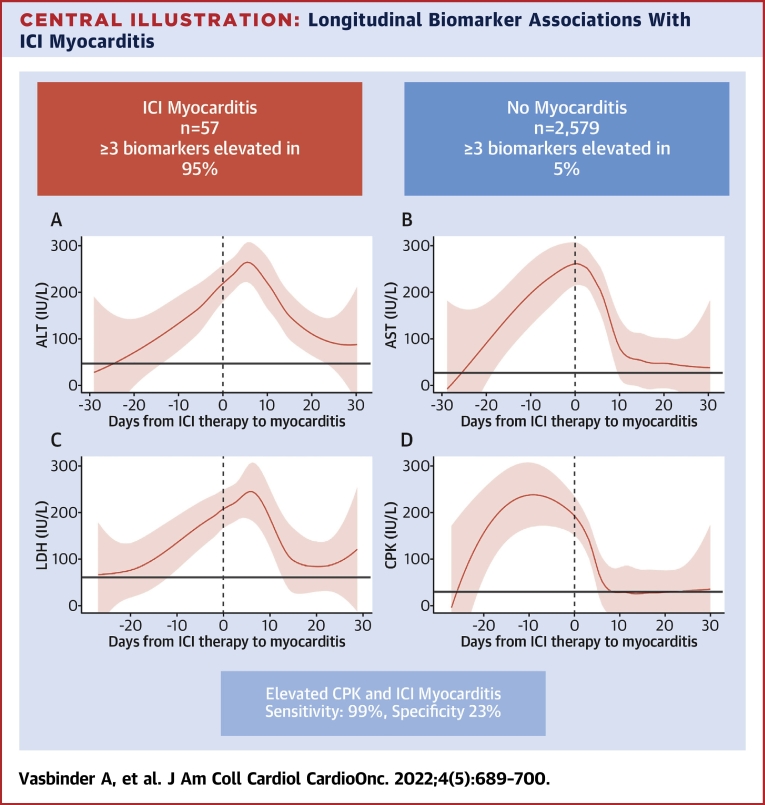
Longitudinal Biomarkers 30 Days Prior to and After Myocarditis Locally weighted scatterplot smoothing and 95% CIs of biomarker levels 30 days prior to and after diagnosis of myocarditis for (A) ALT (reference: 49 IU/L), (B) AST (reference: 34 IU/L), (C) LDH (reference: 240 IU/L), and (D) CPK (reference: 240 IU/L). Time 0 represents the time of myocarditis diagnosis. On average, increases in the levels of the nontroponin biomarkers preceded hospitalization for myocarditis, with CPK peaking the fastest prior to hospitalization. Elevations in these biomarkers may indicate the presence of myocarditis and should prompt further evaluation. Abbreviations as in Figure 2.
Central Illustration
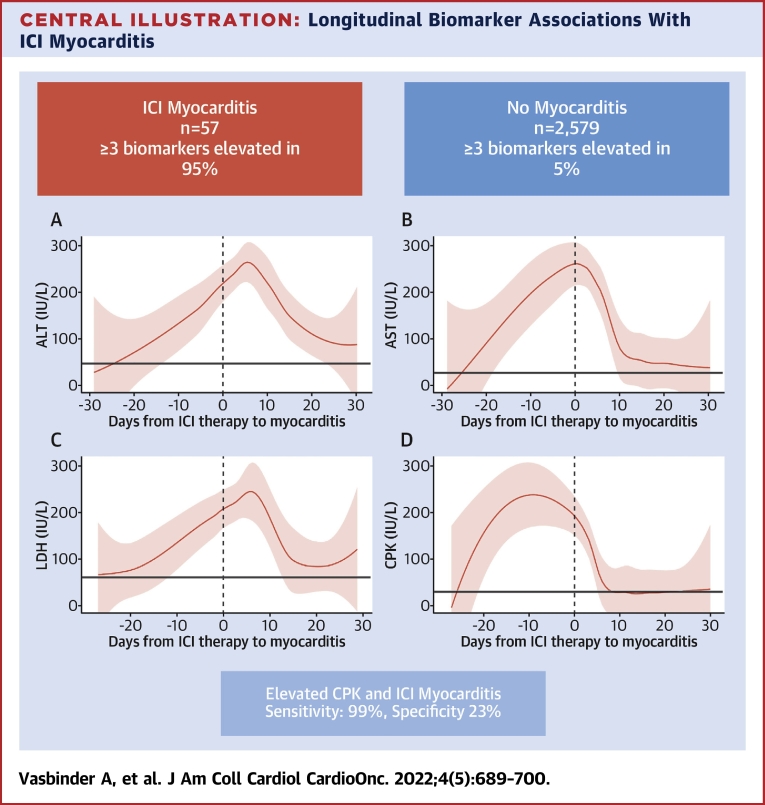
Longitudinal Biomarker Associations With ICI Myocarditis In this cohort study of patients with and without myocarditis, almost all patients with myocarditis had elevations in (A) alanine aminotransferase (ALT), (B) aspartate aminotransferase (AST), (C) lactate dehydrogenase (LDH), and (D) creatine phosphokinase (CPK), compared with only 5% of patients without myocarditis. All biomarkers began to rise prior to the diagnosis of myocarditis with CPK rising the fastest and peaking prior to hospitalization of myocarditis. Elevations in CPK had the best performance, with a sensitivity and specificity of 99% and 23%, respectively. Elevations in these biomarkers should prompt further evaluation for immune checkpoint inhibitor (ICI) myocarditis.

References

    1. Vaddepally R.K., Kharel P., Pandey R., Garje R., Chandra A.B. Review of indications of FDA-approved immune checkpoint inhibitors per NCCN guidelines with the level of evidence. Cancers (Basel) 2020;12:738. - PMC - PubMed
    1. Havel J.J., Chowell D., Chan T.A. The evolving landscape of biomarkers for checkpoint inhibitor immunotherapy. Nat Rev Cancer. 2019;19:133–150. - PMC - PubMed
    1. Wolchok J. Putting the immunologic brakes on cancer. Cell. 2018;175:1452–1454. - PubMed
    1. Wang D.Y., Salem J.-E., Cohen J.V., et al. Fatal toxic effects associated with immune checkpoint inhibitors: a systematic review and meta-analysis. JAMA Oncol. 2018;4:1721–1728. - PMC - PubMed
    1. Salem J.-E., Manouchehri A., Moey M., et al. Cardiovascular toxicities associated with immune checkpoint inhibitors: an observational, retrospective, pharmacovigilance study. Lancet Oncol. 2018;19:1579–1589. - PMC - PubMed

LinkOut - more resources