. 2023 Jan 13;13(1):724.
doi: 10.1038/s41598-023-27885-w.

The identification of metabolites from gut microbiota in NAFLD via network pharmacology

Affiliations

The identification of metabolites from gut microbiota in NAFLD via network pharmacology

Ki-Kwang Oh et al. Sci Rep. .

Abstract

The metabolites of gut microbiota show favorable therapeutic effects on nonalcoholic fatty liver disease (NAFLD), but the active metabolites and mechanisms against NAFLD have not been documented. The aim of the study was to investigate the active metabolites and mechanisms of gut microbiota against NAFLD by network pharmacology. We obtained a total of 208 metabolites from the gutMgene database and retrieved 1256 targets from similarity ensemble approach (SEA) and 947 targets from the SwissTargetPrediction (STP) database. In the SEA and STP databases, we identified 668 overlapping targets and obtained 237 targets for NAFLD. Thirty-eight targets were identified out of those 237 and 223 targets retrieved from the gutMgene database, and were considered the final NAFLD targets of metabolites from the microbiome. The results of molecular docking tests suggest that, of the 38 targets, mitogen-activated protein kinase 8-compound K and glycogen synthase kinase-3 beta-myricetin complexes might inhibit the Wnt signaling pathway. The microbiota-signaling pathways-targets-metabolites network analysis reveals that Firmicutes, Fusobacteria, the Toll-like receptor signaling pathway, mitogen-activated protein kinase 1, and phenylacetylglutamine are notable components of NAFLD and therefore to understanding its processes and possible therapeutic approaches. The key components and potential mechanisms of metabolites from gut microbiota against NAFLD were explored utilizing network pharmacology analyses. This study provides scientific evidence to support the therapeutic efficacy of metabolites for NAFLD and suggests holistic insights on which to base further research.


Conflict of interest statement

The authors declare no competing interests.

Figures
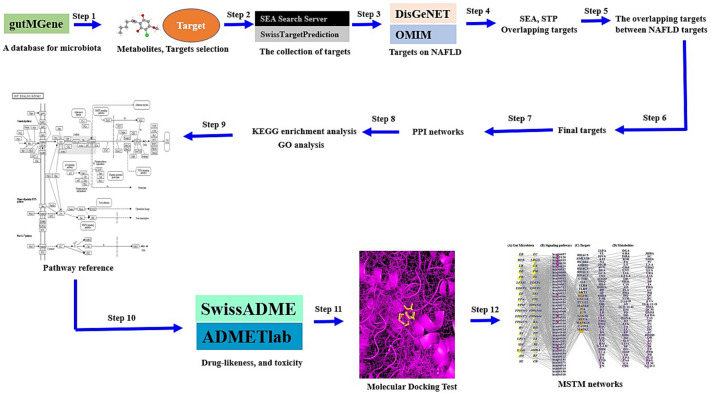
Figure 1
Figure 1
The workflow of this study.
Figure 2
Figure 2
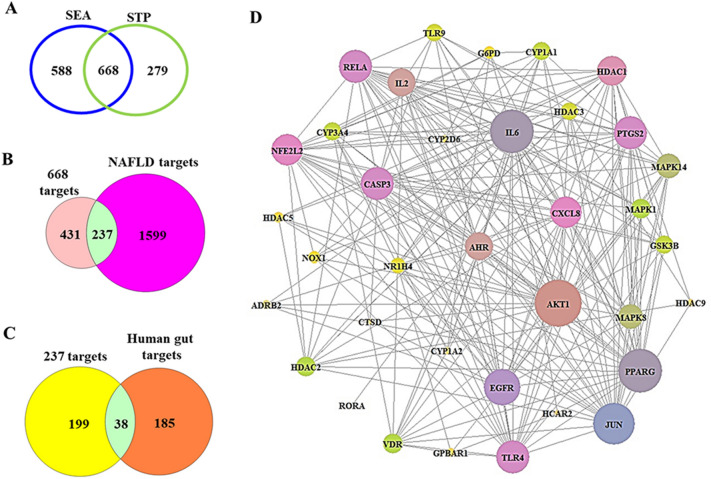
(A) The number of overlapping 668 targets between SEA and STP database. (B) The number of overlapping 237 targets between the 668 targets and NAFLD-related targets. (C) The number of the final overlapping 38 targets between the 237 targets and gut human targets. (D) The PPI networks (36 nodes and 237 targets).
Figure 3
Figure 3
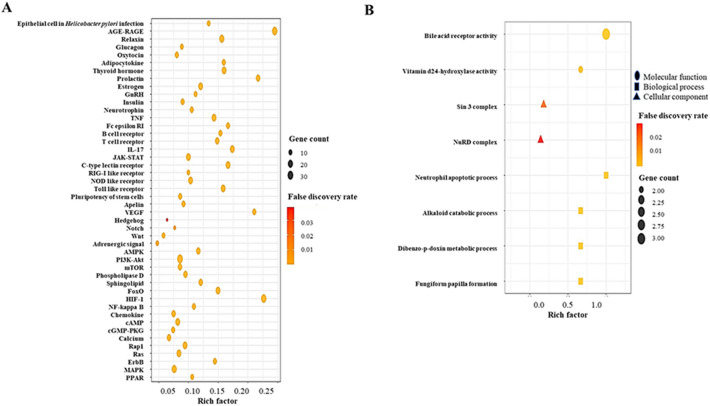
(A) KEGG enrichment analysis. (B) GO analysis.
Figure 4
Figure 4
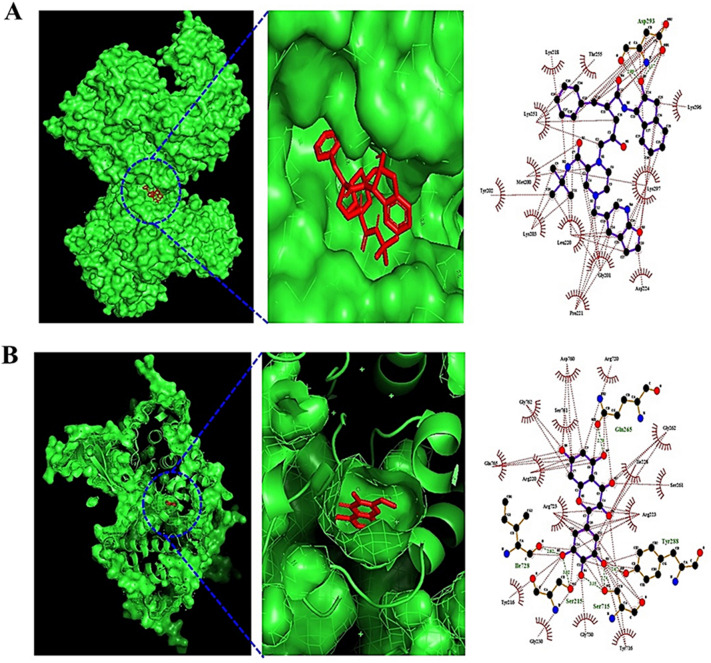
The molecular docking test on key targets of Wnt signaling pathway. (A) compound K-MAPK8 (PDB ID: 4YRB). (B) myricetin-GSK3B (PDB ID: 1J1B).
Figure 5
Figure 5
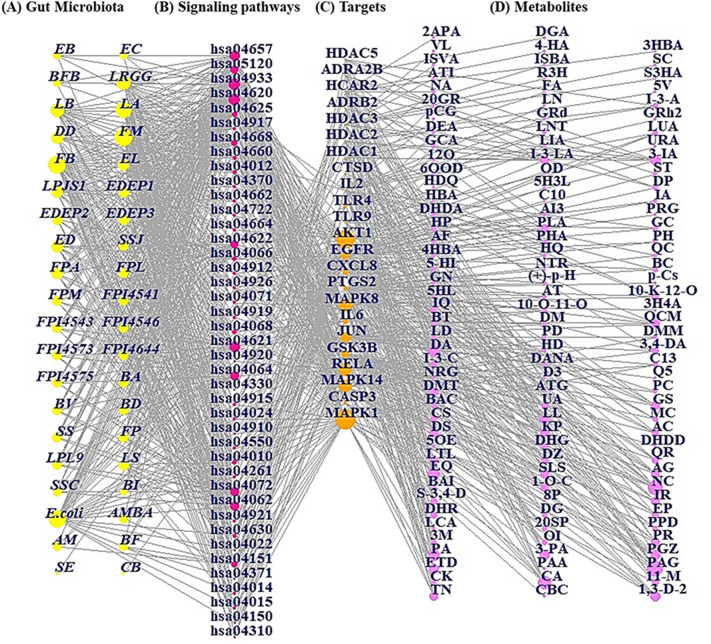
The MSTM networks (229 nodes and 1,044 edges). Yellow circle: gut microbiota; pink circle: signaling pathway; orange circle: target; violet circle: metabolite. (A) Microbiota. Firmicutes: FM; Fusobacteria: FB; Escherichia coli; E.coli; Lactobacillus acidophilus ATCC 4357: LA; Lactobacillus rhamnosus GG: LRGG; Lactobacillus: LB; Dictyostelium discoideum: DD; Enterococcus durans M4-5: ED; Lactobacillus paracasei JS1: LPJS1; Faecalibacterium prausnitzii A2-165: FPA; Eubacterium limosum: EL; Enterococcus durans EP1: EDEP1; Enterococcus durans EP2: EDEP2; Enterococcus durans EP3: EDEP3; Lachnospiraceae: LS; Streptococcus salivarius JIM8772: SSJ; Faecalibacterium prausnitzii L2-6: FPL; Faecalibacterium prausnitzii M 21/2: FPM; Faecalibacterium prausnitzii CNCM I-4541: FPI4541; Faecalibacterium prausnitzii CNCM I-4543: FPI4543, Faecalibacterium prausnitzii CNCM I-4546: FPI4546; Faecalibacterium prausnitzii CNCM I-4573: FPI4573; Faecalibacterium prausnitzii CNCM I-4644: FPI4644; Faecalibacterium prausnitzii CNCM I-4575: FPI4575; Bifidobacterium adolescentis: BA; Bacteroides vulgatus: BV; Bacteroides distasonis: BD; Streptococcus salivarius: SS; Faecalibacterium prausnitzii: FP; Lactobacillus plantarum L9: LPL9; Bacteroides fragilis ATCC 23,745: BF; Streptococcus salivarius CIP102503: SSC; Akkermansia muciniphila ATCC BAA-835: AMBA; Faecalibacterium prausnitzii A2 < U + 2013 > 165: FPA2; Akkermansia muciniphila: AM; Eubacterium: EB; Enterococcus: EC; Bifidobacterium: BFB; Bacteroides: BI; Salmonella enterica: SE; Clostridium butyricum ATCC 19,398: CB. (B) Signaling pathways. hsa04620: Toll-like receptor signaling pathway; hsa04657: IL-17 signaling pathway; hsa04933: AGE-RAGE signaling pathway in diabetic complications; hsa04668: TNF signaling pathway; hsa04917: Prolactin signaling pathway; hsa04660: T cell receptor signa;ing pathway; hsa05120: Epithelial cell signaling in Helicobacter pylori infection; hsa04722: Neurotrophin signaling pathway; hsa04662: B cell receptor signaling pathway; hsa04370: VEGF signaling pathway; hsa04071: Sphingolipid signaling pathway; hsa04068: FoxO signaling pathway; hsa04919: Thyroid hormone signaling pathway; hsa04064: NF-kappa B signaling pathway; hsa04920: Adipocytokine signaling pathway; hsa04062: Chemokine signaling pathway; hsa04630: JAK-STAT signaling pathway; hsa04926: Relaxin signaling pathway; hsa04622: RIG-I-like receptor signaling pathway; hsa04621: NOD-like receptor signaling pathway; hsa04915: Estrogen signaling pathway; hsa04024: cAMP signaling pathway; hsa04910: Insulin signaling pathway; hsa04072: Phospholipase D signaling pathway; hsa04150: mTOR signaling pathway; hsa04912: GnRH signaling pathway; hsa04151: PI3K-Akt signaling pathway; hsa04010: MAPK signaling pathway; hsa04921: Oxytocin signaling pathway; hsa04371: Apelin signaling pathway; hsa04014: Ras signaling pathway; hsa04022: cGMP-PKG signaling pathway; hsa04261: Adrenergic signaling in cardiomyocytes; hsa04015: Rap1 signaling pathway; hsa04310: Wnt signaling pathway; hsa04550: Signaling pathways regulating pluripotency of stem cells; hsa04330: Notch signaling pathway. (C) Targets. HDAC5: Histone deacetylase 5; ADRA2B: Alpha-2B adrenergic receptor; HCAR2: Hydroxycarboxylic acid receptor 2; ADRB2: Adrenoceptor Beta 2; HDAC3: Histone Deacetylase 3; HDAC2: Histone Deacetylase 2; HDAC1: Histone Deacetylase 1; CTSD: Cathepsin D; IL2: Interleukin 2; TLR4: Toll-like receptor 4; TLR9: Toll-like receptor 9; AKT1: AKT Serine/Threonine Kinase 1; EGFR: Epidermal Growth Factor Receptor; CXCL8: C-X-C Motif Chemokine Ligand 8; PTGS2: Prostaglandin-Endoperoxide Synthase 2; MAPK8: Mitogen-Activated Protein Kinase 8; IL6: Interleukin-6; JUN: Jun Proto-Oncogene, AP-1 Transcription Factor Subunit; GSK3B: Glycogen synthase kinase-3 beta; RELA: RELA Proto-Oncogene, NF-KB Subunit; MAPK14: Mitogen-Activated Protein Kinase 14; CASP3: Caspase 3; MAPK1: Mitogen-Activated Protein Kinase 1. (D) Metabolites. Phenylacetylglutamine: PAG; Naringenin chalcone: NC; Caffeic acid: CA; Phenylacetic acid: PA; Equol: EQ; Dihydroisoferulic acid: DA; 1,3-Diphenylpropan-2-ol: 1,3-D-2; Enterodiol: ETD; 3-Phenylpropionic acid: 3-PA; Pioglitazone: PGZ; Lunularin: LL; 3-Indolepropionic acid: 3-IA; Tretinoin: TN; Phloretin: PR; Icaritin: IR; Secoisolariciresinol: SLS; Apigenin: AG; Luteolin: LTL; Diosmetin: DS; Kaempferol: KP; Genistein: GS; Demethyltexasin: DMT; Quercimeritrin: QCM; Phenylalanine: PLA; Indole-3-lactic acid: I-3-LA; 11-Methoxycurvularin: 11-M; Dihydroresveratrol: DHR; Ethyl phenyllactate, (-)-: EP; Stilbene-3,4-diol: S-3,4-D; (S,R)-1-O-caffeoylglycerol: 1-O-C; Daidzein: DZ; Quercetin: QR; Acacetin: AC; Chrysin: CS; Urolithin A: UA; Indole-3-carboxylic acid: I-3-C; 3,4-Dihydroxyphenylacetic acid: 3,4-DA; Isoquercitrin: IQ; 10-Keto-12Z-octadecenoic acid: 10-K-12-O; Compound K: CK; 3-Methyloxindole: 3M; Oxindole: OI; (20S)-Protopanaxadiol: 20SP; Protopanaxadiol: PPD; Diosgenin: DG; Baohuoside I: BAI; Myricetin: MC; Baicalein: BAC; CHEBI:137478: C13; Levodopa: LD; Butyrate: BT; 10-Oxo-11-octadecenoic acid: 10-O-11-O; Baicalin: BC; Phloretic acid: PHA; HPLA: HP; Glycitein: GC; Dopamine: DP; Iuro-a: IA; Indole-3-acrylic acid: I-3-A; Dihydroglycitein: DHG; Leucocianidol: LCA; Ponciretin: PC; Danshensuan A: DANA; Hesperetin dihydrochalcone: HD; Platycodin D: PD; Didemethylmatairesinol: DMM; D-Mannose: DM; Acetic: AT; Genipin: GN; (+)-p-Hydroxyhydratropic acid: (+)-p–H; 5-HIAA: 5-HI; 4-Hydroxyphenylacetic acid: 4-HA; Hydroxyquercitrin: HQ; Quercitrin: QC; Acifran: AF; PhlP: PH; Dihydrocaffeic acid: DHDA; AI3-32,395: AI3; luro-a: IA; Serotonin: ST; Glycocholic acid: GCA; Lacto-N-tetraose: LNT; Nicotinic acid: NA; Colibactin: CBC; Palmitic acid: PAA; 8-Prenylnaringenin: 8P; 5-OH-Equol: 5OE; Dihydrogenistein: DHG; Dihydrodaidzein: DHDD; Arctigenin: ATG; Naringenin: NRG; DIF-3: D3; Q51617483: Q5; 3-Hydroxy-4-methoxybenzenepropanoic acid: 3H4A; 5-(Hydroxy-3-indolyl)lactic acid: 5HL; p-Cresol sulfate: p-Cs; Norathyriol: NTR; Phloroglucinol: PRG; Hydroumbellic acid: HDQ; CHEBI:10980: C10; Hydroquinone: HDQ; 5-hydroxyindole-3-lactic acid: 5H3L; 6′-OH-O-Dma: 6OOD; O-Desmethylangolensin: OD; 10-oxo-12Z-octadecenoic acid: 12O; Lithocholic acid: LIA; Ursodeoxycholic acid: URA; Deoxycholic acid: DEA; p-Cresol glucuronide: PCG; Ginsenoside-Rd: GRD; Ginsenoside Rh2: GRH; 20(R)-Ginsenoside Rh2: 20GR; LNnT: LN; Folic acid: FA; 5-(3,4-Dihydroxyphenyl)-valerolactone: 5V; Acetoin: ATI; (R)-3-Hydroxybutyrate: R3H; (S)-3-Hydroxybutyric acid: S3HA; Isovaleric acid: ISVA; Isobutyric acid: ISBA; Succinate: SC; Valerate: VL; 4-Hydroxybenzoic acid: 4HBA; 3-Hydroxybenzoic acid: 3HBA; 2-Acetoxypropanoic acid: 2APA; D-Glucuronic Acid: DGA.

References

    1. Valdes AM, Walter J, Segal E, Spector TD. Role of the gut microbiota in nutrition and health. BMJ. 2018;361:36–44. - PMC - PubMed
    1. Dogra SK, Doré J, Damak S. Gut microbiota resilience: Definition, link to health and strategies for intervention. Front. Microbiol. 2020;11:2245. doi: 10.3389/fmicb.2020.572921. - DOI - PMC - PubMed
    1. Hobby GP, Karaduta O, Dusio GF, Singh M, Zybailov BL, Arthur JM. Chronic kidney disease and the gut microbiome. Am. J. Physiol. Renal Physiol. 2019;316:F1211–F1217. doi: 10.1152/ajprenal.00298.2018. - DOI - PMC - PubMed
    1. Dosoky NS, May-Zhang LS, Davies SS. Engineering the gut microbiota to treat chronic diseases. Appl. Microbiol. Biotechnol. 2020;104:7657–7671. doi: 10.1007/s00253-020-10771-0. - DOI - PMC - PubMed
    1. Żółkiewicz J, Marzec A, Ruszczyński M, Feleszko W. Postbiotics—A step beyond pre- and probiotics. Nutrients. 2020;12:1–17. doi: 10.3390/nu12082189. - DOI - PMC - PubMed

Publication types

MeSH terms