. 2023 Jan 13;13(1):749.
doi: 10.1038/s41598-023-27808-9.

Dental caries detection using a semi-supervised learning approach

Affiliations

Dental caries detection using a semi-supervised learning approach

Adnan Qayyum et al. Sci Rep. .

Abstract

Early diagnosis of dental caries progression can prevent invasive treatment and enable preventive treatment. In this regard, dental radiography is a widely used tool to capture dental visuals that are used for the detection and diagnosis of caries. Different deep learning (DL) techniques have been used to automatically analyse dental images for caries detection. However, most of these techniques require large-scale annotated data to train DL models. On the other hand, in clinical settings, such medical images are scarcely available and annotations are costly and time-consuming. To this end, we present an efficient self-training-based method for caries detection and segmentation that leverages a small set of labelled images for training the teacher model and a large collection of unlabelled images for training the student model. We also propose to use centroid cropped images of the caries region and different augmentation techniques for the training of self-supervised models that provide computational and performance gains as compared to fully supervised learning and standard self-supervised learning methods. We present a fully labelled dental radiographic dataset of 141 images that are used for the evaluation of baseline and proposed models. Our proposed self-supervised learning strategy has provided performance improvement of approximately 6% and 3% in terms of average pixel accuracy and mean intersection over union, respectively as compared to standard self-supervised learning. Data and code will be made available to facilitate future research.


Conflict of interest statement

The authors declare no competing interests.

Figures
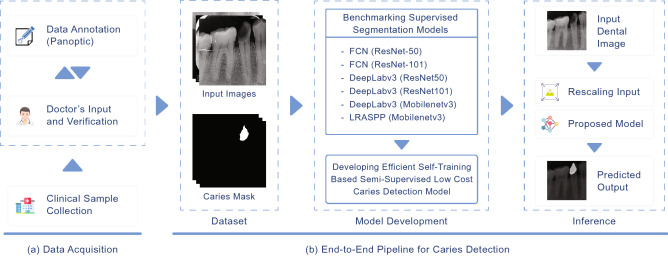
Figure 1
Figure 1
Illustration of our proposed method for caries detection in dental X-ray images that consists of two major parts (1) data collection and annotation; and (2) end-to-end training of caries detection models.
Figure 2
Figure 2
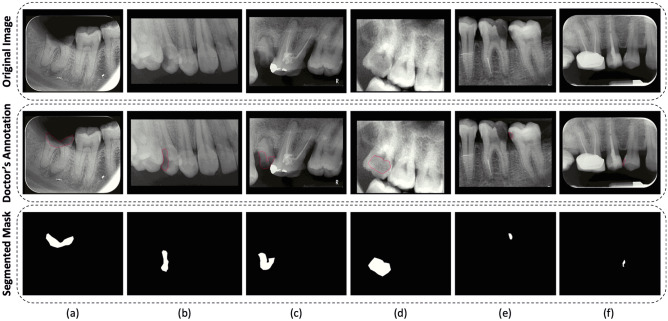
Illustration of different variations in our dataset. The first, second, and third rows contain original images, the doctor’s annotation, and the corresponding generated mask, respectively.
Figure 3
Figure 3
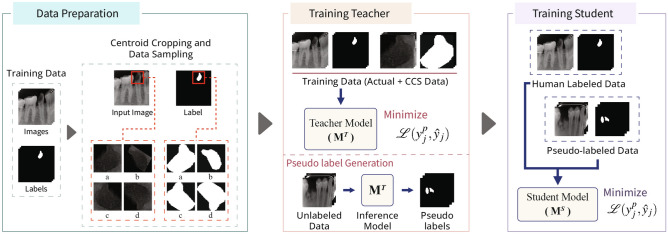
An overview of our proposed self-supervised learning-based method for dental caries segmentation. Firstly, the training data is re-sampled through our centroid cropping-based sampling (CCS) approach that initially extracts the cavity region from the input images and employs state-of-the-art transformation techniques to increase the data samples. Secondly, the teacher model MT is trained in a fully supervised learning fashion on real data (to guarantee high-quality pseudo-label generation), which is then used to generate pseudo labels for unlabelled images for training student model MS. Lastly, the student model is trained on both the real and pseudo labels to ensure better generalization.
Figure 4
Figure 4
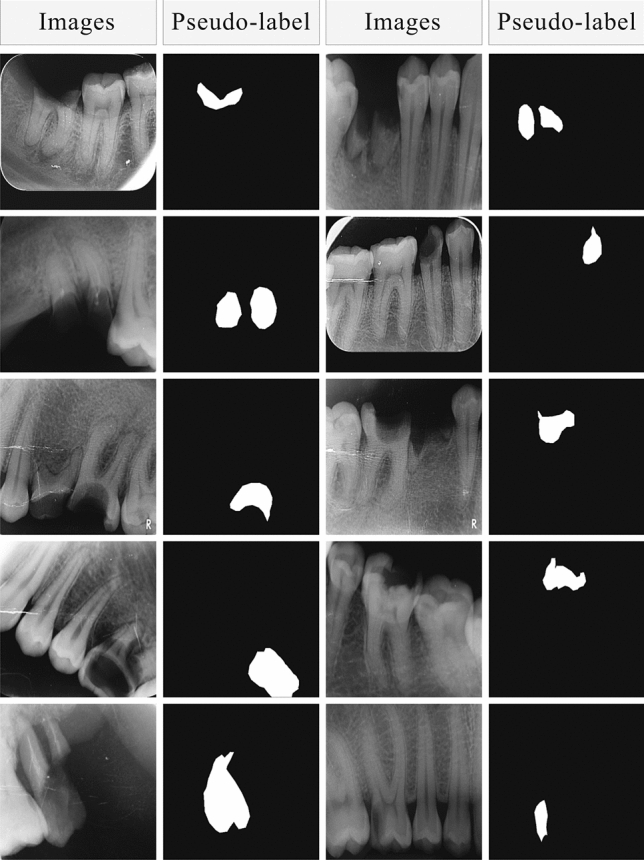
Visual examples of pseudo label generation using teacher model MT that are used for training student model MS in conjunction with unlabelled data DU. It can be seen that MT has accurately predicted the pseudo labels for unlabelled images (it is also supported by the quantitative results).
Figure 5
Figure 5
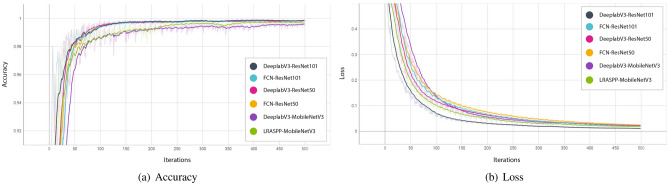
Models trained using the proposed self-training method demonstrate smooth learning behaviour in terms of accuracy and loss with an increase in iterations.
Figure 6
Figure 6
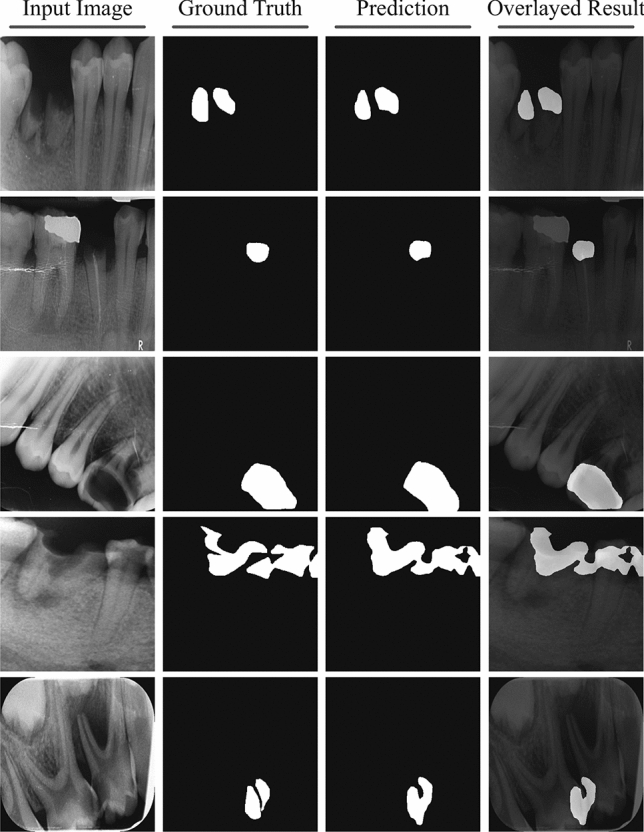
Qualitative results of proposed self-supervised learning strategy for caries detection in dental radiographs.

References

    1. Young DA, et al. The American Dental Association caries classification system for clinical practice: A report of the American Dental Association Council on Scientific Affairs. J. Am. Dent. Assoc. 2015;146:79–86. doi: 10.1016/j.adaj.2014.11.018. - DOI - PubMed
    1. Lee S, et al. Deep learning for early dental caries detection in bitewing radiographs. Sci. Rep. 2021;11:1–8. - PMC - PubMed
    1. Langlais RP, Skoczylas LJ, Prihoda TJ, Langland OE, Schiff T. Interpretation of bitewing radiographs: Application of the kappa statistic to determine rater agreements. Oral Surg. Oral Med. Oral Pathol. 1987;64:751–756. doi: 10.1016/0030-4220(87)90181-2. - DOI - PubMed
    1. Rasib M, Butt MA, Riaz F, Sulaiman A, Akram M. Pixel level segmentation based drivable road region detection and steering angle estimation method for autonomous driving on unstructured roads. IEEE Access. 2021;9:167855–167867. doi: 10.1109/ACCESS.2021.3134889. - DOI

    1. Qayyum A, Qadir J, Bilal M, Al-Fuqaha A. Secure and robust machine learning for healthcare: A survey. IEEE Rev. Biomed. Eng. 2020;14:156–180. doi: 10.1109/RBME.2020.3013489. - DOI - PubMed

Publication types