Review
. 2023 Mar;66(3):425-437.
doi: 10.1007/s00125-022-05857-5. Epub 2023 Jan 14.

Cardiovascular outcomes in type 1 and type 2 diabetes

Affiliations
Review

Cardiovascular outcomes in type 1 and type 2 diabetes

Annika Rosengren et al. Diabetologia. 2023 Mar.

Abstract

Diabetes is one of the most prevalent cardiometabolic disorders on the planet. Type 1 diabetes accounts for only a minority of all cases (recently estimated to be ~2% globally); however, since this is a disorder with an early onset, many people live with type 1 diabetes for a long time. CVD and premature death are the main long-term outcomes for both types of diabetes; however, the type of diabetes that carries the highest risk of these outcomes is a controversial topic and has not been widely studied. Because of the association between diabetes and CVD, the rise in type 2 diabetes prevalence over the past decades has huge effects on global health. The excess risk in people with diabetes compared with those without depends, to a large extent, on the presence of other factors, such as general cardiovascular risk factors (e.g. elevated LDL-cholesterol, hypertension and smoking) and also factors that are more specific to diabetes (e.g. HbA1c, and micro- and macroalbuminuria). Some contributory factors are modifiable, while others are not, such as age, sex and type of diabetes. Older people with type 2 diabetes who have risk factors that are under control can achieve levels of CVD risk that are similar to that of the general population, while younger individuals with type 1 diabetes are mostly unable to achieve similar levels of risk, probably because of long and cumulative exposure to raised blood glucose levels. Despite reports of declining rates of CVD among people with type 1 and type 2 diabetes, rising rates of both types of diabetes lead to a continuing rise in the number of people with cardiometabolic disorders worldwide, offsetting the progress made in many countries. Comparison between individuals with type 1 and type 2 diabetes with respect to risk of CVD is fraught with difficulties and highly dependent on other, concomitant factors, some of which are modifiable and others not. Nonetheless, as a whole, what matters most in determining the management of diabetes is absolute risk and lifetime risk. Life-long efforts to achieve glycaemic control, control of lipids and hypertension, and not smoking are key to prevention, with a healthy lifestyle and pharmacological therapy to be implemented as needed.

Keywords: Cardiovascular disease; Glycaemic control; Review; Risk factors; Type 1 diabetes; Type 2 diabetes.


Figures

Fig. 1
Fig. 1
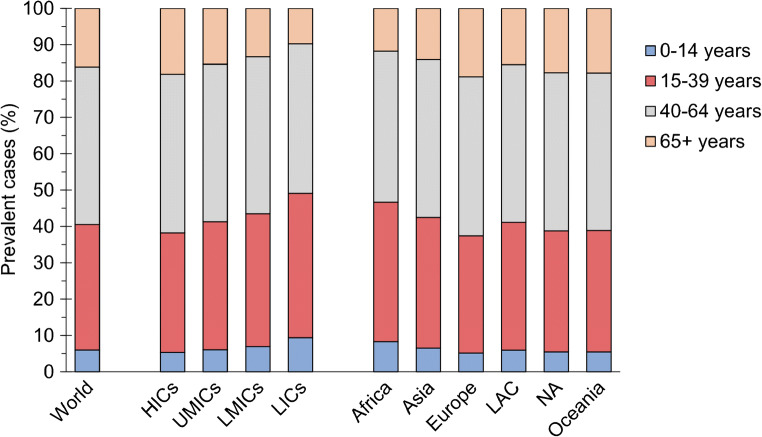
Distribution of prevalent cases of type 1 diabetes by current age, and by income groups and regions defined by UN population estimates. HICs, high-income countries; LAC, Latin America and the Caribbean; LICs, lower income countries; LMICs, lower middle-income countries; NA, North America; UMICs, upper middle-income countries. Reproduced from [10] under the terms of the Creative Commons Attribution 4.0 International License (http://creativecommons.org/licenses/by/4.0/), which permits unrestricted use, distribution, and reproduction in any medium. This figure is available as part of a downloadable slideset
Fig. 2
Fig. 2
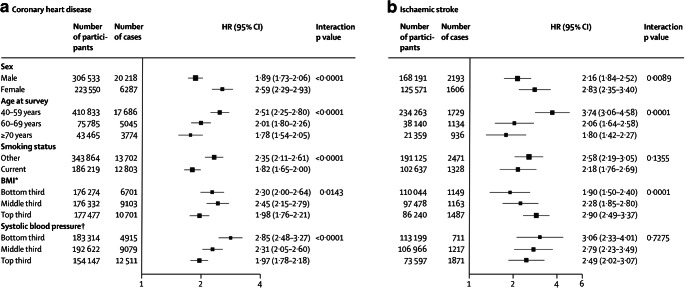
HRs for (a) CHD and (b) ischaemic stroke in people with diabetes at baseline vs those without, by individual characteristics. HRs were adjusted for age, smoking status, BMI and systolic BP, and, where appropriate, stratified by sex. *BMI categories: bottom third, <23.8 kg/m2 (mean: 21.7 kg/m2); middle third, 23.8–<27 kg/m2 (mean: 25.3 kg/m2); top third, ≥27 kg/m2 (mean: 30.7 kg/m2). Systolic BP categories: bottom third, <123 mmHg (mean: 113 mmHg); middle third, 123–<141 mmHg (mean: 132 mmHg); top third, ≥141 mmHg (mean: 157 mmHg). Reproduced from [63], © 2010 Elsevier Ltd, published as Open Access. This figure is available as part of a downloadable slideset
Fig. 3
Fig. 3
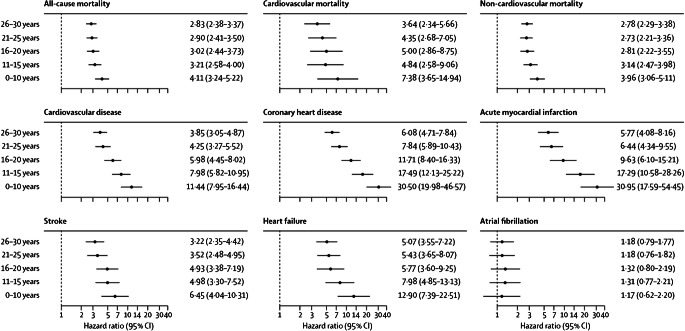
Forest plot showing adjusted HRs for mortality and cardiovascular outcomes, according to age at type 1 diabetes diagnosis. Analyses were based on Cox regression and adjusted for pre-existing comorbidities, calendar year, income, country of birth, marital status, educational attainment, and duration of diabetes. Matched controls served as a reference group for all models. Reproduced from [28], with permission from Elsevier. This figure is available as part of a downloadable slideset
Fig. 4
Fig. 4
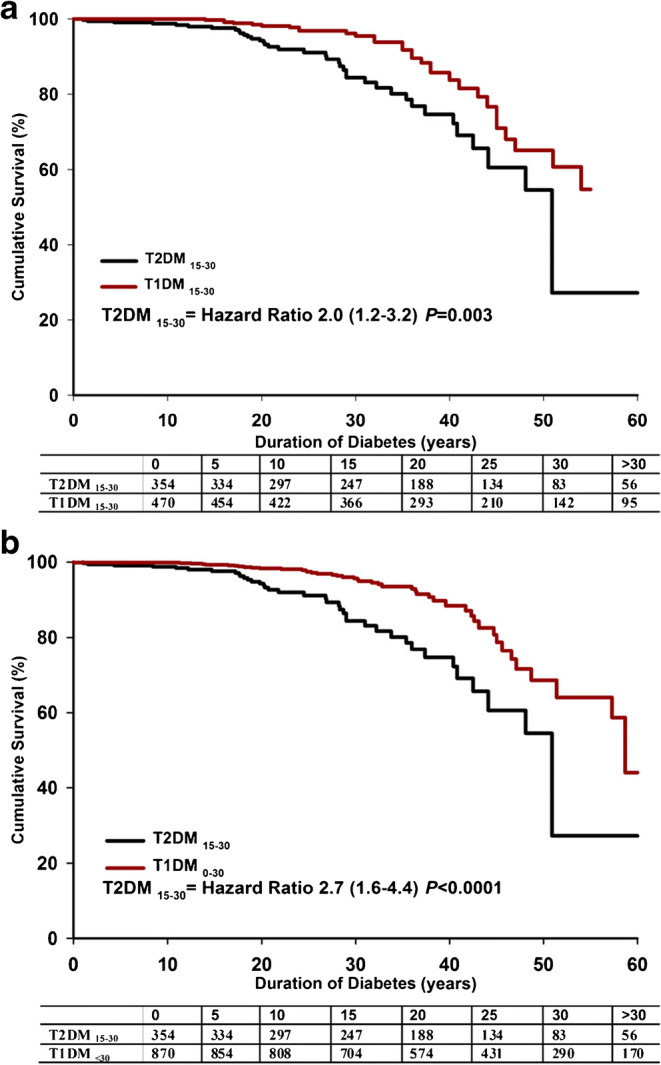
(a) Kaplan–Meier survival curve for individuals with type 2 diabetes (T2DM), aged 15–30 years (n=354), and type 1 diabetes (T1DM), aged 15–30 years (n=470). (b) Kaplan–Meier survival curve for individuals with type 2 diabetes, aged 15–30 years (n=354) and all individuals with type 1 diabetes (age of onset <30 years; n=870). Reprinted from [67] under the terms of the Creative Commons Attribution-NonCommercial-NoDerivs 3.0 Unported License (https://creativecommons.org/licenses/by-nc-nd/3.0/), which permits copying and distribution in any medium or format in the unadapted form, for noncommercial purposes only. This figure is available as part of a downloadable slideset

References

    1. NCD Risk Factor Collaboration (NCD-RisC) Worldwide trends in diabetes since 1980: a pooled analysis of 751 population-based studies with 4.4 million participants. Lancet. 2016;387(10027):1513–1530. doi: 10.1016/S0140-6736(16)00618-8. - DOI - PMC - PubMed
    1. Zimmet P, Alberti KG, Shaw J, et al. Global and societal implications of the diabetes epidemic. Nature. 2001;414(6865):782–787. doi: 10.1038/414782a. - DOI - PubMed
    1. Sun H, Saeedi P, Karuranga S, et al. IDF diabetes atlas: global, regional and country-level diabetes prevalence estimates for 2021 and projections for 2045. Diabetes Res Clin Pract. 2022;183:109119. doi: 10.1016/j.diabres.2021.109119. - DOI - PMC - PubMed
    1. The Lancet Planetary Health Striving for zero hunger in an uncertain world. Lancet Planet Health. 2022;6(6):e455. doi: 10.1016/S2542-5196(22)00126-7. - DOI - PubMed
    1. Dagenais GR, Gerstein HC, Zhang X, et al. Variations in diabetes prevalence in low-, middle-, and high-income countries: results from the prospective urban and rural epidemiological study. Diabetes Care. 2016;39(5):780–787. doi: 10.2337/dc15-2338. - DOI - PubMed

Publication types