


Effect of different dentin moisture on the push-out strength of bioceramic root canal sealer
- PMID: 36643254
- PMCID: PMC9831826
- DOI: 10.1016/j.jds.2022.06.025
Effect of different dentin moisture on the push-out strength of bioceramic root canal sealer
Abstract
Background/purpose: Different moisture condition may affect the adhesion between obturation materials and root canal walls, thus further affect the quality of root canal obturation. The aim of this study was to evaluate the influence of dentin moisture conditions after different root canal drying protocols on the push-out strength of bioceramic root canal sealer.
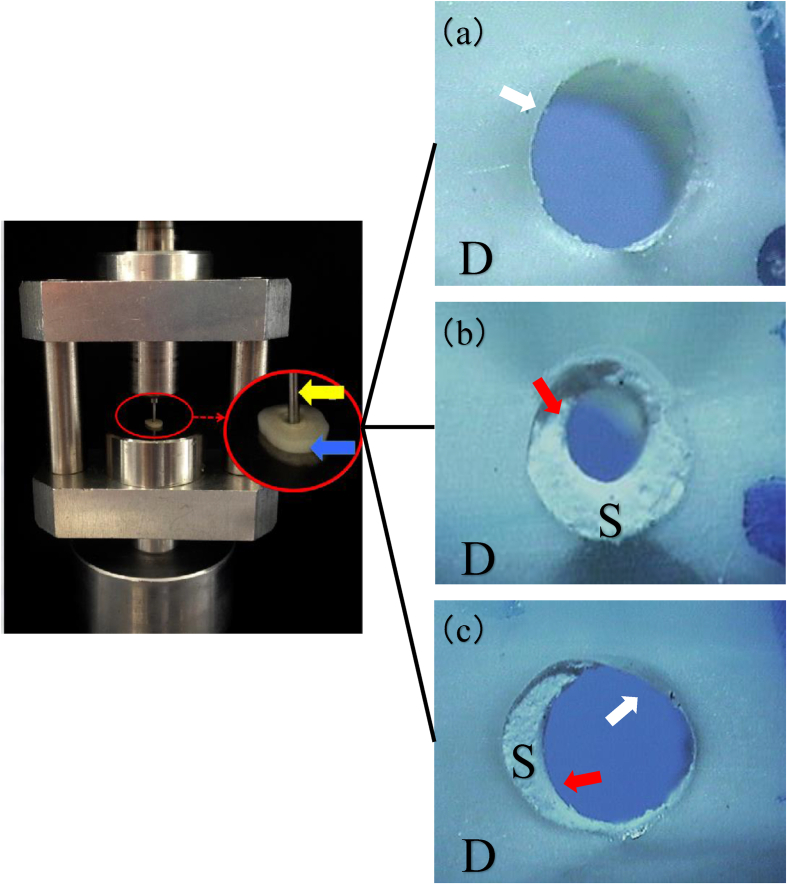
Materials and methods: Twenty root canals from extracted human decoronated premolars were prepared in vitro to #30/0.09 taper and assigned to 4 moisture condition groups after using different root canal drying protocols: normal moisture (paper point) group: the canals were blot dried with paper points until the last one appeared dry. Ethanol dry group: the canals were dried with paper points followed by dehydration with 95% ethanol. Isopropanol dry group: the canals were dried with paper points followed by dehydration with 70% isopropanol. Complete dry group: the canals were dried in an air-blowing thermostatic oven for at least 6 h until there was no change in weight at an interval of 1 h. After drying, the canals were obturated with bioceramic sealer iRoot SP. Then, each root was sectioned into eight slices with 1-mm-thick using a diamond saw (40 slices each group). The push-out strength was tested for each slice between the sealer and dentin wall using a universal testing machine at a crosshead speed of 0.5 mm/min, and failure modes were recorded. Two-way analysis of variance and Tukey test were used to analyze the push-out strength. Logarithmic linear regression analysis was used to compare the failure modes.
Results: Push-out strength was statistically different in different moisture groups (P < 0.05). After drying using paper point, iRoot SP specimens showed the highest push-out strength (2.04 ± 0.03 MPa), followed by 95% ethanol, 70% isopropanol. The lowest push-out strength (0.68 ± 0.04 MPa) was observed under complete dry. For the failure modes, the majority were cohesive failures in the coronal and middle thirds of the root; while in the apical third, mixed failure was common.
Conclusion: Different drying protocols influenced the push-out strength between bioceramic sealer and canal wall.
Keywords: Dentin moisture; Push-out strength; Root canal sealer.
© 2022 Association for Dental Sciences of the Republic of China. Publishing services by Elsevier B.V.
Conflict of interest statement
The authors have no conflicts of interest relevant to this article
Figures


References
-
- Ng Y.L., Mann V., Rahbaran S., Lewsey J., Gulabivala K. Outcome of primary root canal treatment: systematic review of the literature–part 1. Influence of clinical factors. Int Endod J. 2008;41:6–31. - PubMed
-
- Ørstavik D., Qvist V., Stoltze K. A multivariate analysis of the outcome of endodontic treatment. Eur J Oral Sci. 2010;112:224–230. - PubMed
-
- Tavares P.B., Bonte E., Boukpesso T., Siqueira J.F., Jr., Lasfargues J.J. Prevalence of apical periodontitis in root canal-treated teeth from an urban French population: influence of the quality of root canal fillings and coronal restorations. J Endod. 2009;35:810–813. - PubMed
-
- Shipper G., Ørstavik D., Teixeira F.B., Trope M. An evaluation of microbial leakage in roots filled with a thermoplastic synthetic polymer-based root canal filling material (Resilon) J Endod. 2004;30:342–347. - PubMed
LinkOut - more resources
Full Text Sources
