. 2022 Oct 28;8(1):81-90.
doi: 10.1016/j.ekir.2022.10.018. eCollection 2023 Jan.

Hyperparathyroidism Is an Independent Risk Factor for Allograft Dysfunction in Pediatric Kidney Transplantation

Affiliations

Hyperparathyroidism Is an Independent Risk Factor for Allograft Dysfunction in Pediatric Kidney Transplantation

Agnieszka Prytula et al. Kidney Int Rep. .

Abstract

Introduction: Little is known about the consequences of deranged chronic kidney disease-mineral and bone disorder (CKD-MBD) parameters on kidney allograft function in children. We examined a relationship between these parameters over time and allograft outcome.

Methods: This registry study from the Cooperative European Paediatric Renal Transplant Initiative (CERTAIN) collected data at baseline, months 1, 3, 6, 9, and 12 after transplant; and every 6 months thereafter up to 5 years. Survival analysis for a composite end point of graft loss or estimated glomerular filtration rate (eGFR) ≤30 ml/min per 1.73 m2 or a ≥50% decline from eGFR at month 1 posttransplant was performed. Associations of parathyroid hormone (PTH), calcium, phosphate, and 25-hydroxyvitamin D (25(OH)D) with allograft outcome were investigated using conventional stratified Cox proportional hazards models and further verified with marginal structural models with time-varying covariates.

Results: We report on 1210 patients (61% boys) from 16 European countries. The composite end point was reached in 250 grafts (21%), of which 11 (4%) were allograft losses. In the conventional Cox proportional hazards models adjusted for potential confounders, only hyperparathyroidism (hazard ratio [HR], 2.94; 95% confidence interval [CI], 1.82-4.74) and hyperphosphatemia (HR, 1.94; 95% CI, 1.28-2.92) were associated with the composite end point. Marginal structural models showed similar results for hyperparathyroidism (HR, 2.74; 95% CI, 1.71-4.38), whereas hyperphosphatemia was no longer significant (HR, 1.35; 95% CI, 0.87-2.09), suggesting that its association with graft dysfunction can be ascribed to a decline in eGFR.

Conclusion: Hyperparathyroidism is a potential independent risk factor for allograft dysfunction in children.

Keywords: allograft outcome; hyperparathyroidism; kidney transplantation; pediatric; structural marginal models.


Figures

None
Graphical abstract
Figure 1
Figure 1
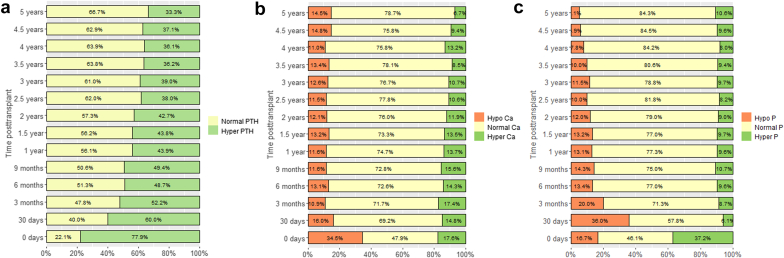
(a) Rate and number of patients with hyperparathyroidism, (b) hypocalcemia or hypercalcemia, and (c) hypophosphatemia or hyperphosphatemia during the follow-up of up to 5 years after transplant. Yellow indicates no hyperparathyroidism, normocalcemia, and normophosphatemia. Orange indicates hypocalcemia and hypophosphatemia. Green indicates hyperparathyroidism, hypercalcemia, and hyperphosphatemia.
Figure 2
Figure 2
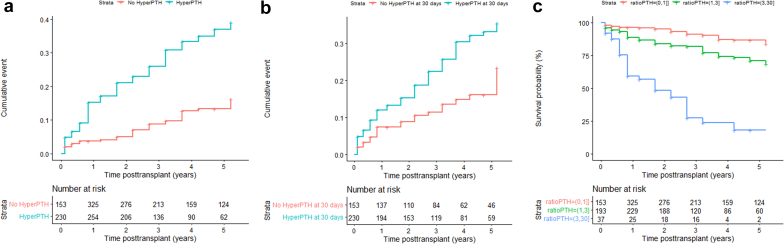
(a) Association between the cumulative incidence of time to composite end point and hyperparathyroidism versus no hyperparathyroidism (HR, 3.4; 95% CI, 2.1–5.2; P < 0.001), (b) the cumulative incidence of time to composite end point plotted for patients with and without hyperparathyroidism using single PTH values at 30 days after transplant (HR, 1.85; 95% CI, 1.13–3.08; P = 0.014), and (c) association between the degree of time-varying hyperparathyroidism and time to composite end point (HR, 2.64; 95% CI, 1.64–4.24; P < 0.001 for PTH ratio 1–3 times above ULN; HR, 13.73; 95% CI, 7.11–26.5; P < 0.001 for PTH ratio above 3 times ULN). Number at risk in time-varying analysis (a and c) corresponds to the number of patients with available PTH levels at a given time point. CI, confidence interval; HR, hazard ratio; PTH, parathyroid hormone; ULN, upper limit of normal.
Figure 3
Figure 3
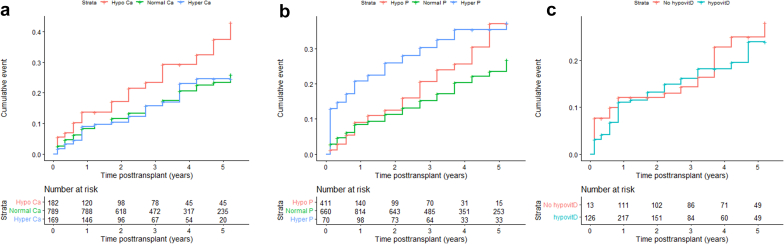
(a) Association between the cumulative incidence of event and hypocalcemia versus normocalcemia or hypercalcemia: hypocalcemia versus normocalcemia HR, 1.7; 95% CI, 1.2–2.3; P = 0.003; hypercalcemia-normocalcemia HR, 0.9; 95% CI, 0.6–1.4; P = 0.79; (b) hyperphosphatemia versus normophosphatemia or hypophosphatemia: hypophosphatemia-normophosphatemia HR, 1.0; 95% CI, 0.7–1.4; P = 0.97; hyperphosphatemia-normophosphatemia HR, 1.9; 95% CI, 1.3–2.8; P < 0.001; (c) hypovitaminosis D versus no hypovitaminosis D HR, 1.4; 95% CI, 0.6–3.2; P = 0.42. Number at risk corresponds to the number of patients with available Ca, P, and 25-hydroxyvitamin D levels at a given time point. Ca, calcium; D, vitamin D; P, phosphate.
Figure 4
Figure 4
Combined hypocalcemia and hyperphosphatemia and the cumulative incidence of event: hypocalcemia HR, 1.6; 95% CI, 1.2–2.3; P = 0.004; hyperphosphatemia HR, 1.9; 95% CI, 1.3–2.8; P = 0.001; no significant hypocalcemia and hyperphosphatemia interaction (P = 0.49). Ca, calcium; P, phosphate.
Figure 5
Figure 5
Relationship between eGFR, PTH, and other clinical and biochemical factors whereupon the structural marginal model was based. The red arrows represent the reciprocal relationship between eGFR and PTH. eGFR, estimated glomerular filtration rate; KTx, kidney transplantation; PTH, parathyroid hormone; X, not available for analysis.

References

    1. Haffner D., Leifheit-Nestler M. CKD-MBD post kidney transplantation. Pediatr Nephrol. 2021;36:41–50. doi: 10.1007/s00467-019-04421-5. - DOI - PubMed
    1. Jorgensen H.S., Behets G., Bammens B., et al. Natural history of bone disease following kidney transplantation. J Am Soc Nephrol. 2022;33:638–652. doi: 10.1681/ASN.2021081081. - DOI - PMC - PubMed
    1. Bonthuis M., Busutti M., van Stralen K.J., et al. Mineral metabolism in European children living with a renal transplant: a European Society for Paediatric Nephrology/European Renal Association-European Dialysis and Transplant Association Registry study. Clin J Am Soc Nephrol. 2015;10:767–775. doi: 10.2215/CJN.06200614. - DOI - PMC - PubMed
    1. Evenepoel P., Van Den Bergh B., Naesens M., et al. Calcium metabolism in the early posttransplantation period. Clin J Am Soc Nephrol. 2009;4:665–672. doi: 10.2215/CJN.03920808. - DOI - PMC - PubMed
    1. Wesseling-Perry K., Pereira R.C., Tsai E., et al. FGF23 and mineral metabolism in the early post-renal transplantation period. Pediatr Nephrol. 2013;28:2207–2215. doi: 10.1007/s00467-013-2547-z. - DOI - PMC - PubMed