. 2023 Jan 11;5(1):zcac045.
doi: 10.1093/narcan/zcac045. eCollection 2023 Mar.

ATR inhibition overcomes platinum tolerance associated with ERCC1- and p53-deficiency by inducing replication catastrophe

Affiliations

ATR inhibition overcomes platinum tolerance associated with ERCC1- and p53-deficiency by inducing replication catastrophe

Joshua R Heyza et al. NAR Cancer. .

Abstract

ERCC1/XPF is a heterodimeric DNA endonuclease critical for repair of certain chemotherapeutic agents. We recently identified that ERCC1- and p53-deficient lung cancer cells are tolerant to platinum-based chemotherapy. ATR inhibition synergistically re-stored platinum sensitivity to platinum tolerant ERCC1-deficient cells. Mechanistically we show this effect is reliant upon several functions of ATR including replication fork protection and altered cell cycle checkpoints. Utilizing an inhibitor of replication protein A (RPA), we further demonstrate that replication fork protection and RPA availability are critical for platinum-based drug tolerance. Dual treatment led to increased formation of DNA double strand breaks and was associated with chromosome pulverization. Combination treatment was also associated with increased micronuclei formation which were capable of being bound by the innate immunomodulatory factor, cGAS, suggesting that combination platinum and ATR inhibition may also enhance response to immunotherapy in ERCC1-deficient tumors. In vivo studies demonstrate a significant effect on tumor growth delay with combination therapy compared with single agent treatment. Results of this study have led to the identification of a feasible therapeutic strategy combining ATR inhibition with platinum and potentially immune checkpoint blockade inhibitors to overcome platinum tolerance in ERCC1-deficient, p53-mutant lung cancers.


Figures

Graphical Abstract
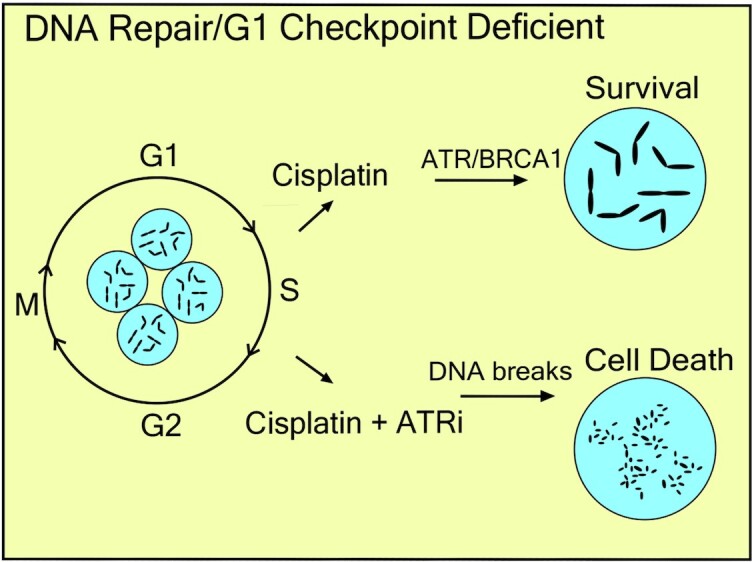
Graphical Abstract
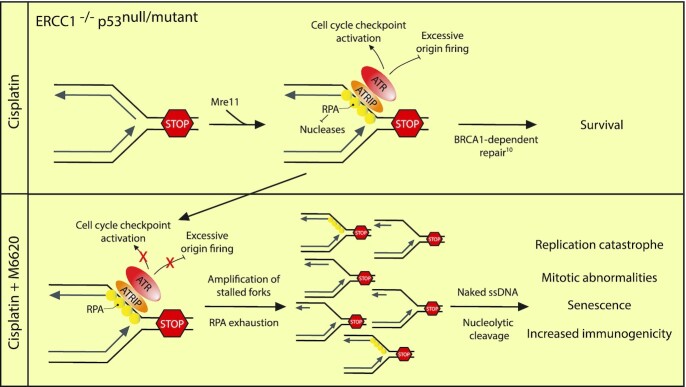
Tolerance to platinum-induced DNA damage in ERCC1 and p53 deficient lung cancers requires ATR signaling during S phase, which serves to limit global replication fork collapse and replication catastrophe.
Figure 1.
Figure 1.
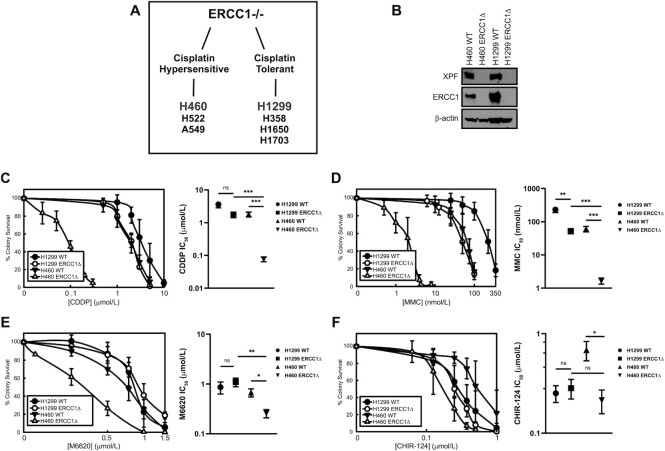
Differential sensitivity of ERCC1-knockout cells to cisplatin. (A) Summary of previously established cell line models of ERCC1 deficiency. (B) Western blot depicting ERCC1 and XPF expression in H460 and H1299 ERCC1 knockout cell lines. Sensitivity of H460 (p53 wildtype) and H1299 (p53 null) isogenic cell lines to (C) cisplatin and (D) mitomycin (E), sensitivity of H460 and H1299 isogenic cell lines to the ATR inhibitor, M6620 and (F) the Chk1 inhibitor, CHIR-124. All clonogenic assays are presented as the average of three independent experiments ± standard deviation. Statistical comparisons were performed by comparing IC50 values by Welch ANOVA with Dunnett T3 test for multiple comparisons; **** P< 0.0001, *** P< 0.001, ** P< 0.01, * P< 0.05, n.s. P> 0.05. IC50 values are presented as mean ± SEM.
Figure 2.
Figure 2.
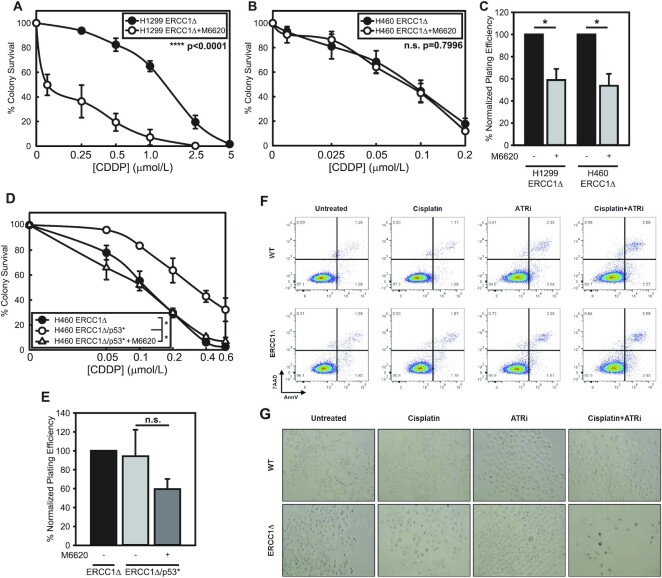
ATR inhibition overcomes platinum tolerance in a p53-null model of ERCC1 deficiency. Platinum tolerance with ERCC1 deficiency is overcome by inhibition of ATR. (A) Sensitization of H1299 (p53 null) ERCC1 knockout cells to cisplatin by M6620 treatment. IC50 values compared by t-test, **** P< 0.0001. (B) Lack of sensitization of H460 ERCC1 knockout cells by M6620 treatment. IC50 values were compared by t-test, n.s., not significant. (C) Effect on plating efficiency of H1299 and H460 ERCC1 knockout with the concentration of M6620 utilized in sensitization experiments. (D) Sensitization of H460 ERCC1 knockout/p53* cells to cisplatin by M6620 treatment representing two independent experiments (*P< 0.05). (E) Effect on plating efficiency of H460 ERCC1 knockout/p53* cells with the concentration of M6620 utilized in sensitization experiments. (F) Apoptotic cell death detected ∼48 h after treatment with 1 μmol/l cisplatin, 1 μmol/l M6620 or combination by 7AAD and PE-Annexin V staining and flow cytometry. Data is representative of two individual experiments. (G) b-Galactosidase staining in H1299 wildtype and knockout cells 6 days after treatment with 500 nmol/l cisplatin, 500 nmol/l M6620 or combination. Data is representative of two individual experiments.
Figure 3.
Figure 3.
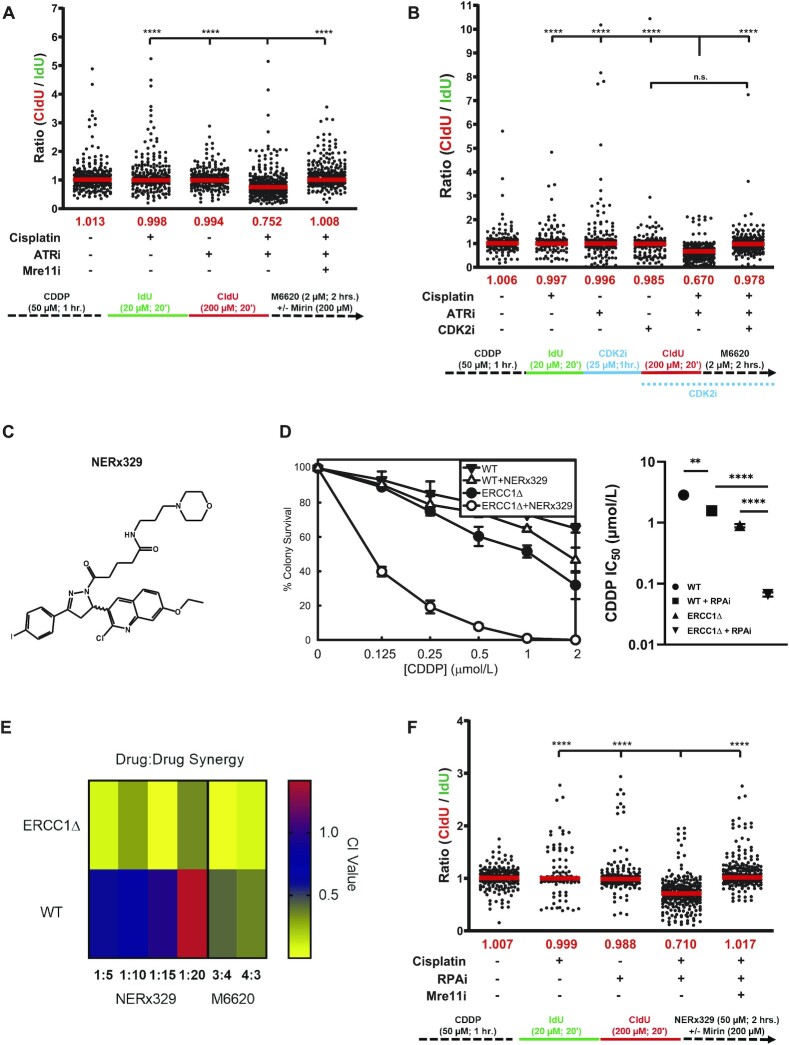
Pharmacological inhibition of ATR or RPA induces fork instability after platinum treatment in p53-null, ERCC1-knockout cells. (A) Results from DNA fiber analysis depicting the effects of platinum, M6620 or combination treatment ± Mre11 inhibition on DNA end resection. Data presented are combined from three individual experiments (100 fibers analyzed per experiment; 300 fibers total) data analyzed by ANOVA with Bonferroni test for multiple comparisons (**** P< 0.0001). (B) Results from DNA fiber analysis depicting the effects of CDK2 inhibition on DNA end resection upon platinum, M6620 or combination-treatment (statistical analysis is the same as in A). (C) Chemical structure of NERx329, an inhibitor of RPA-ssDNA binding. (D) Clonogenic survival assay displaying the effects of RPA inhibition on sensitivity of H1299 wildtype and ERCC1 knockout cell lines to cisplatin. Data are presented as the average of three independent experiments, ± S.D. Statistical comparisons were performed by Welch ANOVA with Dunnett T3 test for multiple comparisons. **** P< 0.0001, ** P< 0.01. (E) Colorimetric plot depicting synergy or lack of synergy between cisplatin and M6620 or NERx329 in H1299 isogenic cell lines. Drug ratios listed on the x-axis indicate cisplatin:M6620 and cisplatin:NERx329 ratios used for synergy testing. (F) Results from DNA fiber analysis depicting the effects of platinum, NERx329 or combination treatment ± Mre11 inhibition on DNA end resection. Data presented are combined from three individual experiments (100 fibers analyzed per experiment; 300 fibers total) data analyzed by ANOVA with Bonferroni test for multiple comparisons (**** P< 0.0001).
Figure 4.
Figure 4.
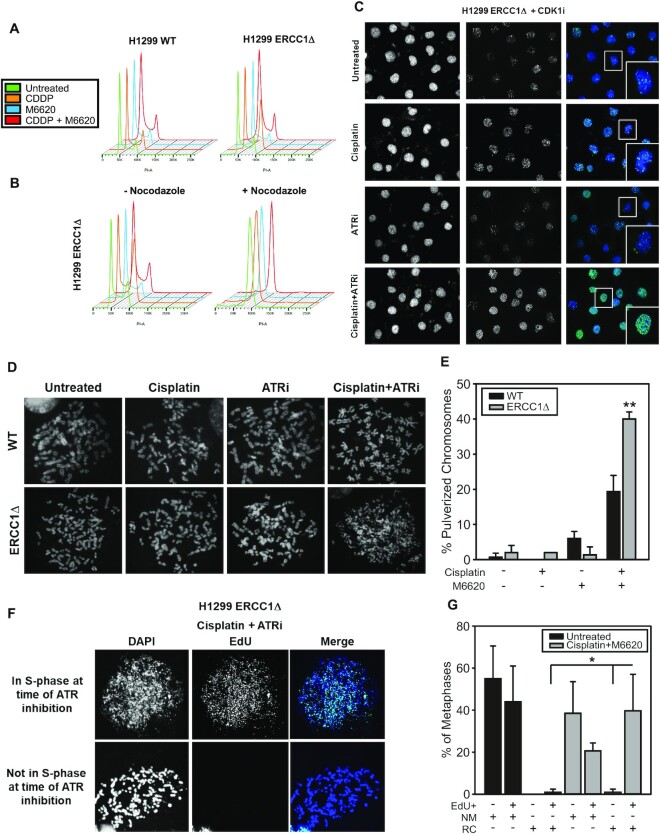
Effects of dual cisplatin and M6620 treatment on cell cycle dynamics, DSB formation and induction of chromosome pulverization. (A) Cell cycle profiles following cisplatin and ATR inhibitor treatment in H1299 isogenic cells. (B) Cell cycle profiles following cisplatin and ATR inhibitor treatment ±200 ng/ml nocodazole. (C) γH2AX staining by immunofluorescence ∼22 h after treatment in H1299 ERCC1 knockout cells. (D) Representative metaphase spreads prepared from H1299 wildtype and ERCC1 knockout cells ∼48 h following treatment with 100 nmol/l cisplatin, 100 nmol/l M6620 or combination. (E) Quantification of chromosome pulverization in H1299 wildtype and ERCC1 knockout cells following treatment with 500 nmol/l cisplatin for two hours and 750 nmol/l M6620 for 4 h. (F) Representative images showing colocalization of EdU with pulverized chromosomes in H1299 ERCC1 knockout cells treated with cisplatin and M6620. (G) Quantification of normal metaphases (NM) and chromosome pulverization (i.e. replication catastrophe (RC)) and colocalization with EdU staining in untreated and cisplatin + M6620 treated H1299 ERCC1 knockout cells. All experiments were performed three times. Error bars represent ± S.D. Statistical comparisons performed using t-test; * P< 0.05; ** P< 0.01.
Figure 5.
Figure 5.
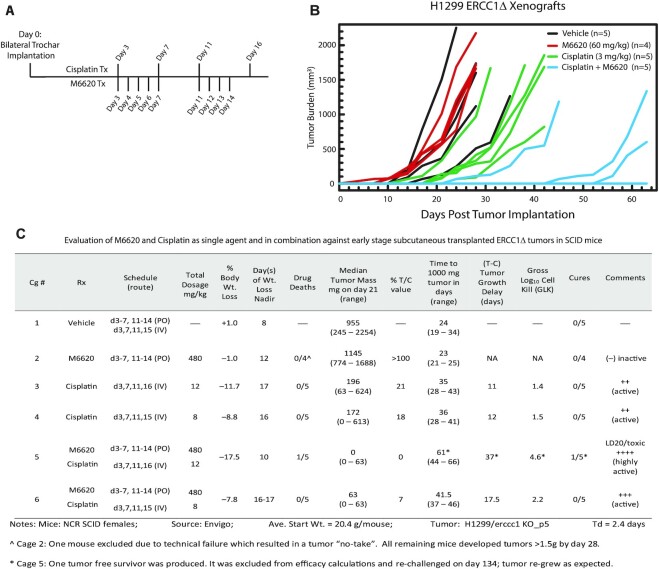
M6620-potentiated platinum sensitization in H1299 ERCC1 knockout tumors in vivo. (A) Model depicting the treatment scheme for cisplatin and M6620 in H1299 ERCC1 knockout xenograft studies. (B) Plot depicting tumor growth for each individual SCID mouse in the study over the course of each treatment as measured by tumor volume, including vehicle control, M6620 at 60 mg/kg, cisplatin at 3 mg/kg, or combination (Cage #6 data not plotted). (C) Table depicting animal study design and efficacy analysis of each drug alone and in combination.
Figure 6.
Figure 6.
Proposed model describing how platinum-tolerant, ERCC1-deficient tumors can be sensitized to platinum-based chemotherapy by ATR inhibition.

References

    1. Bepler G., Kusmartseva I., Sharma S., Gautam A., Cantor A., Sharma A., Simon G. RRM1 modulated in vitro and in vivo efficacy of gemcitabine and platinum in non-small-cell lung cancer. J. Clin. Oncol. 2006; 24:4731–4737. - PubMed
    1. Bepler G., Williams C., Schell M.J., Chen W., Zheng Z., Simon G., Gadgeel S., Zhao X., Schreiber F., Brahmer J. et al. . Randomized international phase III trial of ERCC1 and RRM1 expression-based chemotherapy versus gemcitabine/carboplatin in advanced non-small-cell lung cancer. J. Clin. Oncol. 2013; 31:2404–2412. - PMC - PubMed
    1. Olaussen K.A., Dunant A., Fouret P., Brambilla E., André F., Haddad V., Taranchon E., Filipits M., Pirker R., Popper H.H. et al. . DNA repair by ERCC1 in non–small-cell lung cancer and cisplatin-based adjuvant chemotherapy. N. Engl. J. Med. 2006; 355:983–991. - PubMed
    1. Friboulet L., Olaussen K.A., Pignon J.-P., Shepherd F.A., Tsao M.-S., Graziano S., Kratzke R., Douillard J.-Y., Seymour L., Pirker R. et al. . ERCC1 isoform expression and DNA repair in non–small-cell lung cancer. N. Engl. J. Med. 2013; 368:1101–1110. - PMC - PubMed
    1. Dabholkar M., Vionnet J., Bostick-Bruton F., Yu J.J., Reed E. Messenger RNA levels of XPAC and ERCC1 in ovarian cancer tissue correlate with response to platinum-based chemotherapy. J. Clin. Invest. 1994; 94:703–708. - PMC - PubMed